Orthodontic Treatment Pages: What Every Page Needs
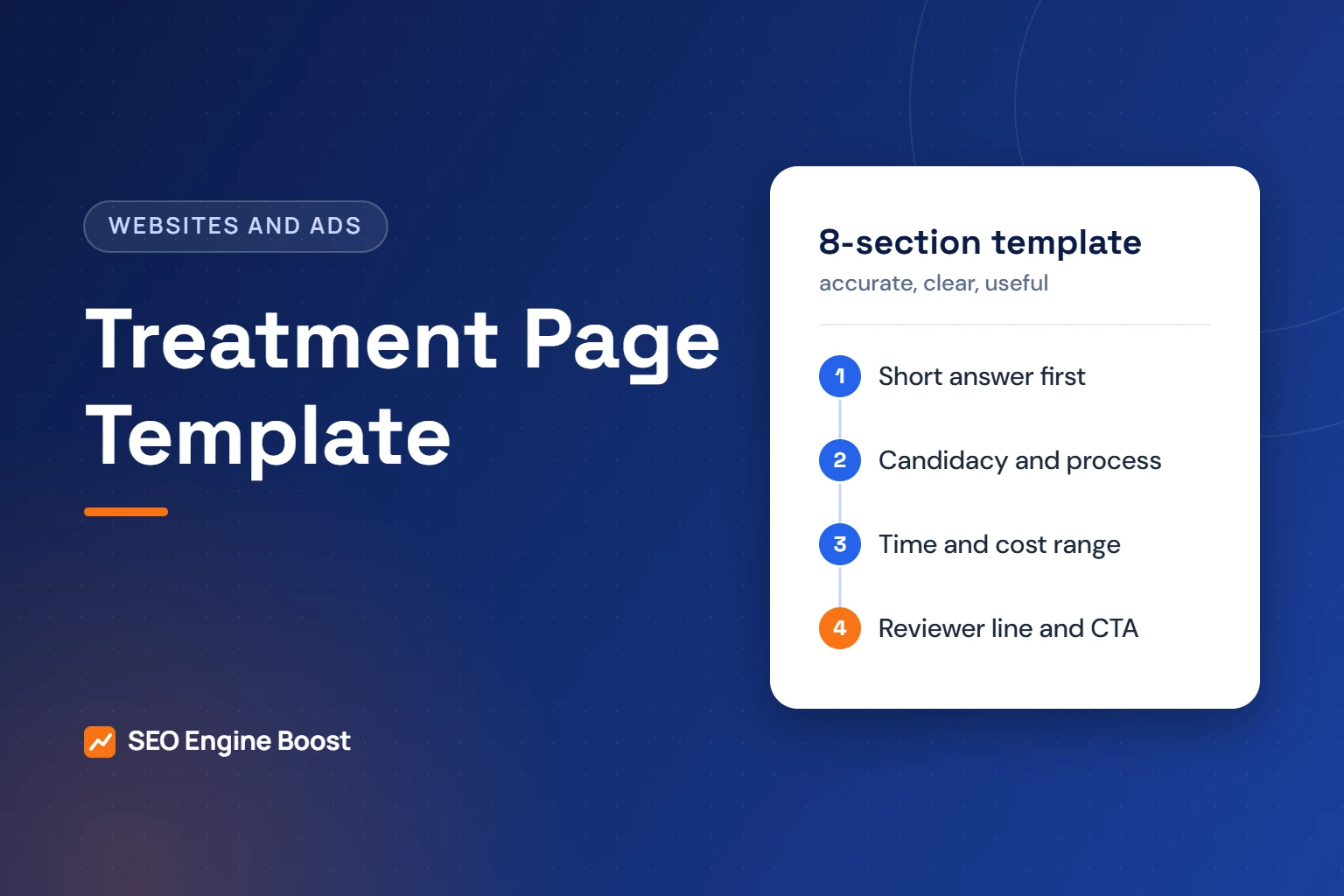
An orthodontic treatment page needs eight sections. Start with a short answer. Then cover who the treatment suits, how it works and how long it takes. Add a cost range with payment options, FAQs, a reviewer line and one clear next step. The treating orthodontist should review every clinical statement.
Treatment pages are where patients decide whether to book. They arrive with specific questions about braces, aligners or early treatment. A page that answers those questions plainly earns trust and consult requests. This guide gives you the template, the clinical accuracy rules and a simple way to measure results.
Key takeaways
- Open each treatment page with a 40 to 60 word answer, then add detail in a fixed order.
- Keep clinical claims in line with AAO guidance. Avoid promises about speed or results.
- Show a cost range or cost factors, plus insurance and payment options, if the practice is comfortable doing so.
- Add a named clinical reviewer and a review date, and end with one clear next step.
In this article
- What a treatment page is for
- The 8-section template at a glance
- Sections 1 and 2: the short answer and who it suits
- Sections 3 and 4: process and treatment time
- Section 5: cost range and payment
- Sections 6 to 8: FAQs, reviewer line and next step
- Clinical accuracy rules for every page
- Which treatment pages to build first
- How to measure whether a page works
- Frequently asked questions
What a treatment page is for
A treatment page answers one question: is this treatment right for me, and what happens next? It is not a brochure. It is a decision page.
Most orthodontic patients and parents compare several practices before they book. They read about braces, clear aligners or early treatment, then look for cost and a way to ask questions. Each page should serve that path.
Google’s guidance on helpful content says pages should be made mainly to help people. It also encourages accurate bylines where readers expect them. Health topics fall into what Google calls “Your Money or Your Life” topics, where trust matters most. A clear, reviewed treatment page fits that standard. Our content marketing services follow this approach for every page we write.
Several problems show up often on practice websites. This is agency observation, not research:
- One long “Treatments” page that covers everything briefly and nothing well.
- Copy supplied by a vendor and never checked by the orthodontist.
- No mention of cost, insurance or payment at all.
- No clear next step, or a form buried at the bottom of a long page.
- Old photos, outdated appliance names or claims the practice no longer stands behind.
Each of these is fixable with a fixed template and a short review routine.
The 8-section template at a glance
Use the same order on every treatment page. Patients learn where to find answers, and your team can update pages quickly. The structure below is agency guidance, not research.
| Section | What it answers | Suggested length |
|---|---|---|
| 1. Short answer | What is this treatment, in plain words? | 40 to 60 words |
| 2. Who it suits | Could this work for me or my child? | 100 to 200 words |
| 3. How it works | What happens, step by step? | 150 to 250 words |
| 4. How long it takes | How long, and how often are visits? | 80 to 150 words |
| 5. Cost and payment | What will I pay, and how? | 100 to 200 words |
| 6. FAQs | What else do people ask? | 4 to 6 questions |
| 7. Reviewer line | Who checked this information, and when? | 1 to 2 lines |
| 8. Next step | How do I book or ask a question? | 1 short block |
The word counts are a guide. A page on lingual braces may need less. A page on early treatment may need more.
Sections 1 and 2: the short answer and who it suits
The short answer
Start with two or three sentences that define the treatment and its main purpose. Write for a parent or adult with no dental training. Avoid jargon unless you explain it.
For example, a clear aligner page might say that aligners are removable trays that move teeth in small steps. It might add that the AAO says each aligner is typically worn for one week, at least 22 hours a day.
Who it suits
Candidacy is where many pages overreach. The AAO says clear aligners are not right for everyone. It also says some cases are treated more predictably with braces. Say the same on your page.
- Describe the kinds of problems the treatment often addresses, in plain language.
- State that the orthodontist decides the right option after an exam and records.
- Name the alternatives, such as braces, aligners or a combination.
- Avoid absolute phrases such as “perfect for everyone” or “no visits needed”.
If you describe bite problems, check the terms carefully. Our guide to overbite vs overjet content accuracy covers common mix-ups.
Not sure where your practice stands? A free growth audit lists your top three fixes for Google, Maps and AI answers, in writing. Get a free growth audit · See our orthodontic marketing services
Sections 3 and 4: process and treatment time
How it works
Describe the patient journey as numbered steps. Patients like to know what each visit involves.
- Consultation and exam.
- Records, such as photos, scans or X-rays, as needed.
- Treatment plan review, including options and costs.
- Appliance placement or aligner delivery.
- Progress visits.
- Appliance removal and retainers.
Keep retention in the process. The AAO says patients wear a retainer after braces are removed. It also says retainers only work if worn as directed.
How long it takes
Give honest ranges and explain what changes them. The AAO says most people have braces for 12 to 24 months. Its treatment guide says mild crowding or spacing can often be resolved in eight to twelve months. It adds that more complex bite issues may take a couple of years.
Visit frequency matters to busy families. The AAO says adjustment or aligner visits are typically every six to ten weeks. Its braces page gives a wider range of every 4 to 12 weeks, depending on the stage of treatment. Use your own schedule, and keep it within what your orthodontist actually does.
Do not claim that one appliance is always faster. The AAO says neither braces nor aligners has a built-in speed advantage.
Section 5: cost range and payment
Cost is often the question that decides whether someone books. The AAO says treatment cost depends on the type, complexity and duration of treatment. It does not publish national price figures, so do not quote “average” prices from unknown sources.
You have three honest options:
- Publish a range for your practice, with a note that the exact fee comes after the exam.
- Publish cost factors only, if the practice prefers not to show numbers.
- Publish a starting monthly payment, with clear terms and conditions next to it.
Then explain payment. The AAO says insurance typically covers a percentage of the cost or a fixed benefit. It advises checking lifetime maximums and age limits. It notes many practices offer in-house plans, often with low or no interest. It also says FSAs and HSAs can be used for eligible expenses. Our guide to orthodontic prices and financing on your website covers wording in detail.
Want your treatment pages reviewed?
We will check your treatment pages for structure, clinical accuracy and conversion, and list the fixes that matter most.
Sections 6 to 8: FAQs, reviewer line and next step
FAQs
Pull FAQs from real questions. Ask your treatment coordinator what patients ask on the phone and at consults. Write each answer in 40 to 70 words, and lead with the direct answer.
Useful FAQ topics include pain and soreness, eating, sports, school or work, missed aligner wear, and what happens if a bracket breaks. Keep each answer general. Tell readers to ask the orthodontist about their own case.
Reviewer line
Add a line near the top or bottom such as “Clinically reviewed by Dr. [Name], [credentials], on [date].” Link the name to a real bio page. Only list credentials the reviewer actually holds. Update the date only when someone really reviews the page.
Next step
End with one clear action, such as booking a consult. Add a phone number that can be tapped on mobile. A second option, such as a short question form, is fine. Too many choices can stall a decision.
Clinical accuracy rules for every page
Treatment pages are health content. Errors cost trust, and some claims may raise advertising concerns with your state board. Use this checklist before publishing:
- Match AAO patient guidance on timing, wear and retention.
- Avoid guarantees, such as “straight teeth in six months”.
- Use real patient photos only with written authorization. See our guide to before-and-after photos.
- Describe specialty status only in the way your state allows.
- Explain that results vary and depend on the case and on patient cooperation.
- Have the orthodontist approve every clinical sentence.
Our free orthodontic website clinical checklist lists 25 common clinical and compliance mistakes. Use it as a second check.
Which treatment pages to build first
Most practices need a core set before they add niche pages. Build one page per treatment, not one page that covers everything.
- Braces, with sections on metal and ceramic options if offered.
- Clear aligners.
- Early or children’s treatment, including the AAO age 7 check.
- Adult orthodontics.
- Retainers and retention.
- Other treatments you actually offer, such as lingual braces or surgical cases.
Only build pages for treatments your practice provides. A page for a service you do not offer misleads patients and wastes their time.
How to measure whether a page works
Track each treatment page as its own funnel. Watch three numbers each month:
- Search impressions and clicks for the page, from Google Search Console.
- Consult requests that start on the page, from your analytics events.
- Consults booked from those requests, from your practice management software.
For example, a page that gets many visits but few requests may need a clearer cost section or next step. A page with few visits may need better titles or more internal links. Change one thing at a time, then compare results after a few weeks.
Frequently asked questions
How long should an orthodontic treatment page be?
Long enough to answer the questions patients ask before booking. For most treatments, that means 800 to 1,500 words across the eight sections. This is agency guidance, not a rule. A page should never add filler to reach a length. Every paragraph should answer a real question or help the reader take the next step.
Should we publish prices on treatment pages?
Publishing a range or starting monthly payment can help patients self-qualify. The AAO says cost depends on the type, complexity and duration of treatment, so explain that the exact fee follows the exam. If the practice prefers not to show numbers, list the cost factors and payment options instead. Always keep terms next to any monthly figure.
Who should review a treatment page?
The treating orthodontist should review every clinical statement before publishing. Add a reviewer line with their name, real credentials and the review date. Link the name to an accurate bio page. Never list credentials the reviewer does not hold. Re-review the page when treatment options, fees or guidance change.
Can one page cover braces and aligners together?
A comparison page can help patients choose, but each treatment also deserves its own page. Separate pages let you answer specific questions about wear time, visits and candidacy. The AAO says neither option has a built-in speed advantage and some cases are treated more predictably with braces. Say this on both pages.
Do FAQ sections still help a treatment page?
Yes, for readers. FAQs answer the small questions that stop people from booking, such as soreness, sports or missed wear. Write them from real patient questions and keep answers short. Do not add FAQs mainly to chase search features, because how Google displays them can change.
Sources
- American Association of Orthodontists: How Do Braces Work? (last modified September 30, 2026)
- American Association of Orthodontists: Clear Aligners (last modified September 30, 2026)
- American Association of Orthodontists: What to Expect During Orthodontic Treatment (September 16, 2026)
- American Association of Orthodontists: How Much Do Braces Cost? Financing Options for Orthodontic Treatment (October 16, 2025)
- Google Search Central: Creating helpful, reliable, people-first content (last updated October 5, 2026)
Keep reading


See where your practice stands
If you would like a second pair of eyes on your own practice, we offer a free growth audit: a manual review of your local visibility, website, reviews and content, with a prioritized list of what to fix first.
Check your pages: run your treatment pages through our free orthodontic website clinical checklist before you publish.