
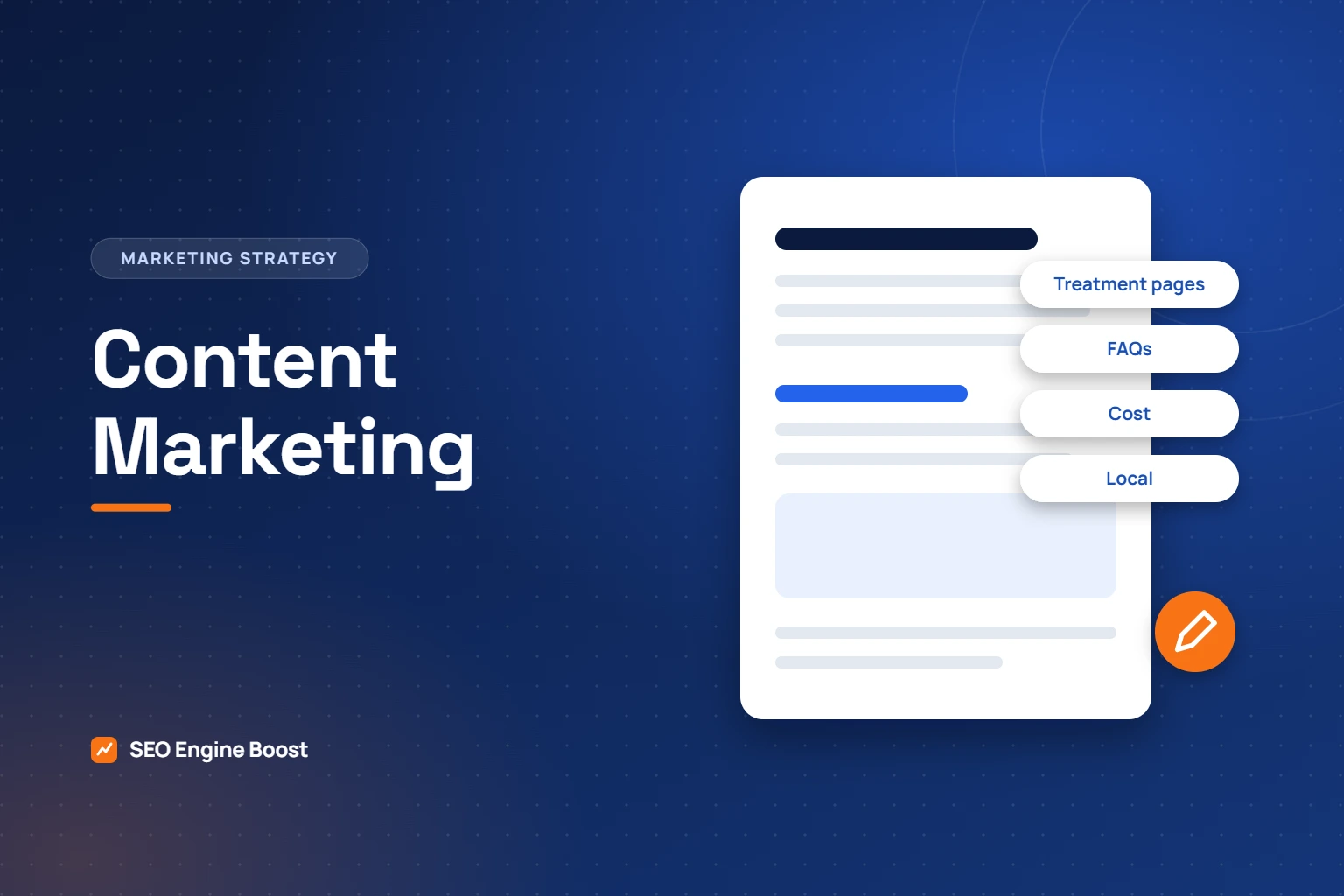
Content Marketing for Orthodontists: What to Write and Why
Content marketing for orthodontists means publishing the pages that answer what patients and parents search for, in an order that reflects what brings consultations. It is not a blog schedule. A practice with eight excellent pages will usually outperform one with eighty thin articles.
Key takeaways
- Write treatment pages first, then first-visit and cost pages, then problem, age and location pages.
- Use the patient’s word in the title and explain the clinical meaning inside the page.
- For most single-location practices, fifteen to twenty-five strong pages are enough.
In this article
- Write in this order
- How to structure a treatment page
- Use the patient’s words, then the correct ones
- What to avoid
- Who should write it?
- How much content marketing for orthodontists is enough?
- Does AI search change this?
- Start with an inventory, not a blank page
- Find the questions patients really ask
- Write a brief before every page
- An example outline: a clear aligner page
- A realistic 90-day plan
- Keep content current
- How to tell whether content is working
- Using AI writing tools responsibly
- Process mistakes that waste the effort
- Frequently asked questions
Write in this order
1. Treatment pages
These are the pages that convert. Each main treatment needs its own: braces, clear aligners, early treatment, adult treatment and retainers.
2. First-visit and cost pages
What happens at a consultation, how long it takes, whether there is a fee, what affects the cost of treatment and which payment options you offer.
3. Problem pages
Crowding, spacing, overbite, underbite, crossbite and open bite, written from the patient’s point of view and linked to the treatments that address them.
4. Age and stage pages
When a child should first be seen, treatment for teens, treatment for adults. The American Association of Orthodontists recommends a first check-up by age 7.
5. Location pages
One per office, with directions, parking, hours and the team who work there.
6. Supporting articles
Only once the above exist: care instructions, emergencies such as a poking wire, eating with braces, retainer wear.
How to structure a treatment page
- A direct answer in the first two sentences: what the treatment is and who it suits.
- How it works, in plain language.
- What treatment involves: visits, typical length, what the patient has to do.
- Advantages and limitations, honestly stated.
- Cost factors and payment options.
- Common questions.
- A clear next step: request a consultation.
Use the patient’s words, then the correct ones
Patients search for “overbite” and “crooked teeth”. Use those words in the title and opening, then explain the clinical meaning inside the page. This is where accuracy matters, and we cover it in overbite vs. overjet: why clinical accuracy matters.
What to avoid
- Promises about results or treatment time. Every case differs.
- Near-identical pages for every nearby town. Google’s spam policies describe these as doorway pages.
- Mass-produced articles. Google lists generating many low-value pages, including with AI tools, as scaled content abuse.
- Copying manufacturer text. Hundreds of practices publish the same paragraphs about the same aligner brand.
- Patient photos or stories without written authorization.
Need treatment pages written and checked?
We plan, write and clinically review practice content. Start with a free growth audit of your content gaps.
Who should write it?
The doctor knows the subject best but rarely has time. A workable division: a writer drafts from an outline, someone with clinical knowledge checks it, and the doctor approves it. Put the doctor’s name and a review date on the page.
How much content marketing for orthodontists is enough?
For most single-location practices, fifteen to twenty-five strong pages cover what patients search for. After that, improving existing pages usually does more than adding new ones.
Does AI search change this?
Google says there is no need to break content into small pieces for its AI features and no ideal page length. Clear, accurate, well-organized pages serve both readers and AI systems.
We plan and write this as part of orthodontic SEO and our content marketing service.
Start with an inventory, not a blank page
Most practice websites already have content. Some of it is useful, some is thin, and some repeats what another page says. Before writing anything new, list every page and decide what to do with it. Content marketing for orthodontists usually begins with tidying up, not with publishing.
| Decision | When it applies | What to do |
|---|---|---|
| Keep | The page answers a real question, is accurate and is current | Leave it, and note the date you checked it |
| Improve | The topic is right and the page is thin, vague or out of date | Rewrite it at the same address |
| Merge | Two or three pages cover the same topic | Combine them into the strongest one and redirect the others |
| Remove | The page serves no patient and no purpose | Remove it and redirect the address to the closest relevant page |
Keep the address when you improve a page. A page that has existed for years may have links and history that a new address would have to earn again. When you do merge or remove pages, use permanent redirects so that visitors and search engines reach the right place.
Then compare what is left with the six page types above. The gaps are your writing list, in the same order.
Find the questions patients really ask
You do not need a keyword tool to begin. Four sources are free and closer to your patients than any database.
- The front desk. Ask the team to note every question a new caller asks for two weeks. The repeated ones are page topics.
- Consultations. Treatment coordinators hear the same worries about cost, length and discomfort every day.
- Google Search Console. The performance report lists the searches your site already appears for, with clicks and impressions for each. Searches with many impressions and few clicks often point to a page that exists and does not answer the question well.
- Your reviews. Patients describe what mattered to them in their own words, and those words belong in your pages.
Write each question down the way the patient said it. Does it hurt is a better starting point than a heading about patient comfort.
Write a brief before every page
A short brief prevents the most common failure, which is a page that is pleasant to read and answers nothing in particular. One paragraph is enough if it settles these points.
| Element | What to decide |
|---|---|
| Reader | A parent of a child, a teen, or an adult considering treatment for themselves |
| Question | The one question the page must answer in its first two sentences |
| Next step | What the reader should do after reading, usually request a consultation |
| Must include | Facts specific to your practice: options offered, visit pattern, payment choices |
| Must avoid | Promises about results, treatment time or price that depend on the individual case |
| Links | Two or three related pages on your own site |
| Reviewer | The clinician who will check it, and the date |
The must include row is what separates your page from the same topic on a hundred other practice sites. Generic text can be written by anyone. How your practice handles a first visit can only come from you.
An example outline: a clear aligner page
This outline is an illustration of the structure, not text to copy. The facts in each section must come from your own practice and be checked by a clinician.
- Opening answer. What clear aligners are and, in general terms, who they tend to suit. Two or three sentences.
- How treatment works. Records, a treatment plan, a series of trays, check-ups at intervals your practice sets.
- What the patient has to do. Wear time, cleaning, keeping appointments. Be direct about the commitment, because it affects the result.
- Aligners or braces. A fair comparison, including the situations where your clinicians tend to recommend braces.
- What affects the cost. The factors, and the payment options you offer. A range only if the practice is comfortable publishing one.
- Common questions. Eating, speaking, sport, discomfort, lost trays, retainers afterward.
- Next step. A consultation request, with a sentence on what happens at that visit.
Notice what is missing: a claim about how long treatment takes, a promise about the result, and a paragraph copied from a manufacturer. A page built this way gives a parent enough to decide whether to book, and that is its job.
A realistic 90-day plan
A small team cannot publish thirty pages in a month and keep them accurate. A steady pace that includes clinical review is worth more than a burst. The plan below assumes one person writing part-time and one clinician reviewing.
| Period | Focus | Output |
|---|---|---|
| Weeks 1 to 2 | Inventory, question list, briefs | A prioritized list and a brief for each of the first six pages |
| Weeks 3 to 6 | Treatment pages | Three or four pages rewritten or written, reviewed and published |
| Weeks 7 to 9 | First-visit and cost pages | Two pages, plus fixes to any thin pages found in the inventory |
| Weeks 10 to 12 | Problem and age pages | Three or four pages, each linked to the treatment pages |
| End of week 12 | Review | Check Search Console for the new pages and plan the next quarter |
Treat the numbers as a guide and adjust them to your capacity. If review by the doctor is the bottleneck, publish fewer pages. Do not skip the review.
Keep content current
A page about treatment is a statement by the practice, and it stays on the internet long after the day it was written. Three habits keep it accurate.
- Put a reviewed date on each clinical page and record who reviewed it.
- Read every clinical page once a year. Schedule it like any other recurring task.
- Update immediately when something changes: a new treatment option, a changed fee policy, new hours, a clinician joining or leaving.
Updating a good page is usually a better use of an hour than writing a new one. It also avoids the slow build-up of near-duplicate pages that confuses both patients and search engines.
How to tell whether content is working
Content takes time to show results. Google’s own starter guide says some changes take effect within hours and others take several months, so judge a page over a quarter, not a week.
- In Search Console, filter the performance report by page. Rising impressions show the page is being shown for more searches. Clicks show whether the title and description earn the visit.
- Look at the searches listed for that page. If they match the question in your brief, the page is doing its job.
- Count consultation requests that begin on the page, where your form or analytics can show it.
- Ask new patients what they read before they called.
Rankings alone do not tell you much. A page can rank well for a phrase nobody uses. The full method, from visibility through to starts, is in measuring orthodontic marketing.
Using AI writing tools responsibly
Google’s guidance focuses on whether content is helpful and reliable, not on how it was produced. Its spam policies, though, are clear that producing many pages mainly to manipulate rankings is a violation however the pages are made. For a practice, that leaves a sensible middle path.
- Use a tool to draft an outline, suggest questions or tidy a paragraph.
- Do not publish a draft that no clinician has read. A fluent paragraph can still be clinically wrong.
- Add what the tool cannot know: how your practice works, what your clinicians recommend and why.
- Check every factual statement against a source you trust.
The risk in health content is not that a page sounds artificial. It is that a confident, incorrect sentence about treatment carries your practice name. Our article on overbite vs. overjet shows how easily two common terms are confused.
Process mistakes that waste the effort
- Starting with a blog. Articles about care tips are easier to write than a treatment page and matter far less to a parent choosing a practice.
- Writing for other orthodontists. If a sentence would only be understood by a colleague, rewrite it.
- Publishing without internal links. A new page that nothing links to is hard for visitors and search engines to find.
- Hiding the next step. Every page should make it obvious how to request a consultation.
- Splitting one topic across several short pages. One complete page is easier to maintain and more useful to read.
- Never returning to a page. Content marketing for orthodontists is maintenance as much as writing.
Want to know which pages to write first?
A free growth audit includes a review of your existing content and the gaps in it.
Frequently asked questions
How long should a page be?
Long enough to answer the question fully and no longer. Google has said there is no ideal length for its systems. A first-visit page may be complete in four hundred words, and a page comparing treatment options may need far more.
How often should we publish?
There is no required frequency. For most practices the first goal is a complete set of core pages. After that, a new or improved page each month, properly reviewed, is a pace a small team can sustain.
Do we need a blog at all?
Only after the core pages exist. A blog is a good home for supporting topics such as care instructions and common worries. It is a poor substitute for a clear page on each treatment you offer.
Should we publish prices?
That is a practice decision. Whatever you decide, explain what affects the cost and which payment options are available, because cost is among the first things families want to understand. A page that avoids the subject entirely sends them elsewhere for the answer.
We have several locations. Can each one use the same text?
Treatment pages can be shared across the practice. Location pages should be different in substance: the address, directions, parking, hours, the team at that office and photos of that building. Near-identical pages that only swap the town name are what Google’s spam policies describe as doorway pages.
Who should be named on the page?
The clinician who reviewed it, with a date, and only if that review really happened. Naming a reviewer is a claim about your process, and it should be true. We describe how we handle drafting and review in our process.
Is content worth it if we already run ads?
The two do different jobs. An ad brings a visit while you pay for it. A strong treatment page is where that visit lands, and it keeps working after the campaign ends. Weak pages make advertising more expensive, which we explain in Google Ads for orthodontists.
Where should we begin?
With the inventory. If you would like an outside view of the gaps, a free growth audit includes a review of your existing pages against the questions patients search for, and our pricing page shows what ongoing content work costs.
Keep reading


See where your practice stands
If you would like a second pair of eyes on your own practice, we offer a free growth audit: a manual review of your local visibility, website, reviews and content, with a prioritized list of what to fix first.