
Overbite vs. Overjet: Why Clinical Accuracy Matters in Practice Content
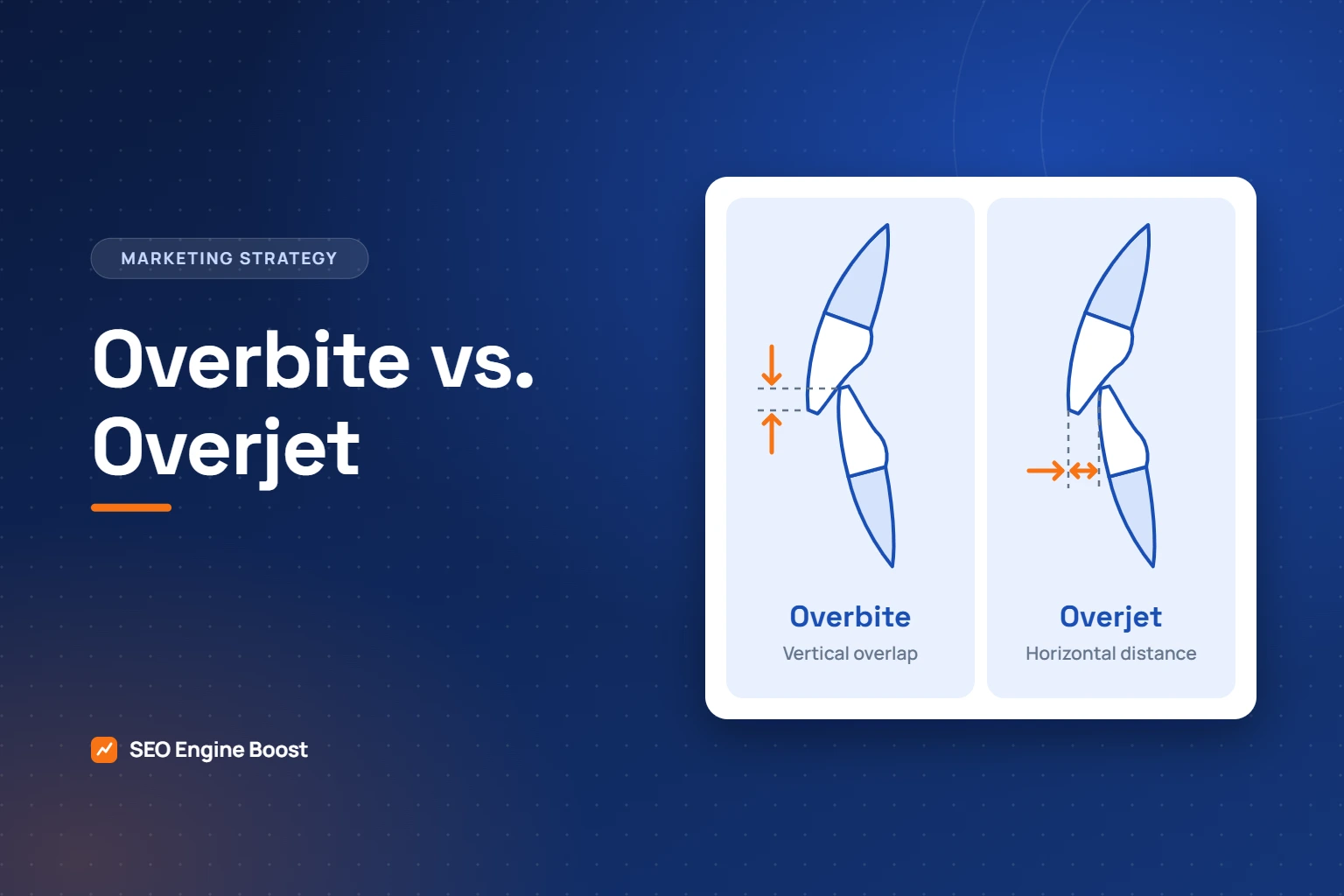
Overbite vs. overjet is the most common mix-up in orthodontic content. When a parent says their child has an “overbite”, they usually mean the upper front teeth stick out. Clinically, that is increased overjet. Overbite is something else: the vertical overlap of the front teeth. The two are measured in different directions and can occur separately or together. Practice websites that blur them are not just imprecise. They miss the chance to show a careful parent that the practice knows its subject.
Key takeaways
- Overjet is the horizontal distance between the upper and lower incisors. Overbite is their vertical overlap.
- Patients search for “overbite”, so use that word in the title and explain the difference inside the page.
- Every clinical statement should be checked by someone qualified and approved by the doctor.
In this article
- Overbite vs. overjet: the two terms
- Related terms patients mix up
- Why this matters for a practice website
- A pattern you can reuse
- What not to do
- Who checks the content?
- How the two are measured
- Overbite vs. overjet is not the only mix-up
- Sentences to fix, and how to fix them
- A before and after
- Where inaccuracy creeps in
- A review checklist for clinical pages
- Consider a short glossary page
- Frequently asked questions
Overbite vs. overjet: the two terms
| Term | Direction | What it describes | How patients describe it |
|---|---|---|---|
| Overjet | Horizontal | How far the upper incisors sit ahead of the lower incisors | “Buck teeth”, “teeth stick out”, often “overbite” |
| Overbite | Vertical | How much the upper incisors overlap the lower incisors | “Deep bite”, “top teeth cover the bottom ones” |
A small amount of each is normal. Standard orthodontic texts such as Proffit’s Contemporary Orthodontics describe a normal incisor relationship as having a few millimeters of horizontal overjet and a slight vertical overlap. Problems arise when either is excessive, absent or reversed.
Related terms patients mix up
- Deep bite: excessive overbite, where the upper front teeth cover too much of the lower ones.
- Open bite: no vertical overlap; the front teeth do not meet when the back teeth are together.
- Underbite: the everyday word for an anterior crossbite, where the lower front teeth sit ahead of the upper ones, often associated with a Class III relationship.
- Crossbite: upper teeth biting inside the lower teeth, at the front or the back.
Why this matters for a practice website
Patients search with their own words
A page titled “Increased overjet correction” will not be found. A page titled “Overbite treatment” will. The title has to use the patient’s word.
But the content should be right
Inside the page, explain the difference in one or two plain sentences. A parent who has read around the subject will notice, and a practice that explains clearly earns trust before the consultation.
Search engines hold health content to a higher standard
Accurate, well-explained content with a named clinician behind it is a signal of quality that generic copy cannot imitate.
Want your treatment pages checked?
The free growth audit reviews your content for gaps. Clinical review is built into the pages we write.
A pattern you can reuse
- Title in patient language: “Overbite treatment for children and teens”.
- Opening that bridges the gap: “Many people use the word overbite to describe upper front teeth that stick out. Orthodontists call that overjet. Overbite refers to how much the upper teeth overlap the lower teeth vertically. Both can be treated, and they often occur together.”
- What causes it, in general terms: tooth position, jaw relationship, habits.
- How it is assessed: examination and records at the first visit.
- Treatment options, without promising a specific appliance or timeline.
- When to seek advice, with a link to book a consultation.
What not to do
- Do not diagnose in an article. Describe; do not prescribe.
- Do not promise that a particular appliance fixes a particular problem in a set time.
- Do not copy definitions from another website without checking them.
- Do not use before-and-after photos without written patient authorization.
Who checks the content?
Every clinical statement on a practice website should be reviewed by someone qualified to check it, and approved by the doctor whose name is on the door. That review is built into how we write for practices. See content marketing for orthodontists and orthodontic SEO.
Reference: Proffit WR, Fields HW, Larson BE, Sarver DM. Contemporary Orthodontics. 6th ed. Elsevier; 2019. This article is written for practice owners and is not clinical advice for patients.
How the two are measured
Both terms describe the relationship between the upper and lower incisors when the back teeth are together, and both are measured in millimeters.
- Overjet is the horizontal distance from the front surface of the lower incisors to the edge of the upper incisors. When the lower incisors sit in front of the upper ones, the value is negative and is called a reverse overjet.
- Overbite is the vertical overlap of the upper incisors over the lower incisors. It is recorded in millimeters or as the share of the lower incisor crown that is covered. When there is no overlap and a gap remains, the overbite is negative, which is an anterior open bite.
Textbooks give normal values of a few millimeters for each, and the exact figures differ slightly between sources. For a practice website the numbers matter less than the idea: one measurement runs front to back, the other runs top to bottom, and a patient can have a problem with either, both or neither.
We would not publish a threshold on a patient page, such as a figure above which treatment is needed. Whether treatment is advisable depends on the whole examination, and a number on a website invites people to diagnose themselves with a ruler.
Overbite vs. overjet is not the only mix-up
The same gap between everyday words and clinical terms runs through most treatment content. The table below lists the pairs that most often cause inaccurate sentences.
| What patients say | Clinical term | What it describes |
|---|---|---|
| Crooked or crowded teeth | Crowding | Not enough space in the arch for the teeth to line up |
| Gaps | Spacing | More space in the arch than the teeth fill. A gap between the two upper front teeth is a midline diastema |
| Overbite, buck teeth | Increased overjet | Upper incisors sitting well ahead of the lower incisors |
| Deep bite | Increased overbite | Upper incisors covering too much of the lower incisors |
| Underbite | Anterior crossbite or reverse overjet | Lower front teeth biting in front of the upper front teeth |
| Crossbite | Posterior crossbite | Upper back teeth biting inside the lower back teeth, on one side or both |
| Open bite | Anterior open bite | Front teeth that do not overlap or meet when the back teeth are together |
| Bad bite | Malocclusion | Any departure from ideal alignment of the teeth or from an ideal fit between the upper and lower teeth |
Where Class II and Class III fit in
Angle’s classification is a separate idea, and websites often blend it with the terms above. It describes the front-to-back relationship of the first molars. In Class I the molars meet in the expected relationship. In Class II the lower first molar sits further back relative to the upper one, and in Class III it sits further forward.
A Class II molar relationship is often seen together with an increased overjet, and sometimes with a deep overbite, but the terms are not interchangeable. Class II describes how the back teeth relate. Overjet and overbite describe the front teeth. Clinicians also use Class II and Class III for the relationship between the jaws, which is a third thing again.
Patients rarely need this vocabulary. If a page uses it, one plain sentence of explanation is enough, and it is better to leave the classification out than to state that Class II means overbite.
Sentences to fix, and how to fix them
These are typical of what appears on practice websites. Each one sounds reasonable, and each one is either inaccurate or promises more than a page should.
| Sentence on the page | The problem | A more accurate version |
|---|---|---|
| An overbite is when the top teeth stick out | It describes overjet | Many people say overbite when the upper front teeth stick out. Orthodontists call that overjet |
| An underbite is caused by a large lower jaw | It gives one cause as the only cause | An underbite can come from the position of the teeth, the relationship between the jaws, or both |
| Thumb sucking causes an open bite | It turns a contributing factor into a certainty | A prolonged habit such as thumb sucking can contribute to an open bite |
| A crossbite is corrected with an expander | It prescribes an appliance without an examination | Treatment for a crossbite depends on its cause and on the patient’s age |
| Braces fix an overbite in twelve months | It promises a timeline | Treatment length varies from case to case and is discussed at the consultation |
| Class II is the technical name for an overbite | It merges two different ideas | Leave the classification out, or explain it in one accurate sentence |
The corrected versions are slightly longer and slightly less confident. That is the right trade for health content. A parent reads the better sentence as honest, and a referring dentist reads it as competent.
A before and after
The paragraph below is invented to show the difference. It is not taken from any practice website.
Before: Do you have an overbite? An overbite is when your upper teeth stick out too far. It is caused by genetics or thumb sucking. Our braces and aligners fix overbites fast, usually in about a year.
After: Many people use the word overbite for upper front teeth that stick out. Orthodontists call that overjet, and they use overbite for how far the upper teeth overlap the lower teeth vertically. The two often occur together. Several things can contribute, including the position of the teeth, the way the jaws relate and long-lasting childhood habits. At a first visit we examine the bite, take records where needed and explain which options suit the individual case.
The second version uses the patient’s word in the first sentence, so it still matches what people search for. It then gives the correct term, avoids a single cause, and replaces the promise with a description of what happens next.
Where inaccuracy creeps in
- Writers without clinical training. A general copywriter will repeat whatever the top search results say, errors included.
- AI drafts. A fluent paragraph can swap overbite and overjet without any sign that something is wrong.
- Manufacturer text. It is written to promote a product and it appears on many other websites.
- Old pages. Content written years ago by a previous agency often stays online unreviewed.
- Simplifying too far. Removing every qualification makes a sentence easier to read and less true.
None of these is a reason to avoid publishing. They are reasons to add one step: a read-through by someone qualified before the page goes live. We explain how that fits into a writing routine in content marketing for orthodontists.
A review checklist for clinical pages
- Is every clinical term used in its correct sense, and explained in plain words the first time it appears?
- Does any sentence state a single cause where several are possible?
- Does any sentence promise a result, a treatment time or a specific appliance?
- Could a reader mistake the page for a diagnosis of their own case?
- Are photos and patient stories covered by written authorization?
- Is the reviewer named, with a date, and did that review really take place?
- Does the page end with a clear, low-pressure next step?
A page that passes all seven is accurate, safe to publish and useful to a parent trying to understand the options.
Consider a short glossary page
A glossary gives every writer on the site one agreed definition for each term, and it gives patients a place to check a word they heard at the consultation. Keep it short, write each entry in two sentences, and link treatment pages to it where a term first appears. The American Association of Orthodontists publishes a glossary of orthodontic terms that is a sound reference to check your wording against. Write your own entries in your own words; do not copy theirs.
Start with the pages patients read most
A free growth audit is a manual review of your visibility, website, reviews and content, with the findings in writing.
Frequently asked questions
Is an overbite the same as an overjet?
No. Overjet is the horizontal distance between the upper and lower front teeth. Overbite is the vertical overlap. In everyday speech, overbite is used for both, which is why the overbite vs. overjet distinction needs one clear sentence on any page about the subject.
Is it wrong to use overbite in a page title when we mean overjet?
No. The title should use the word patients search for, or the page will not be found by the people it was written for. The accuracy comes in the opening lines, where the page explains what orthodontists mean by each term.
Should patient pages include measurements in millimeters?
Usually not. Describing what is measured helps understanding. Publishing a figure that separates normal from abnormal encourages self-diagnosis and cannot reflect the rest of the examination.
Do patients need to know Angle’s classification?
Rarely. It is useful between clinicians. On a patient page it tends to add jargon without adding understanding. If you include it, explain it in one sentence and make sure that sentence is correct.
Who is qualified to review clinical content?
Someone with the clinical training to check it, with final approval from the doctor responsible for the practice. A marketing writer can make a page clear. Only a clinician can confirm it is right.
Does accurate content rank better?
Nobody can promise that, and we do not. Google says its systems aim to reward helpful, reliable content and that it gives more weight to trust signals on topics that can affect health. Accuracy is one part of being reliable. It is also worth doing for its own sake, because the page represents the practice.
How often should clinical pages be reviewed?
Once a year is a sensible minimum, and whenever the practice changes what it offers. Record the review date on the page so that patients and staff can see it is current.
Where do we start if our existing pages have these problems?
List the clinical pages, read each one against the checklist above and fix the highest-traffic pages first. A free growth audit includes a review of existing content, and clinical review is part of how we write, as described in our process. For the wider question of what makes a practice site work, see orthodontic website mistakes.
Does this apply to social media posts as well?
Yes. A short caption that uses a clinical term carries the practice name in the same way a web page does. The same rule applies: use the patient’s word, use it accurately, and have someone qualified glance at anything that explains a condition or a treatment.
Keep reading


See where your practice stands
If you would like a second pair of eyes on your own practice, we offer a free growth audit: a manual review of your local visibility, website, reviews and content, with a prioritized list of what to fix first.