
Google Ads for orthodontists
Google Ads for orthodontists, built around consultations, not clicks
Paid search can put your practice at the top of Google tomorrow. It can also burn through a budget on searches for jobs, DIY aligners and practices in other cities. We build Google Ads for orthodontists by treatment and area, track every call and form, and move spend toward what produces booked consultations.
- Campaigns by treatment and area
- Negative keywords managed weekly
- Calls and forms tracked to source

Account health check
- Campaign structureBy treatment
- Negative keywordsManaged
- Location targetingPresence
- Call trackingLive
- Ad spend billingYour card
Included in Growth
Google Ads management for one location is included in the $1,490/mo Growth plan. See SEO plans
No surprises
Clear scope and price agreed before any work begins.
You own it
Profile, analytics, ads and website accounts stay in your name.
Reviewed
Treatment pages clinically reviewed by a dentist completing an MSD in Orthodontics. How we work
How do Google Ads work for orthodontists?
Google Ads shows a practice’s ad at the top of results when people search terms like “braces near me”, and the practice pays only when someone clicks. For orthodontists, results depend on tight local targeting, negative keywords, treatment-specific landing pages and call tracking, judged by cost per consultation rather than cost per click. Campaigns are built around consultations, not clicks, so budget goes where patients actually book.
By Dr. Mahmoud Elsheikh · Updated
Why orthodontic ad spend is often wasted
Most wasted spend comes from a handful of avoidable settings
When we review orthodontic ad accounts, the same problems appear again and again. One campaign covers every treatment, so the budget flows to whatever is cheapest to click rather than what you want to grow. Broad keywords match searches like "orthodontist assistant jobs", "how to straighten teeth at home" and "free braces". Location settings include people who are merely interested in your city rather than located there. And conversion tracking counts page views as leads.
None of these require a bigger budget to fix. They require structure, regular attention and honest measurement. Good Google Ads management for orthodontists is mostly discipline: clear campaigns, tight targeting, weekly search-term reviews and conversion tracking that reflects real inquiries.
Paid search also works best alongside a strong foundation. Ads send people to your website and they check your reviews before calling. A fast landing page and a credible Business Profile can make the same budget produce noticeably more consultations.
Account structure
One campaign per treatment, not one campaign for everything
Separate campaigns let you set budgets by priority, write relevant ads and send each searcher to the most useful page.
Budget by priority
If you want more adult aligner cases, that campaign gets the budget, rather than competing with cheaper clicks for general terms.
Relevant ads
An adult searching for discreet options sees an ad about clear aligners for adults, not a generic practice message.
Matching landing pages
Each campaign sends people to the treatment page that answers their question, with a clear consultation button.
Orthodontic PPC management
What is included every month
Transparent management with the details that actually move results.
Keyword strategy and search terms
High-intent keywords grouped by treatment, with phrase and exact matching where it protects budget, and weekly reviews of the actual search terms that triggered your ads. We cover which orthodontic keywords to bid on in Which orthodontic keywords to bid on.
- Negative lists for jobs, DIY, schools and free offers
- Competitor terms tested carefully, if at all
Location targeting
Targeting set to people in or regularly in your service area, with radius or ZIP code adjustments per office.
Ads and assets
Ads written for each treatment and patient group, with call, location, sitelink and structured snippet assets.
Conversion tracking
Calls from ads and website, form submissions and booking requests tracked as separate actions.
Landing pages
Fast, focused pages per treatment with a short form and a visible phone number.
Offline conversion import
Where your systems allow, booked consultations are imported back into Google Ads so bidding learns from real outcomes rather than form fills.
Plain-language reporting
Spend, calls, forms and consultations by campaign, with what changed and why. Ad spend is billed directly to your card, never marked up.
Healthcare ad rules
Ads that respect patients and Google’s policies
Healthcare advertising has extra rules. Ignoring them can lead to disapproved ads, limited reach or privacy problems.
Personalized advertising limits
Google lists health as a sensitive category in its personalized advertising policy. Advertisers promoting health services cannot use their own audience lists, such as Customer Match or website remarketing segments, for targeting, although some predefined Google audiences remain available. We design campaigns that rely mainly on search intent and location.
Privacy in tracking
Conversion tracking should record that an inquiry happened, not what the patient wrote. We avoid sending form contents or other sensitive details to advertising platforms and configure tracking with patient privacy in mind.
Honest ad copy
No promises of perfect results, no misleading pricing and no claims you cannot support. Offers such as a free consultation are stated clearly with any conditions. Ads that overpromise also tend to bring the wrong inquiries. For a deeper look, see What the consult landing page needs.
Brand and trademark considerations
Treatment brand names, such as aligner brands, may carry trademark rules for ads. We follow the brand owner’s guidelines and Google’s trademark policies when using them.
Test first, then scale
How a new orthodontic Google Ads account develops
We start with a controlled test, learn what converts, then scale what works.
Ad Rank explained
What decides where your ad appears
Google does not simply show the highest bid. These are the factors Google lists for Ad Rank, and what we do about each.
| Ad Rank factor | What it means | How we improve it |
|---|---|---|
| Your bid | The most you will pay for a click | Bid strategies matched to conversion data |
| Ad and landing page quality | Relevance and usefulness, summarized as Quality Score | Tight ad groups, relevant ads, fast pages |
| Ad Rank thresholds | Minimum quality to show at all | Quality improvements before bid increases |
| Auction competitiveness | How close competitors are | Focus on areas and treatments where you can win |
| Search context | Query, location, device and time | Location and schedule settings per office |
| Expected impact of assets | Sitelinks, calls and other extensions | Complete, relevant assets on every campaign |
Source: Google Ads Help, About Ad Rank.
Ads and SEO together
Paid search works harder with a strong foundation
Ads buy visibility while you pay. Orthodontic SEO builds visibility that keeps working. Used together, ads cover gaps and test which treatments convert, while organic pages lower the long-term cost of each new patient.
We use search-term data from ads to guide new SEO pages, and we reduce ad spend on searches where your organic and map listings already win reliably.
- Ad data guides content priorities
- Spend reduced where organic results are strong
- One report covering paid and organic
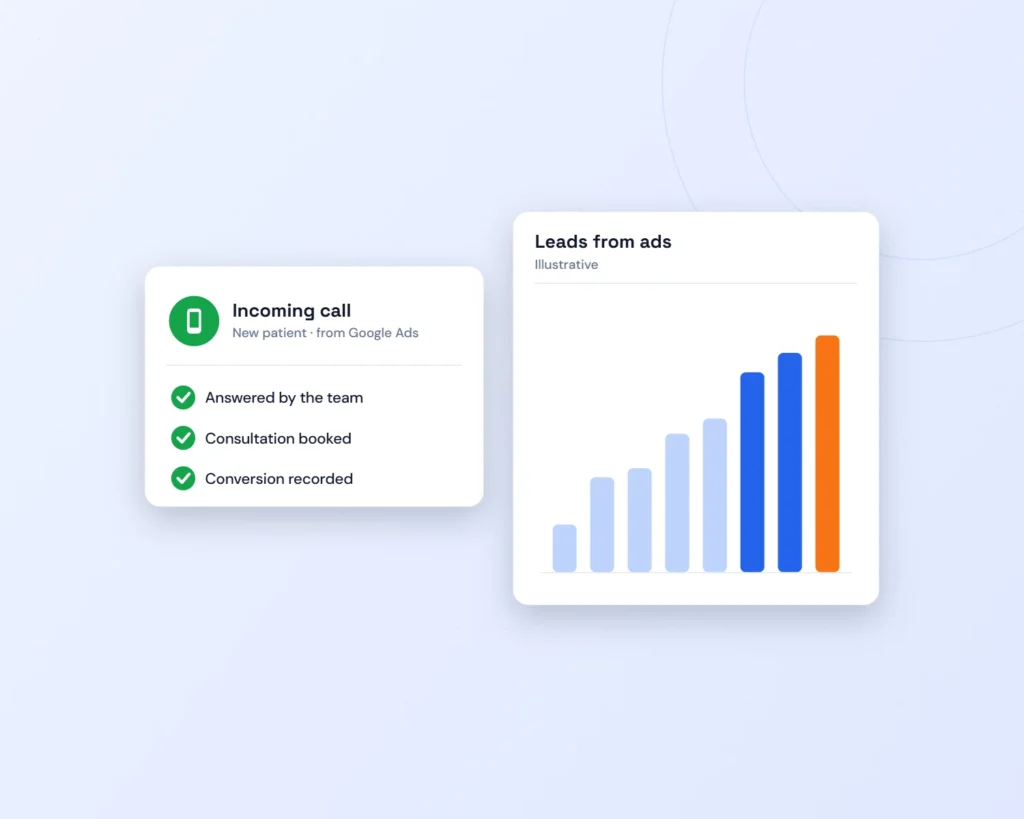
Is Google Ads right for you now?
When paid search makes sense
Paid search fits well when you
- Need inquiries quickly, for example after opening a new office
- Want to grow a specific treatment
- Have capacity for more consultations now
- Can answer calls and forms promptly
- Have a landing page that loads fast on a phone
Fix these first if you
- Miss many calls during busy hours
- Have no conversion tracking at all
- Send ads to a slow, outdated home page
- Cannot handle more consultations
- Expect ads alone to fix weak reviews
Inside a well-run account
The details that decide whether ad spend turns into consultations
These are the practices we apply to every orthodontic account we manage.
Search-term reviews every week
The keywords you choose are not the searches you pay for. Google matches ads to related searches, and some of them are useless to an orthodontic practice. Reviewing the actual search terms weekly, then adding negatives and refining match types, is the single most effective habit in paid search for orthodontists.
- Job and career searches
- At-home and mail-order aligner searches
- Free and low-cost clinic searches outside your offer
- Locations you do not serve
- Informational searches with no booking intent
Location settings that match reality
By default, location targeting can include people who are interested in your area rather than physically there. For most practices we target people in or regularly in the service area, set a sensible radius per office and adjust bids for neighborhoods that convert better.
Ad schedule aligned with your phones
Call ads should run when someone can answer. Outside office hours, we shift toward form and booking actions or reduce bids, so families are not sent to voicemail.
Landing pages that match the ad
An ad about clear aligners for adults should land on a page about clear aligners for adults, not on the home page. Matching pages improve conversion and the quality factors that affect Ad Rank. Each landing page has a short form, a visible phone number and the practice rating near the top.
Conversion values that reflect reality
Not every conversion is equal. A booked consultation matters more than a click on a phone number. We set primary and secondary conversions so that bidding focuses on actions that lead to consultations, and where possible we import consultation outcomes from your practice systems.
Before you decide
What working with us looks like
Straight answers to what practice owners and managers ask before a first call.
| Question | Answer |
|---|---|
| What does it cost? | Google Ads management for one location is included in the $1,490/mo Growth plan; multi-location accounts are quoted in writing after a free audit. Monthly SEO plans start at $990, month-to-month. See pricing. |
| How does it start? | A short kickoff call, access to your accounts and a written plan before any work begins. See our process. |
| Who owns the accounts? | You do. Your Google Business Profile, Search Console, analytics, ads and website accounts stay in your name, and you keep everything if you leave. |
| Who does the work? | You work directly with the consultant, a dentist completing an MSD in Orthodontics. Every treatment page is clinically reviewed before it goes live. |
| What do you report? | A monthly report that leads with calls, forms and consultation requests, with map visibility, Search Console data, reviews and AI answer tests as supporting detail, plus a change log of every edit. |
| Can we see results? | We are a new agency, so we do not show client logos or claimed numbers. Our first case study documents our own site rebuild, with ranking data added at 30, 60 and 90 days. We also publish original research. |
| When are we not the right fit? | If you need social media managed, or want guaranteed rankings or a fixed number of new patients. Our honest comparison explains when a general agency suits you better. |
Google Ads questions
Plan your spend: use our free Google Ads budget calculator to work back from the new patient starts you want to a monthly and daily budget.
Google Ads for orthodontists FAQ
Budget, timing, ownership and results.
How much should an orthodontist spend on Google Ads?
Start with a controlled test budget sized to your market and capacity, measure the cost per consultation, then scale the campaigns that work. Competitive cities cost more per click than smaller markets. We recommend a starting range after reviewing your area and goals.
How quickly do Google Ads produce inquiries?
Ads can start producing calls within days of launch. The first weeks are a learning period while we refine keywords, ads and bids, so expect performance to improve over the first two to three months.
Who owns the ad account and who pays Google?
You do. The account is in your name and ad spend is billed directly to your card. Management for one location is included in the Growth plan.
Can we run remarketing ads for orthodontic treatment?
Google treats health as a sensitive category, so health advertisers cannot use their own remarketing or Customer Match lists for targeting. Some predefined Google audiences are still allowed. We focus on search intent and location, and check any audience use against current policy.
Should we bid on competitors’ names?
Sometimes it can work, but it often produces expensive clicks with low conversion and can strain local professional relationships. We test it carefully, if at all.
How do you measure success?
By cost per inquiry and, ideally, cost per booked consultation, not by clicks or impressions. Where possible, we import booked consultations back into Google Ads.
Is SEO better than Google Ads?
They do different jobs. Ads are fast and stop when spending stops. SEO is slower and keeps working. Most practices benefit from both, with the balance shifting toward SEO as organic visibility grows.
Do you guarantee a number of leads?
No. Results depend on your market, competition, budget and follow-up. We guarantee transparent management and honest reporting.
What is a good cost per consultation from Google Ads?
It varies widely by city, competition and treatment. The useful comparison is your own cost per consultation over time and against the value of a start in your practice.
Can you take over our existing account?
Yes. We audit it first, keep what works, fix tracking and structure, and document every change so performance can be compared before and after.
Keep exploring
Related services and guides
Paid search management
For dental and healthcare practices.
Before you spend on Google Ads
What to fix first.
Orthodontic marketing budget
Size spend from capacity.
Orthodontic website design
Landing pages that convert.
Measuring orthodontic marketing
From clicks to starts.
Orthodontic marketing
The full system.
Free account review
Find out what a consultation costs you today
We review your campaigns, search terms, targeting and tracking, and show where budget is leaking. No obligation.
- Search-term waste found
- Tracking checked
- Clear fix list