
Orthodontic reputation management
Reviews that keep arriving, and replies that protect your patients
Reviews shape two decisions at once: where Google places you on the map and which practice a family calls. Our orthodontic reputation management gives your team a simple routine to ask every patient, replies that never compromise privacy, and monitoring that catches problems early.
- A steady weekly routine
- Privacy-safe replies
- Within Google and FTC rules
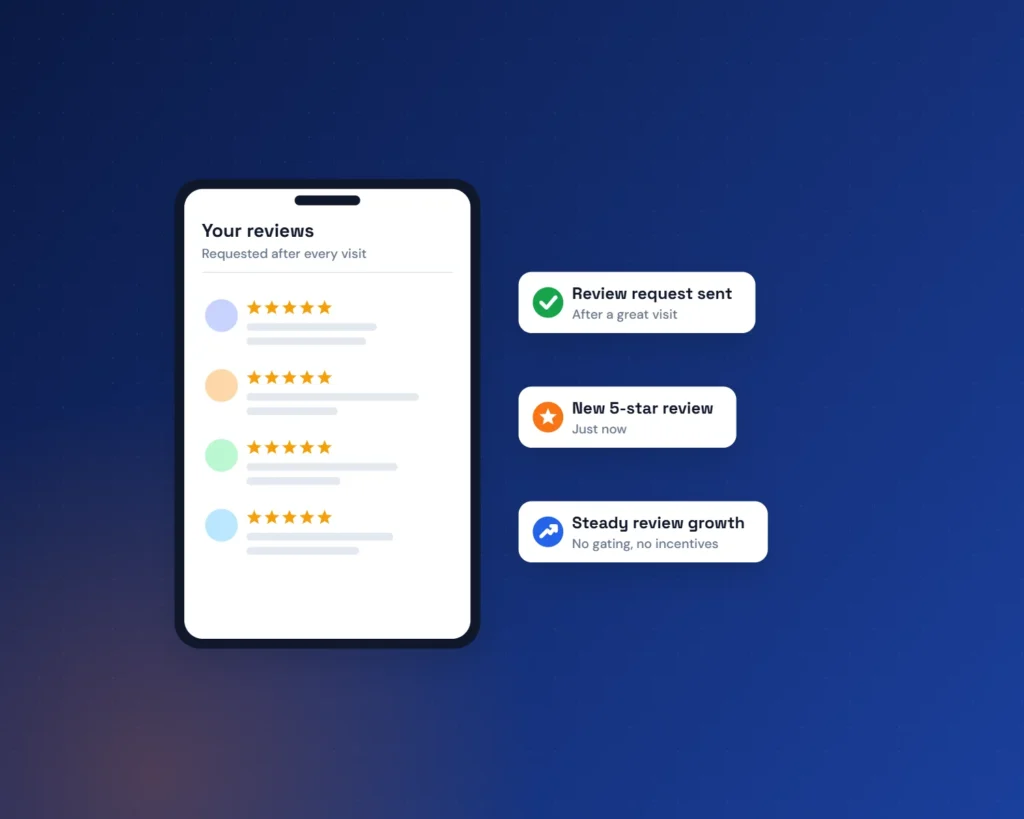
Reputation snapshot
- Review paceWeekly
- Reply rate100% goal
- Reply timeWithin days
- Privacy checkEvery reply
- Platforms monitoredAll major
$990/mo
Plans from $990 a month. Most start with a $790 audit, credited to month one. See pricing
No contract
Month-to-month, no setup fees, cancel any month.
You own it
Profile, analytics, ads and website accounts stay in your name.
Reviewed
Treatment pages clinically reviewed by a dentist completing an MSD in Orthodontics. How we work
What is orthodontic reputation management?
Orthodontic reputation management is the steady work of earning genuine patient reviews and replying to them well. It means asking every satisfied patient at the right moment, replying to positive and negative reviews without confirming anyone is a patient, which protects privacy under HIPAA, and never buying or filtering reviews. The result is reviews that keep arriving each month, and replies that protect your patients’ privacy.
By Dr. Mahmoud Elsheikh · Updated
Prominence
Google says review count and rating are part of how prominent, and therefore how visible, a local business is.
Source: Google Business Profile Help
No gating
Google prohibits discouraging negative reviews or selectively asking only happy customers.
Source: Google Maps content policy
No incentives
Offering discounts, gifts or payment for reviews breaks Google policy.
Source: Google Maps content policy
2024
The FTC finalized a rule banning fake reviews, incentivized sentiment and review suppression.
Source: FTC
Why reputation decides more than you think
Reviews shape the decision and the map
A parent comparing three orthodontists on a phone sees each practice’s rating and review count before anything else. A practice with a strong rating but only a handful of old reviews can look less established than a competitor with a steady stream of recent ones. Families also read the content of reviews: how the team treated a nervous child, whether appointments ran on time, how the practice handled a problem.
Google uses reviews too. Review count and rating are part of what Google calls prominence, one of the three main factors behind local rankings. That means a consistent review routine supports both visibility and conversion.
Orthodontic reputation management is not about chasing five-star ratings. It is about making it easy for every patient to share an honest experience, responding professionally and privately when something goes wrong, and using feedback to make the practice better. Done that way, a strong reputation follows naturally.
The review routine
A reputation process your team can keep up
The practices with the strongest reviews are not running campaigns. They ask consistently, at natural moments, with almost no effort.
- 1. Moment Debond or great visit
- 2. Ask Personal, in person
- 3. Link Text or email follow-up
- 4. Review Patient posts honestly
- 5. Reply Privacy-safe response
- 6. Learn Themes shared with team
Replies and privacy
A calm, consistent approach to criticism
How you reply is read by every future patient. In healthcare, it also carries privacy obligations.
The privacy rule for every reply
A reply must never confirm that the reviewer is a patient, mention their treatment, appointments or account, or reveal anything from their record, even if the reviewer shared those details publicly. The US Department of Health and Human Services has taken enforcement action against dental practices that disclosed patient information in review replies. When in doubt, say less and take the conversation offline.
| Avoid | Write instead |
|---|---|
| "We are sorry your son’s brackets broke twice." | "We are sorry to hear about this experience." |
| "Our records show you missed three appointments." | "We would like to understand what happened. Please call our office manager." |
| "Thank you, Sarah! Your aligner results look great." | "Thank you for your kind words. Our team loves hearing this." |
Replying to positive reviews
Thank the reviewer warmly and briefly, mention something about the practice rather than the patient, and vary the wording so replies do not look automated. Positive replies show families that real people read and care about feedback.
Replying to negative reviews
Acknowledge the concern without arguing, avoid any detail about the person or their care, and invite them to call a named role such as the office manager. Then resolve it offline. A calm, professional reply often reassures future patients more than a perfect rating would.
Fake or policy-violating reviews
Reviews that are spam, off-topic, from competitors or contain hateful content may break Google’s policies. We document and report them through the proper channels. Reviews that are simply negative but genuine stay up, and the best response is a professional reply.
What is included
Everything in our review process
A complete reputation program that fits into your team’s existing day.
Review request system
Simple scripts for your team plus automated text or email follow-ups with a direct review link, timed to natural moments in treatment.
- Every patient asked, not only happy ones
- No incentives of any kind
- Works with your practice software where possible
Reply management
Professional, privacy-safe replies to every review, with sensitive cases escalated to you before posting.
Monitoring
Google, Yelp, Facebook and healthcare directories watched, with alerts for new reviews.
Policy reports
Spam and policy-violating reviews documented and reported through official channels.
Team training
A short session on how to ask naturally and what never to say in public.
Monthly reputation report
Review pace, rating trend, reply status and comparison with nearby practices.
Feedback themes
Patterns in reviews and private feedback shared with you, so recurring issues like wait times can be fixed at the source.
The rules
What is allowed and what is not
Review rules come from Google’s policies and the FTC. Breaking them can lead to removed reviews, suspended profiles or legal risk.
| Practice | Allowed? | Why |
|---|---|---|
| Asking every patient for an honest review | Encouraged by Google | |
| Sending a direct review link by text or email | Makes reviewing easy | |
| Asking only patients you expect to be happy | Google prohibits selective solicitation | |
| Offering a discount, gift or raffle entry | Incentives break Google policy | |
| Staff or family writing reviews | FTC rule bans undisclosed insider reviews | |
| Buying reviews or using review services that write them | Fake reviews are banned by the FTC rule | |
| Reporting spam or off-topic reviews | Through official reporting tools | |
| Threatening reviewers to remove a review | FTC rule bans review suppression |
Self-check
How healthy is your reputation?
Check your Google profile and the profiles of two nearby competitors.
Volume and recency
- New reviews arrive every week or two
- Your count compares well with nearby practices
- Recent reviews mention your team by role
Replies
- Every review has a reply
- Replies never mention treatment or appointments
- Negative reviews invite an offline conversation
Process
- Your team knows when to ask
- A direct review link is ready to send
- Nobody offers anything in exchange
Beyond star ratings
Using reputation to improve the practice
Reviews are public proof, but they are also free, honest feedback about the patient experience.
Read reviews for patterns, not just ratings
Every quarter we group review comments into themes: scheduling, waiting times, communication with parents, financial conversations, the experience of children, emergency handling. Patterns tell you where to focus training or process changes, and they often point to the exact details prospective families care about.
Private feedback before public reviews
A short private feedback survey at key moments, such as mid-treatment, catches problems while they can still be fixed. This must never be used to filter who gets asked for a public review. Every patient should still receive the review request.
Reviews on your website, done honestly
Showing genuine reviews on your website builds trust, as long as they are real, unedited and not cherry-picked to mislead. We prefer live review feeds or clearly sourced excerpts with consent where patient names appear.
Making every team member part of it
The best review requests come from the person a patient connects with most, often a treatment coordinator or assistant. A short training session gives the whole team the words to ask naturally, the timing that works and the boundaries to respect.
- Ask in person, then send the link the same day
- Never ask in the middle of a difficult appointment
- Never coach the content or the rating
- Never discuss a review publicly with patient details
Before you decide
What working with us looks like
Straight answers to what practice owners and managers ask before a first call.
| Question | Answer |
|---|---|
| What does it cost? | From $990 a month (Local Core) or $1,490 a month (Growth and AI Visibility). Most practices start with a $790 audit, credited to your first month if you continue. See pricing. |
| Is there a contract? | No. Month-to-month, no setup fees, cancel any month. |
| How long until we see movement? | Weeks 1 to 2: diagnosis. Weeks 3 to 6: foundation fixes. Weeks 6 to 10: treatment and location pages. Then ongoing growth work. Some changes show within weeks, others take months. See our process. |
| Who owns the accounts? | You do. Your Google Business Profile, Search Console, analytics, ads and website accounts stay in your name, and you keep everything if you leave. |
| Who does the work? | You work directly with the consultant, a dentist completing an MSD in Orthodontics. Every treatment page is clinically reviewed before it goes live. |
| What do you report? | A monthly report that leads with calls, forms and consultation requests, with map visibility, Search Console data, reviews and AI answer tests as supporting detail, plus a change log of every edit. |
| Can we see results? | We are a new agency, so we do not show client logos or claimed numbers. Our first case study documents our own site rebuild, with ranking data added at 30, 60 and 90 days. We also publish original research. |
| When are we not the right fit? | If you need social media managed, or want guaranteed rankings or a fixed number of new patients. Our honest comparison explains when a general agency suits you better. |
For step-by-step guidance on difficult cases, read how orthodontists should handle negative reviews.
Review questions
Orthodontic reputation management FAQ
Straight answers on reviews, rules and replies.
What is orthodontic reputation management?
It is the ongoing work of earning, monitoring and responding to online reviews and feedback for an orthodontic practice, within platform rules and patient privacy requirements.
How many Google reviews does an orthodontist need?
There is no magic number. Compare your count and pace with the practices that appear alongside you on the map. A steady flow of recent reviews matters as much as the total.
Can we give patients a reward for leaving a review?
No. Google prohibits incentives for reviews, and the FTC rule bans incentives tied to a particular sentiment. Ask every patient honestly instead.
Can we remove a negative review?
Only reviews that break Google’s policies, such as spam, off-topic or hateful content, can be reported for removal. Genuine negative reviews stay. A professional, privacy-safe reply is the best response.
How should we reply without breaking HIPAA?
Never confirm the person is a patient or mention treatment, appointments or records. Thank them or acknowledge the concern in general terms and invite them to call the office.
What if a competitor posts fake reviews about us?
Document the evidence and report the reviews through Google’s tools. We help gather what is needed and follow up through official channels.
Which platforms matter besides Google?
Google matters most for most practices. Facebook, Yelp and healthcare directories also matter in some markets. We monitor all of them and focus effort where your patients look.
Do reviews really affect rankings?
Google states that review count and rating are part of prominence, one of the main local ranking factors. Reviews also strongly influence which practice a family chooses.
Should we use review software?
Software can automate requests and monitoring, which helps busy teams. The routine and the replies matter more than the tool. We work with what you already use where possible.
How fast should we reply to reviews?
Within a few days is a good standard. Negative reviews deserve a prompt, calm reply that invites an offline conversation.
Keep exploring
Related services and guides
Free reputation review
See how your reviews compare
We compare your review volume, pace and replies with nearby practices and send a simple plan your team can start this week.
- Competitor comparison
- Reply risk check
- Ready-to-use scripts
Sources and further reading
- Google Maps user contributed content policy: Prohibited and restricted content
- FTC: Final rule banning fake reviews and testimonials (August 2024)
- Google Business Profile Help: Tips to improve your local ranking
- HHS: HIPAA Privacy Rule
- HHS resolution agreement: dental practice disclosures in online review replies