
Should Orthodontists Put Prices and Financing on Their Website?
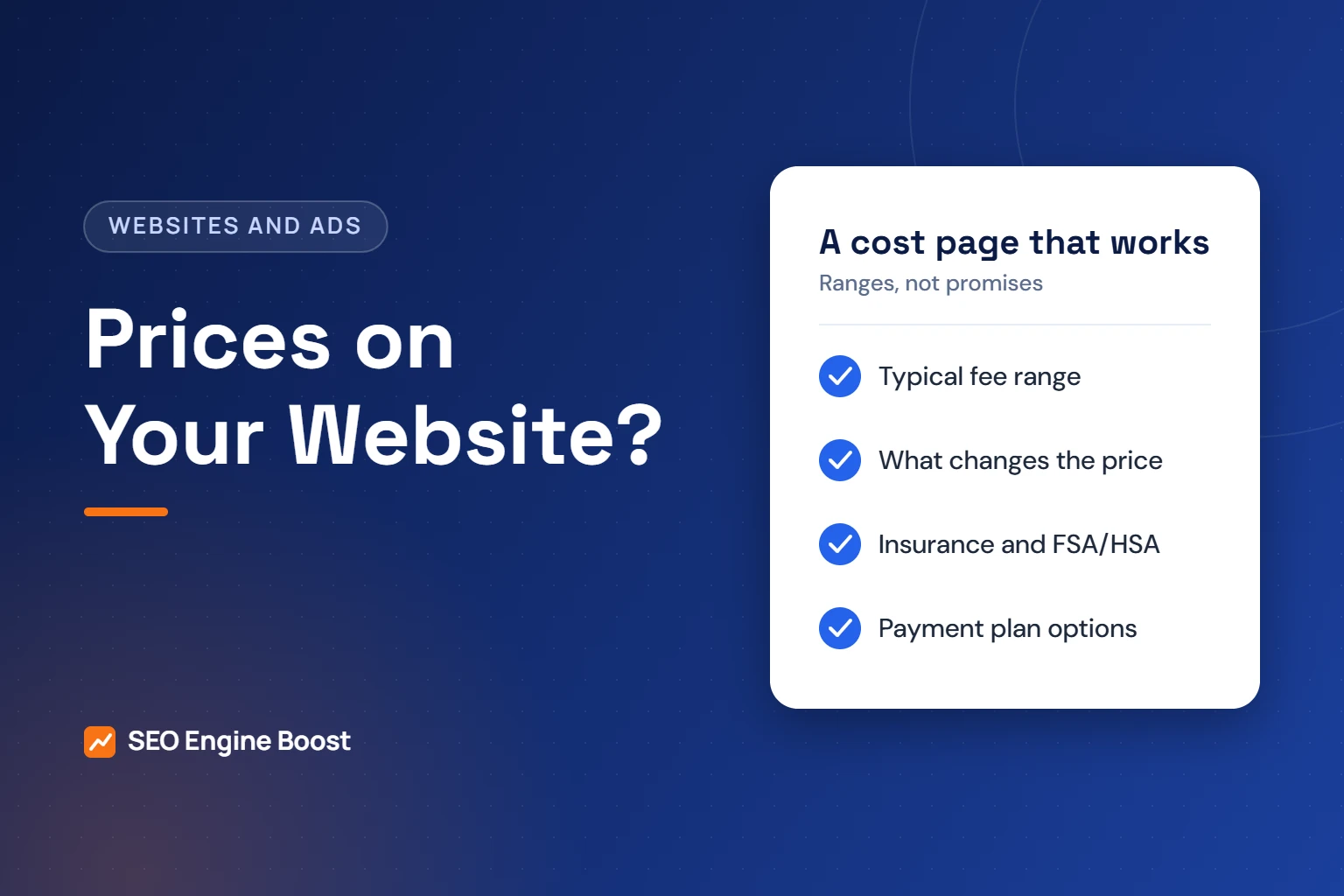
Yes, most orthodontic practices should publish cost information, but as a typical range rather than a fixed price. Patients search for braces and Invisalign costs before they book. A clear range, the factors that change it, and your payment options answer that question. Your exact fee is still set at the consultation.
The risk is in the details. A single “starting at” number can mislead. Payment terms can trigger federal Truth in Lending disclosure rules. This guide covers what to show, how to word it, and what has changed for FAQ markup in Google.
Key takeaways
- Publish a typical fee range and the factors that move it, not a single fixed price.
- Explain insurance, FSA/HSA use, down payments, in-house plans and third-party financing in plain language.
- Stating a payment amount, number of payments or down payment amount in an ad can trigger Regulation Z disclosures. Get your wording reviewed.
- Google no longer shows FAQ rich results. Write your cost FAQs as visible text that people and AI tools can read.
In this article
- Why patients look for cost before they call
- Pros and cons of publishing prices
- What national price ranges look like
- How to present a price range honestly
- Financing language and Truth in Lending
- How to show cost without trapping yourself
- FAQ schema and AI answers in 2026
- A simple outline for your cost page
- Frequently asked questions
Why patients look for cost before they call
Cost is one of the first questions people type into Google. Common searches include “braces cost”, “invisalign cost” and “how much are braces near me”. If your site is silent, the answer comes from a directory, a competitor or an AI summary.
Even the American Association of Orthodontists publishes a patient article on what braces cost. It explains that cost varies with the type, complexity and length of treatment. It also covers insurance, FSAs, HSAs and in-house payment plans.
A practice page that covers the same ground keeps the patient on your site. It also lets you explain your own fees and policies in your own words.
Pros and cons of publishing prices
| Pros | Cons |
|---|---|
| Answers the most common question before the call | A range can anchor patients to the low end |
| Filters out patients who cannot proceed, saving consult time | Competitors can see your fees |
| Builds trust when other local practices stay silent | Fees change, so the page needs regular review |
| Gives Google and AI tools accurate text to quote | Payment wording can trigger disclosure rules |
| Lets you explain value, not just a number | Complex cases may fall outside the published range |
Most of the cons are about wording, not about publishing itself. A range with clear conditions handles the anchoring problem. A “last reviewed” date handles the change problem.
What national price ranges look like
If you cite national figures, label them as national and show their date. Here are the ranges published by Healthline in a 2021 medically reviewed article. Prices may have changed since then.
| Treatment | National range without insurance (Healthline, 2021) |
|---|---|
| Metal braces | $3,000 to $7,500 |
| Ceramic braces | $2,000 to $8,500 |
| Lingual braces | $5,000 to $13,000 |
| Invisalign clear aligners | $3,000 to $7,000 |
The same article cites an American Dental Association 2018 survey that put comprehensive orthodontic treatment at $5,000 to $6,000. Use these figures for context only. Your own fee range should come from your own fee schedule.
A practical approach is to state your own typical range first. Then add one sentence noting how it compares with national ranges, with the source linked.
How to present a price range honestly
A good cost section answers six questions in order. Each one gets a short heading and two or three sentences.
- Typical range: “Most comprehensive treatment at our office falls between $X and $Y.” Use your real numbers.
- What changes the price: type of appliance, case complexity, treatment length, and whether a first phase is needed.
- Insurance: explain that orthodontic benefits vary, often have a lifetime maximum and age limits, and that you will check coverage.
- FSA and HSA: note that many patients pay with pre-tax dollars, and FSAs often follow a use-it-or-lose-it rule.
- Down payment and in-house plans: describe that plans exist and are flexible. Hold the exact terms for the consult or a fully disclosed page.
- Third-party financing: name the provider and link to its own terms, rather than restating rates yourself.
Place this section on a dedicated cost page, and link to it from each treatment page. Our orthodontic website design service builds this structure in from the start.
Not sure your cost page is working?
We review your fees page, payment wording and tracking in one audit.
Financing language and Truth in Lending
This is general information, not legal advice. Advertising credit terms is regulated by the federal Truth in Lending Act through Regulation Z. Have a lawyer review your wording, and check your state dental board’s advertising rules.
Regulation Z’s advertising rules apply to all persons who advertise consumer credit, not just lenders. Under section 1026.24(d), four “triggering terms” require extra disclosures when they appear in an ad:
- The amount or percentage of any down payment
- The number of payments or period of repayment
- The amount of any payment
- The amount of any finance charge
If you use a triggering term, the ad must also state three things. These are the down payment, the full repayment terms and the “annual percentage rate”, using that term. Any rate you state must be called an annual percentage rate. You may only advertise terms you actually offer.
| Example wording | Triggers extra disclosures? | Based on |
|---|---|---|
| “Payable in installments of $103” | Yes, it states a payment amount | CFPB commentary 24(d)(1)-3 |
| “No down payment” | No, per the official commentary | CFPB commentary 24(d)(1)-1 |
| “Monthly payments to suit your needs” | No, no amount is stated | CFPB commentary 24(d)(1)-3 |
| “Pay over 24 months” | Yes, it states a repayment period | Section 1026.24(d)(1)(ii) |
| “0% interest” | Must be stated as an annual percentage rate | Section 1026.24(c) |
The safest pattern for most sites is general wording, such as “flexible monthly payment plans available”. Put exact terms on the written agreement, or on a page with full disclosures reviewed by counsel.
How to show cost without trapping yourself
The goal is to be useful without making a promise you cannot keep. These habits help.
- Use a range, not “starting at”. A low single number invites disappointment at the consult.
- Say what is included. For example, records, retainers and follow-up visits, if your fee includes them.
- Avoid guarantees. Do not promise an insurance amount or a monthly payment.
- Date the page. Add “Fees last reviewed” with a month and year, and update it yearly.
- Keep ads consistent. Google Ads and social posts should match the cost page wording.
- Make the next step clear. Close with an invitation to a consult where the exact fee is set.
Vague or outdated fee pages are a common problem we see. Our list of orthodontic website mistakes covers several related issues.
Price also connects to value over time. A family that starts treatment may later bring siblings or a parent. Our patient lifetime value calculator shows what one new patient can be worth to your practice.
FAQ schema and AI answers in 2026
FAQ markup no longer earns a special search result. Google limited FAQ rich results to well-known government and health sites in September 2023. It then said the feature would stop appearing in Search from May 7, 2026. In June 2026 it removed the documentation.
That does not make cost FAQs pointless. Google says there are no special requirements to appear in AI Overviews or AI Mode. It also says no special schema is needed. Its advice is that any structured data should match the visible text on the page.
- Write each cost question as a visible heading with a short, direct answer.
- Keep answers factual and dated, so any AI summary quotes current information.
- If you keep FAQPage markup, make sure it matches the visible text exactly. Do not expect a rich result.
A simple outline for your cost page
| Section | What to include |
|---|---|
| Short answer | Your typical fee range and that the exact fee is set at the consult |
| What affects cost | Appliance type, complexity, length, phases of treatment |
| Insurance and FSA/HSA | How you check benefits; that coverage varies |
| Payment options | Down payment approach, in-house plans, third-party financing link |
| Cost FAQs | Four to six visible questions with short answers |
| Next step | Book a consultation; fees last reviewed date |
Frequently asked questions
Should an orthodontist list exact prices on the website?
Most practices are better served by a typical range than an exact price. Treatment fees depend on appliance type, complexity and length, so one number rarely fits every patient. Publish your usual range, explain what moves it, and state that the exact fee is set at the consultation. Review the page at least once a year.
How much do braces cost in the US?
National figures vary by source and year. A medically reviewed 2021 Healthline article listed metal braces at $3,000 to $7,500 and Invisalign at $3,000 to $7,000 without insurance. These are national ranges, not quotes. Your local fees may be higher or lower, so publish your own typical range.
Can I advertise a monthly payment amount for braces?
You can, but stating a payment amount is a triggering term under Regulation Z. The ad must then also disclose the down payment, the full repayment terms and the annual percentage rate. General wording such as “flexible monthly plans available” does not state an amount. This is general information, not legal advice.
Does FAQ schema still help an orthodontic website?
FAQ schema no longer produces rich results. Google said the feature would stop appearing in Search from May 7, 2026. Visible FAQ content still helps patients, and Google says no special schema is needed for its AI features. If you keep the markup, make sure it matches the visible text exactly.
Will publishing prices scare patients away?
It may discourage some patients who cannot proceed, which can save consultation time. For others, a clear range and payment options remove uncertainty before they call. Pair the range with what is included and how financing works. Then track consult requests from the cost page to see how it performs for your practice.
Sources
- American Association of Orthodontists: How Much Do Braces Cost? Financing Options for Orthodontic Treatment
- Healthline: How Much Do Braces Cost? (Apr 1, 2021, medically reviewed)
- CFPB: Regulation Z, 12 CFR 1026.24 Advertising, with official commentary
- CFPB: Regulation Z, Official Interpretation of 1026.2 (comment 2(a)(2)-2, persons covered)
- Google Search Central: Latest Google Search Documentation Updates (Sep 14, 2023; May 8, 2026; Jun 15, 2026 entries)
- Google Search Central: AI features and your website
Keep reading

See where your practice stands
If you would like a second pair of eyes on your own practice, we offer a free growth audit: a manual review of your local visibility, website, reviews and content, with a prioritized list of what to fix first.
Try it with your own numbers: use our free patient lifetime value calculator to see what one new start is worth over time.