Reducing Orthodontic Consult No-Shows: Reminders, Texts and Email
To reduce orthodontic consult no-shows, confirm the visit at booking, send a short what-to-expect email, and text or call a reminder before the day. Make rescheduling easy. A Cochrane review found text reminders improved attendance compared with no reminder. Keep messages brief, consented and free of clinical detail.
Every missed consult is a lost chance to help a patient, and an empty chair your team prepared for. Marketing pays to create that booking, so losing it at the last step hurts. This guide covers the evidence on reminders, a simple sequence, consent and privacy basics, and how to follow up without pressure.
Key takeaways
- Reminders help. A 2013 Cochrane review found text reminders raised attendance versus no reminder, and worked about as well as phone calls.
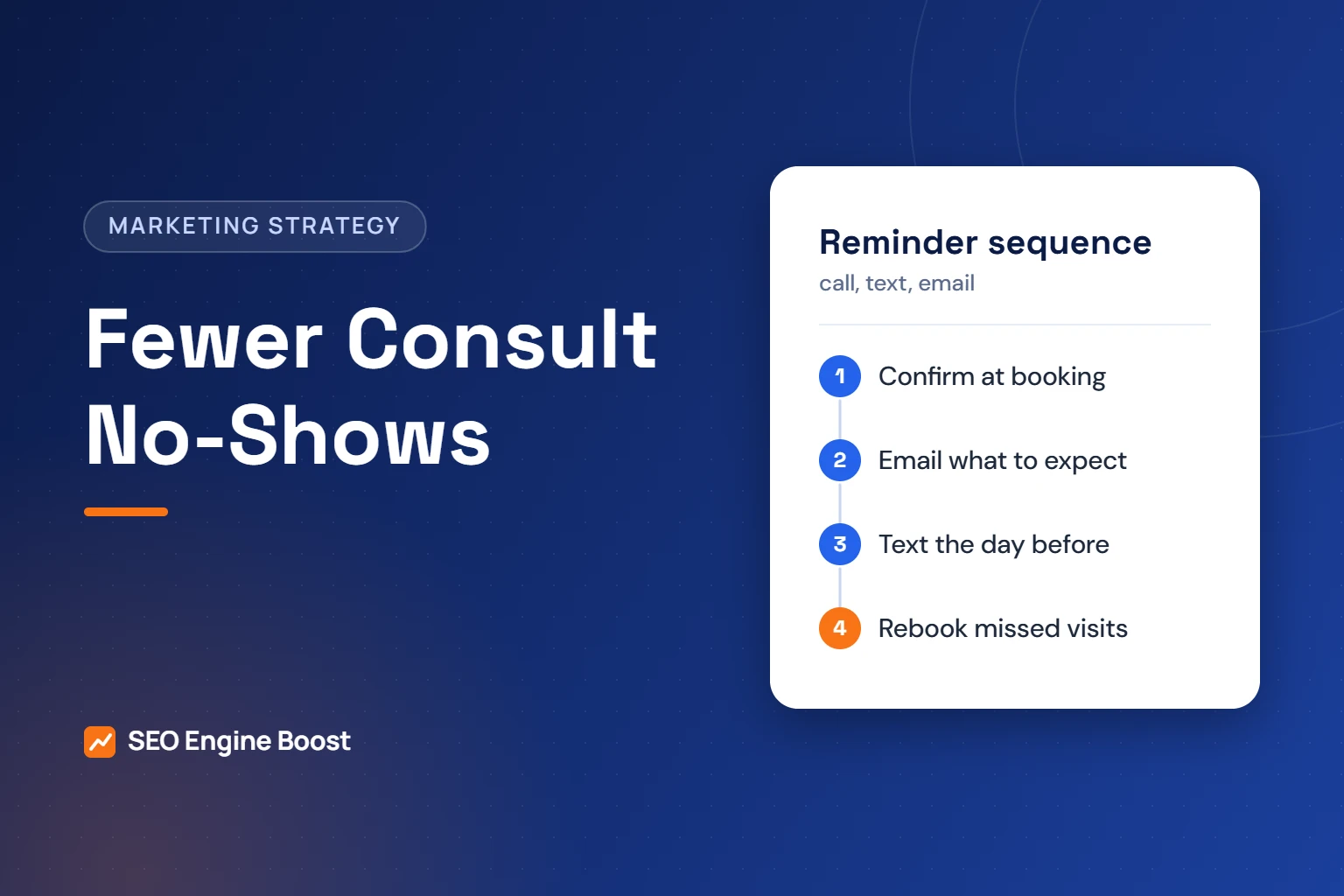
- Use a short sequence: confirm at booking, email what to expect, then remind by text or call before the visit.
- Keep reminders minimal. HHS says providers should limit what they disclose in messages such as voicemails.
- Appointment reminders and marketing messages follow different consent rules. Check yours with counsel.
In this article
- Why consults get missed
- What the research says about reminders
- A simple reminder sequence
- Sample reminder wording
- Confirmation calls and voicemail
- Texts and email: consent basics
- Keep reminders private and minimal
- Make the consult easy to keep
- When a patient does not show
- How to measure no-shows
- Frequently asked questions
Why consults get missed
Patients rarely skip a consult on purpose. Most no-shows have simple causes. The list below is agency observation, not research:
- They forgot, especially when the visit was booked weeks ahead.
- Plans changed, and calling to cancel felt awkward.
- They were unsure what the visit involves, how long it takes or what it costs.
- A parent booked for a teen, then a school or sports conflict came up.
- They booked with several practices and kept only one appointment.
Each cause points to a fix. Reminders address forgetting. Easy rescheduling addresses changed plans. Clear pre-visit information addresses uncertainty. A short wait between booking and visit helps with all of them.
No-shows are one of several leaks between a marketing lead and a new patient. Our hub on orthodontic marketing covers the full path, from first search to treatment start.
What the research says about reminders
The best summary evidence is a Cochrane review of mobile phone message reminders, published in 2013. It is not specific to orthodontics, but it covers scheduled healthcare appointments in general.
| Comparison | Trials (participants) | Finding |
|---|---|---|
| Text reminder vs no reminder | 7 (5,841) | Attendance higher with text reminders (risk ratio 1.14) |
| Text reminder vs phone call reminder | 3 (2,509) | No clear difference (risk ratio 0.99) |
| Attendance rates reported | Pooled | 67.8% no reminder, 78.6% text, 80.3% phone call |
The review rated the evidence as moderate quality. Two practical points follow. First, any reminder is better than none. Second, texts appear to work about as well as calls, and they cost staff less time.
Do not quote these figures as your expected result. Your own no-show rate depends on your patients, booking lead time and process. Measure before and after you change anything.
A simple reminder sequence
Use the same sequence for every new-patient consult. The timing below is agency guidance, not research. Adjust it to your booking lead time and your team’s capacity.
| When | Channel | Content |
|---|---|---|
| At booking | Phone or online confirmation | Date, time, address, parking and how to reschedule |
| Same day as booking | What to expect, how long it takes, what to bring, forms link | |
| About 2 to 3 days before | Text or call | Reminder with a simple reply option to confirm or reschedule |
| Day before or morning of | Text | Short reminder with address and phone number |
| Missed visit, same day | Call, then text | Friendly check-in and an offer to rebook |
Keep each message short. Include the practice name and phone number. Make it easy to reply or rebook online. Avoid stacking many messages close together, which can feel like pressure.
Sample reminder wording
Good reminders are short, specific and easy to act on. Adapt these examples to your practice. Replace the brackets with your details, and have your compliance lead approve the final text.
Booking confirmation email
“Thanks for booking your visit with [Practice] on [day, date] at [time]. The visit usually takes about [time range]. You can complete forms here: [link]. Need a different time? Call [phone] or reply to this email.”
Reminder text, 2 to 3 days before
“[Practice]: reminder of your visit on [day] at [time]. Reply C to confirm or R to reschedule. Questions? Call [phone]. Reply STOP to opt out.”
Day-before text
“[Practice]: see you tomorrow at [time], [address]. Parking: [short note]. Call [phone] if plans change.”
Notice what these messages leave out. They do not name the treatment, the reason for the visit or the patient’s age. They do not include offers or discounts. That keeps them clearly informational and limits what someone else might see on a shared phone.
For parents booking for a child, address the message to the parent. Include the child’s first name only if your consent process and privacy policy allow it.
Not sure where your practice stands? A free growth audit lists your top three fixes for Google, Maps and AI answers, in writing. Get a free growth audit · See our orthodontic marketing services
Confirmation calls and voicemail
A friendly call still works well for new patients, especially parents booking for a child. Use the call to answer questions, not just to confirm a time.
HHS guidance says the HIPAA Privacy Rule permits providers to leave appointment reminders on answering machines or with a family member. It also says providers should limit the information disclosed. A safe voicemail includes only:
- The practice name and a callback number.
- The appointment date and time.
- A request to call back to confirm or reschedule.
Leave out the reason for the visit, treatment details and fees. HHS also says providers must accommodate reasonable requests for confidential communication. If a patient asks you to call only their mobile, flag it in your system and follow it.
Texts and email: consent basics
This section is general information, not legal advice. Federal and state rules on calls, texts and email change. Check your setup with a healthcare attorney.
Texts
The FCC says callers need consent before sending autodialed texts to a mobile number. It says informational texts may rest on oral consent, while commercial texts need written consent. It also says consumers may opt out of any robotext at any time, in any reasonable manner.
In practice, collect clear consent to appointment texts when the patient books. Keep reminder texts separate from promotions. Honor “STOP” and similar replies promptly. Our guide to orthodontic text message consent covers the rules in more depth.
The FTC’s CAN-SPAM guide separates commercial email from transactional or relationship email. A message that facilitates or confirms an agreed transaction is treated differently from an ad. Confirmation and reminder emails usually fit the second group. If you add promotions, the email may become commercial. Commercial email needs a clear opt-out, a valid postal address and opt-outs honored within 10 business days.
Losing booked consults?
We will review your booking, reminder and follow-up flow and show where new patients drop out.
Keep reminders private and minimal
Reminders should confirm logistics, not discuss care. This protects patient privacy and keeps messages clearly in the reminder category.
- Do not name the treatment or problem in texts, emails or voicemails.
- Use a reminder platform that will sign a business associate agreement if it handles patient information.
- Limit who on your team can edit message templates.
- Do not reuse reminder lists for ads or social media audiences without proper authorization.
Our guide to HIPAA marketing basics for orthodontists explains when a message counts as marketing.
Make the consult easy to keep
Reminders work best when the visit itself feels simple. Remove the doubts that make people skip.
- Say how long it takes. Give a realistic time range.
- Say what happens. Exam, records if needed, and a talk about options.
- Say what it costs. The AAO says most of its members offer low-cost or free initial consultations. State your own policy plainly.
- Offer online forms. Shorter check-in means less waiting.
- Shorten the wait. Long gaps between booking and visit invite second thoughts.
- Offer times that fit families. After school and early morning slots help parents.
Speed at the first contact matters too. A lead that waits days for a callback may book elsewhere. See our guide to consultation request follow-up.
When a patient does not show
Treat a no-show as a scheduling problem, not a failure by the patient. Reach out the same day with a short, warm message.
- Call once. Say you missed them and ask if they would like a new time.
- If there is no answer, send one text with a link or number to rebook.
- Try once more a few days later.
- If there is still no reply, mark the record and stop. Add them to a general newsletter only if they agreed to it.
Never charge or threaten a fee for a missed free consult unless your written policy says so and the patient was told at booking.
How to measure no-shows
Track your consult show rate every month. Use your practice management software as the source of truth.
For example, a practice that books 60 new-patient consults in a month and sees 51 has a show rate of 85%. Its no-show rate is 15%. These numbers are hypothetical.
Record three things for every consult: the lead source, the date it was booked and the outcome. Outcomes can be kept, rescheduled, cancelled ahead or no-show. Cancelled-ahead visits are much easier to refill than no-shows, so count them separately.
Split the data by lead source, booking lead time and day of week. You may find that consults booked more than two weeks out miss more often. Change one thing at a time, then compare the next two or three months. Our guide to measuring orthodontic marketing shows how show rate fits into the wider funnel.
Frequently asked questions
What is a normal no-show rate for orthodontic consults?
We have not found a reliable published benchmark for orthodontic consult no-shows, so we do not quote one. Measure your own rate for three months, split by lead source and booking lead time. Then test changes, such as an extra reminder or shorter wait, and compare against your own baseline.
Are text reminders better than phone calls?
A 2013 Cochrane review found no clear difference in attendance between text and phone call reminders. Both beat no reminder. Texts take less staff time, while calls let you answer questions. Many practices use both: a call or email at booking, and texts closer to the visit.
Do we need consent to send appointment reminder texts?
The FCC says autodialed texts to mobile numbers need prior consent, and informational texts may rest on oral consent. Commercial texts need written consent. Collect clear consent at booking and keep reminders separate from promotions. This is general information, not legal advice, so confirm your process with counsel.
What should a reminder voicemail say?
Keep it minimal. Give the practice name, the appointment date and time, and a callback number. HHS says providers may leave reminders on answering machines but should limit the information disclosed. Do not mention the treatment, the problem or fees. Follow any request for confidential communication.
Should we charge a fee for missed consults?
That is a practice policy decision. For free consults, a fee can feel harsh and may discourage rebooking. If you do charge, put the policy in writing and tell patients clearly at booking. Most practices get better results from reminders and easy rescheduling than from fees.
Do reminder emails need an unsubscribe link?
Usually not, if they are purely transactional. The FTC’s CAN-SPAM guide says a message whose primary purpose is transactional or relationship content may not contain false or misleading routing information but is otherwise exempt from most provisions of the law. Once you add promotions, the email may become commercial and need an opt-out. Offering a simple way to stop reminders is still courteous.
Should we offer virtual consults to cut no-shows?
They may help some families, because they remove travel and fit around school. We have not found orthodontic research showing they reduce no-shows, so test them and measure. HHS’s pandemic-era telehealth flexibility ended after a transition period that closed on August 9, 2023, so use a platform whose vendor will sign a business associate agreement. Check your state’s rules on remote consultations.
Should patients be able to book consults online?
Online booking suits people who research after office hours, and the confirmation it sends is itself a reminder. Keep the form short and ask only for scheduling details. HHS has said tracking technology on appointment scheduling pages may involve protected health information, so keep ad pixels away from the booking tool, and confirm the booking vendor will sign a business associate agreement.
Is it a good idea to double-book consult slots?
As agency guidance, we prefer a short waitlist to double-booking. Double-booking can leave two families waiting if both arrive, which hurts the first impression the consult is meant to create. A list of patients who want an earlier visit lets the team fill same-day cancellations and no-shows. Measure your own show rate first, so any overbooking rests on your numbers.
Sources
- Cochrane Database of Systematic Reviews: Mobile phone messaging reminders for attendance at healthcare appointments (2013, CD007458)
- U.S. Department of Health and Human Services: May health care providers leave messages for patients? (content last reviewed December 28, 2022)
- Federal Communications Commission: Stop Unwanted Robocalls and Texts (February 27, 2026)
- Federal Trade Commission: CAN-SPAM Act: A Compliance Guide for Business
- American Association of Orthodontists: How Much Do Braces Cost? Financing Options for Orthodontic Treatment (October 16, 2025)
Keep reading
See where your practice stands
If you would like a second pair of eyes on your own practice, we offer a free growth audit: a manual review of your local visibility, website, reviews and content, with a prioritized list of what to fix first.
See what a missed consult is worth: use our free patient lifetime value calculator with your own fees and start rates.