Text Message Marketing for Orthodontists: Consent Basics
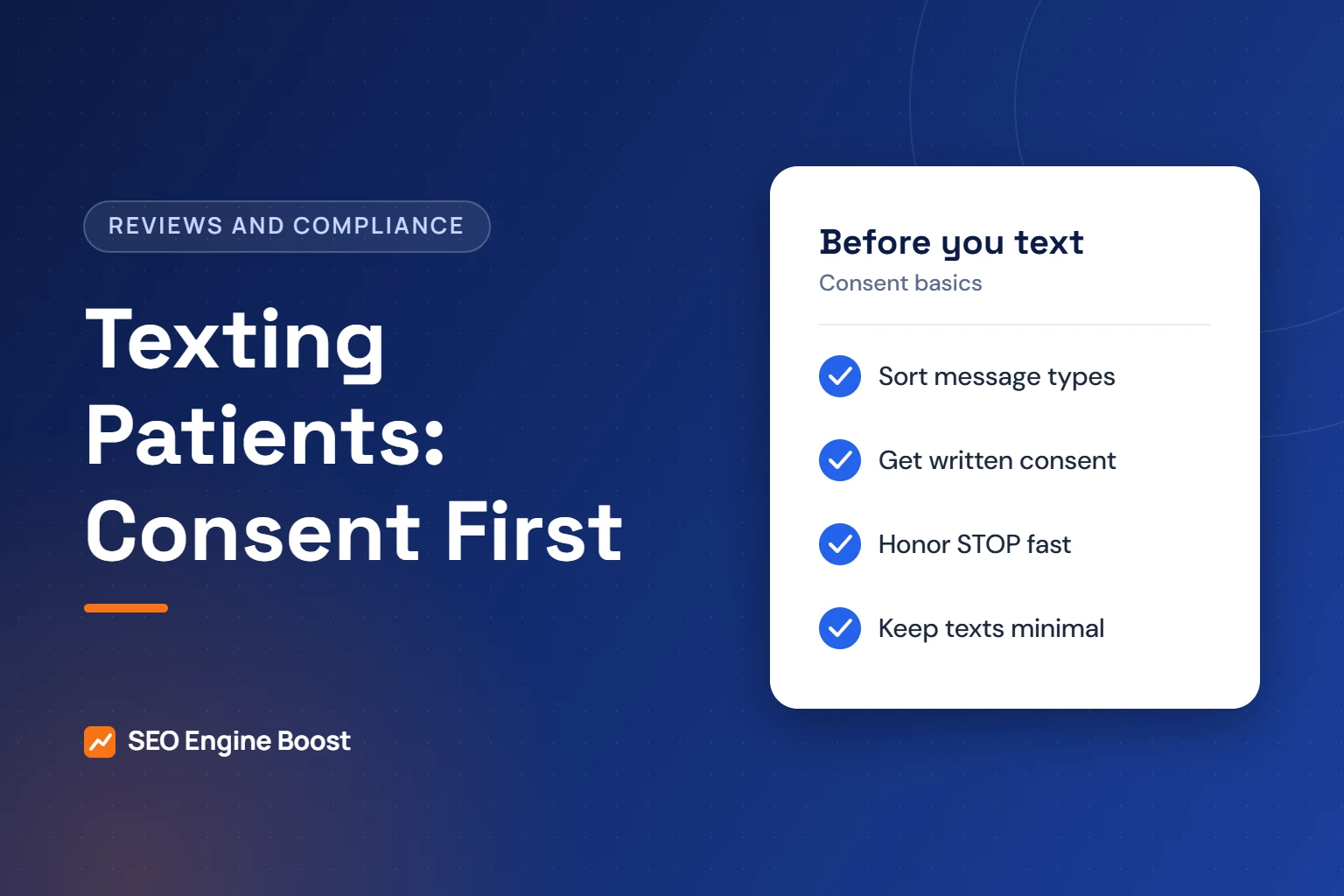
Orthodontic text message marketing needs prior express written consent from the patient or parent. Appointment reminders and treatment texts are informational, and the FCC says consent for those may be oral. Every text needs an easy opt-out. Opt-outs must be honored within 10 business days at most, and texts should carry minimal health details.
This guide explains the difference between informational and marketing texts, what the current federal rules say, and what changed in 2025 and 2026. It is general information, not legal advice. Check with a healthcare attorney and your state dental board before you launch a texting program.
Key takeaways
- Sort every text into informational or marketing. The consent rules differ.
- The FCC says commercial texts require written consent, while consent for informational texts may be oral.
- Opt-outs by any reasonable means, such as replying STOP, must be honored within 10 business days.
- The FCC’s one-to-one consent rule was vacated by the 11th Circuit in January 2025 and never took effect.
In this article
- Two kinds of texts, two consent standards
- What the federal rules require
- Appointment and treatment texts
- Marketing texts need written consent
- The one-to-one consent rule that never took effect
- Opt-outs: what the rules require now
- HIPAA: keep texts minimal and on purpose
- Quiet hours and state rules
- A front desk checklist before you text
- Frequently asked questions
Two kinds of texts, two consent standards
The Telephone Consumer Protection Act (TCPA) and the FCC’s rules treat texts like calls. The first question is what the text is for. The table below sorts common orthodontic texts. It is a general guide, not legal advice.
| Text type | Orthodontic example | Likely category | Consent to plan for |
|---|---|---|---|
| Appointment confirmation or reminder | “Your adjustment is Tuesday at 3:30. Reply C to confirm.” | Informational | Prior express consent, which may be oral |
| Treatment instructions | “Remember to wear your elastics full time this week.” | Informational | Prior express consent |
| Billing or payment reminder | “Your monthly payment is due Friday.” | Informational, but outside the healthcare exemption | Prior express consent |
| Promotion or offer | “Book a free aligner consult this month.” | Marketing | Prior express written consent |
| Referral or review campaign | “Refer a friend this month.” | Usually marketing | Prior express written consent |
When a text mixes purposes, treat it as marketing. A reminder that also promotes whitening or a new aligner offer is safest under the stricter standard.
What the federal rules require
The FCC’s consumer guide summarizes the core rule. Its rules ban autodialed texts to a mobile phone without the owner’s prior consent. Emergency messages are the exception. The guide adds that commercial texts require written consent. For informational texts, consent may be oral.
The stakes are real. Under the TCPA, a person can sue for $500 per violation, or actual losses if higher. A court may triple that amount if the violation was willful or knowing.
Whether your texting platform counts as an autodialer is a legal question we will not answer here. We recommend getting clear consent for every text program. That is the safer approach, and it is agency guidance.
Appointment and treatment texts
The FCC’s rules include a narrow exemption for certain healthcare calls and texts to wireless numbers. It applies to messages from healthcare providers that meet every listed condition. Key conditions include:
- Messages go only to the wireless number the patient provided.
- Each message states the provider’s name and contact information.
- Purposes are limited to items such as appointment and exam confirmations and reminders, wellness checkups and similar care messages.
- No telemarketing, solicitation or advertising, and no billing, debt-collection or other financial content.
- Texts stay concise, generally 160 characters or less.
- No more than one message per day and three per week to each patient.
- Each text tells patients they can opt out by replying STOP, and opt-outs are honored immediately.
Those limits are tight. A busy treatment schedule can exceed three texts a week. We recommend collecting consent for appointment texts at registration as well. Do not treat the exemption as a license to skip consent.
Good reminders also reduce missed visits. Our guide on reducing orthodontic consult no-shows covers timing and wording.
Not sure where your practice stands? A free growth audit lists your top three fixes for Google, Maps and AI answers, in writing. Get a free growth audit · See our orthodontic marketing services
Marketing texts need written consent
The rules define prior express written consent as a signed written agreement. It must clearly authorize the seller to send advertisements or telemarketing messages. It must also include the phone number those messages may go to. The FCC’s consumer guide says written consent can be given on paper or electronically, including through website forms.
Here is how to collect it in a practice setting. These steps are agency guidance.
- Use a separate checkbox. Do not bundle marketing consent into intake paperwork or the HIPAA notice.
- Leave it unchecked. The patient or parent should tick it themselves.
- Name your practice. Say who will send the texts and what kinds of messages to expect.
- Show the number. Display the phone number the consent applies to.
- Explain how to stop. State that replying STOP ends the messages.
- Keep records. Store the date, the wording shown and the source of each consent.
For minors, the parent or guardian usually holds the phone and gives consent. Confirm whose number you are texting, and keep the record with the patient’s file.
Want a consent-safe follow-up system?
We can map your new patient follow-up and texting flow so marketing and reminders stay separate.
The one-to-one consent rule that never took effect
You may have heard of an FCC rule requiring one-to-one consent for each seller. That rule was struck down before it took effect.
On January 24, 2025, the U.S. Court of Appeals for the 11th Circuit decided Insurance Marketing Coalition v. FCC. The court vacated the part of the FCC’s 2023 order that created the one-to-one consent rule. It also vacated the requirement that calls be logically and topically related to the consent interaction.
The court held that the FCC exceeded its authority under the TCPA. For a single practice collecting its own consent, the main lesson is unchanged. Get consent directly, in your practice’s name, for the texts you plan to send.
Opt-outs: what the rules require now
Here is the current picture of opt-out rules, from the federal rule text and FCC orders. One part is still delayed.
| Requirement | What it says | Status |
|---|---|---|
| Any reasonable method | Patients can revoke consent in any reasonable way. Replies such as stop, quit, end, cancel or unsubscribe count automatically. | In the rules now |
| 10 business days | Revocation requests must be honored within a reasonable time, no later than 10 business days. | In the rules now |
| One confirmation text | A single text confirming the opt-out is allowed if it has no marketing. Sent within five minutes, it is presumed fine. | In the rules now |
| Revoke all | An opt-out from one type of message would apply to unrelated messages from the same sender. | Delayed to January 31, 2027 |
The revoke-all delay came in FCC order DA 26-12, released January 6, 2026. An earlier order had moved it to April 11, 2026. Check for updates before that date, since it may change again.
In practice, one simple policy works best. When a patient says stop, stop all non-essential texts and note it in the patient record the same day.
HIPAA: keep texts minimal and on purpose
The TCPA governs consent to text. HIPAA governs what health information you share and how you use it for marketing. HHS defines marketing as a communication about a product or service that encourages recipients to buy or use it.
HHS lists exceptions. Communications for a patient’s treatment are not marketing. Neither are messages describing the provider’s own health-related services. Marketing paid for by a third party, however, requires the patient’s written authorization, which must disclose the payment.
HHS names two cases where marketing does not need authorization: face-to-face communications and promotional gifts of nominal value. A text message is neither, so plan on authorization for any sponsored content.
- Share only what is needed. “Your appointment is Tuesday at 3:30” is enough. Avoid diagnoses or treatment details in reminders.
- Avoid sponsored messages. A text promoting another company’s product, paid for by that company, needs authorization.
- Check your vendor. A texting vendor handling patient information may need a business associate agreement. Ask your HIPAA advisor.
Tracking scripts raise similar risks on your website. Our guide to tracking pixels and patient privacy explains the issue.
Quiet hours and state rules
Federal rules bar telephone solicitations to residential subscribers before 8 a.m. or after 9 p.m. Applying the same window to all marketing texts is a simple, safe habit. That is agency guidance.
State law can add requirements. The FCC notes that many states keep their own do-not-call lists. Ask your attorney which rules apply in each state where you have offices or patients.
A front desk checklist before you text
Use this checklist when you set up or review a texting program. It is agency guidance and does not replace legal review.
- List every text you send. Label each one informational or marketing.
- Check consent for each list. Marketing lists need written consent records.
- Add opt-out wording. Every message should say how to stop.
- Test the STOP flow. Reply STOP from a staff phone and confirm the system stops sending.
- Set a review cycle. Recheck templates, consent wording and vendor settings every six months.
- Train the team. Staff should know how to record a spoken opt-out from a patient or parent.
Then ask your texting vendor these questions. This list is agency guidance.
- How do you record consent, and can we export those records?
- Do STOP and similar replies stop all messages automatically?
- Can we keep reminder lists and marketing lists separate?
- Will you sign a business associate agreement if you handle patient information?
- Can we schedule marketing texts only within set hours?
Follow-up texts after a consult request also need care. Our guide to consultation request follow-up covers timing, and our orthodontic referral marketing guide covers referral programs and their limits. For the full picture of how texting fits your growth plan, see our orthodontic marketing services.
Frequently asked questions
Do we need consent to send appointment reminder texts?
Plan on it. The FCC says autodialed texts to mobile phones need prior consent, which may be oral for informational texts. A narrow healthcare exemption exists, but it has strict limits, such as three messages a week. We recommend collecting texting consent at registration. Confirm your setup with a healthcare attorney.
Is a patient’s phone number on the intake form enough for marketing texts?
Generally not. Marketing texts need prior express written consent, which the rules define as a signed written agreement authorizing advertising messages to a specific number. A phone number on an intake form does not clearly authorize marketing. Use a separate, unchecked consent box with clear wording and keep the record.
How fast must we stop texting after a patient replies STOP?
Federal rules require opt-outs to be honored within a reasonable time, no later than 10 business days. A reply such as stop, quit or unsubscribe counts automatically. You may send one confirmation text with no marketing. In practice, configure your system to stop sending immediately and note the opt-out in the record.
Is the FCC one-to-one consent rule still coming?
No. The 11th Circuit vacated that part of the FCC’s 2023 order on January 24, 2025, in Insurance Marketing Coalition v. FCC. The court found the FCC exceeded its authority. Practices should still collect consent directly, in their own name, for the texts they plan to send.
Can we text patients about a new aligner promotion?
Only with prior express written consent for marketing texts. A promotion encourages patients to buy a service, so treat it as marketing. Keep promotions separate from reminders. Under HIPAA, promoting your own services is generally not marketing, but third-party paid messages need written authorization. This is general information, not legal advice.
Do we need to register our texting number with the carriers?
If you text from a regular local number through a business texting platform, most likely yes. US carriers require A2P 10DLC registration of your brand and campaigns through The Campaign Registry, and traffic from unregistered numbers can be blocked. Your texting vendor usually guides the filing. Make sure the campaign description matches what you actually send, such as reminders versus promotions.
Does the National Do Not Call Registry apply to text messages?
Yes. In an order published in January 2024, the FCC codified that the National Do Not Call Registry’s protections extend to text messages, effective March 26, 2024. Marketing texts to registered numbers are restricted unless an exception applies, such as the recipient’s signed written permission. Appointment reminders are not sales messages. Keep marketing consent records, and confirm the exceptions with counsel.
How long should we keep texting consent records?
We have not found a federal rule naming a retention period for texting consent records. A federal appeals court has applied a four-year limitation period to TCPA claims, so, as agency guidance, keep each record for at least four years after the last message to that number. Store the wording shown, the date, the phone number and how consent was given.
Can staff text patients from their personal phones?
As agency guidance, avoid it. Personal phones do not keep consent records, apply STOP replies across the practice, or save messages to the patient record. They also put patient information on a device the practice does not control, which raises HIPAA security questions. Use one practice texting platform so every message, consent and opt-out is logged in one place.
Sources
- FCC: Stop Unwanted Robocalls and Texts (reviewed Feb 27, 2026)
- eCFR: 47 CFR 64.1200, Delivery restrictions
- U.S. Court of Appeals for the 11th Circuit: Insurance Marketing Coalition Ltd. v. FCC, No. 24-10277 (Jan 24, 2025)
- FCC: Order DA 26-12, revocation of consent rule waiver extension (Jan 6, 2026)
- HHS: Marketing (HIPAA Privacy Rule guidance)
- Cornell Law School LII: 47 U.S. Code 227, Restrictions on use of telephone equipment
Keep reading
See where your practice stands
If you would like a second pair of eyes on your own practice, we offer a free growth audit: a manual review of your local visibility, website, reviews and content, with a prioritized list of what to fix first.