
Measuring Orthodontic Marketing: From Clicks to Starts
To measure orthodontic marketing, count new patient starts and the cost of producing each one. Everything else, including rankings, impressions and clicks, is a means to that end. Most practices cannot connect the two because the marketing data sits in one place and the patient record in another. Closing that gap takes a simple routine, not expensive software.
Key takeaways
- The number that matters is new patient starts, and the cost of producing each one.
- Add a “source” field to every new patient record and fill it in at first contact.
- Watch three ratios: inquiry to consultation, consultation to start, and cost per start by channel.
In this article
- How to measure orthodontic marketing: the path
- What to track at each step
- The one field that makes it work
- Three ratios worth watching
- A one-page monthly report
- Things that distort the picture
- What good reporting from an agency looks like
- Agree the definitions first
- Setting up the source field
- The tools, and what each one tells you
- A worked example
- How to read the numbers without fooling yourself
- Measure orthodontic marketing without tracking patients
- A 30-minute quarterly review
- Mistakes that make the numbers useless
- Who owns the data
- Frequently asked questions
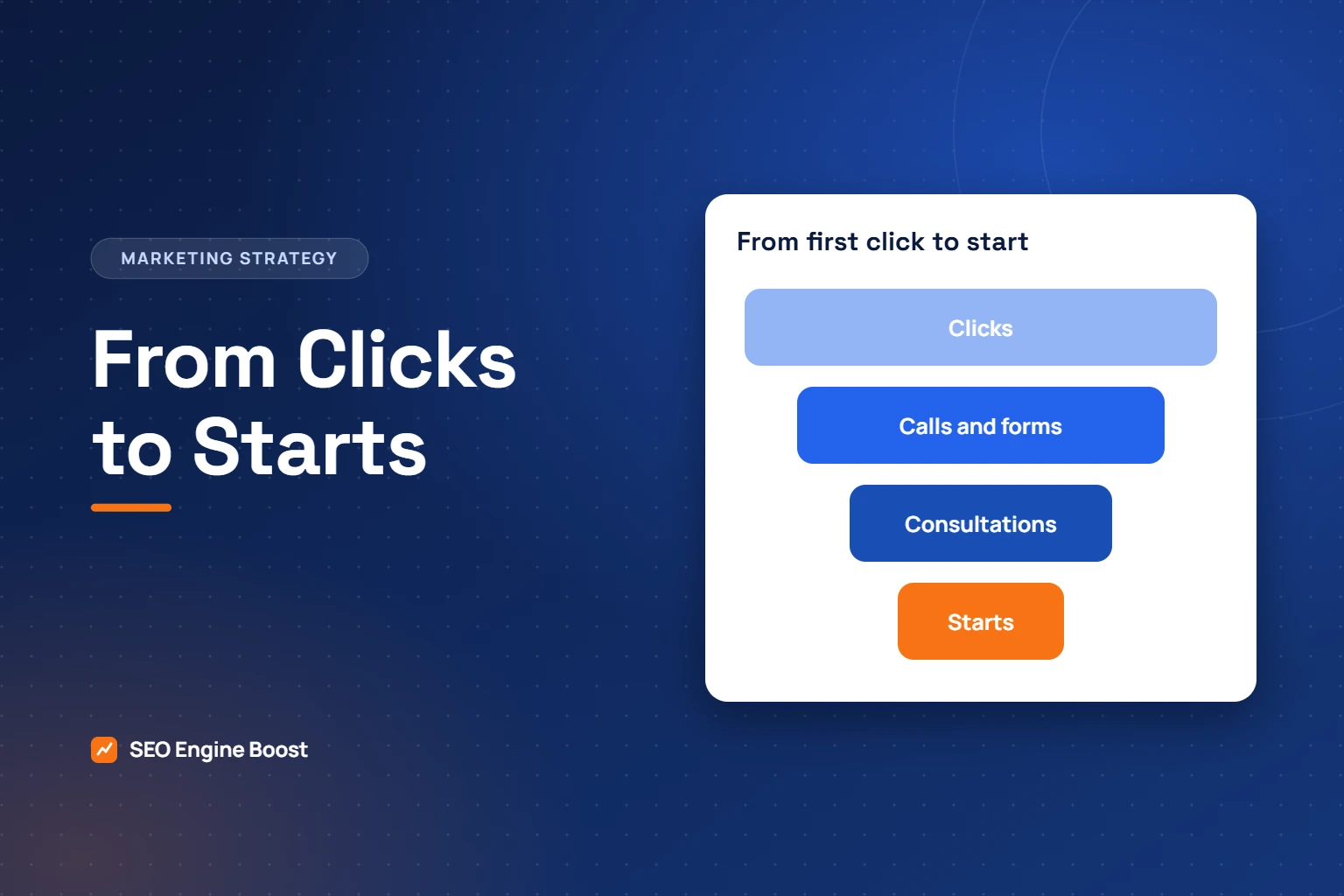
How to measure orthodontic marketing: the path
- Visibility: how often you appear in search and on the map.
- Visits: people who reach your website or profile.
- Inquiries: calls, consultation forms and messages.
- Consultations: inquiries that become a booked and attended visit.
- Starts: consultations that begin treatment.
Agencies usually report steps one to three. Steps four and five live in your practice management system. The value comes from joining them.
What to track at each step
| Step | Number | Where it comes from |
|---|---|---|
| Visibility | Map views and search appearances | Google Business Profile and Search Console |
| Visits | Website sessions by channel | Analytics |
| Inquiries | Calls and forms by source | Call tracking and form records |
| Consultations | Booked and attended | Front desk or practice software |
| Starts | Treatment started | Practice software |
The one field that makes it work
Add a “source” field to every new patient record and fill it in at the first contact: Google search, Google Maps, an ad, a dentist referral, a friend, a school event. Ask the question the same way every time.
Patients do not always remember accurately, so compare their answers with your call and form tracking. Where the two agree, you can be confident.
Three ratios worth watching
- Inquiry to consultation. If this is low, the problem is usually follow-up, not marketing. See consultation request follow-up.
- Consultation to start. This reflects the consultation itself, fees and financing.
- Cost per start by channel. Channel spend divided by starts attributed to it.
Want reporting that leads with inquiries?
See how we plan, measure and report the work, or start with a free growth audit.
A one-page monthly report
| Channel | Spend | Inquiries | Consultations | Starts | Cost per start |
|---|---|---|---|---|---|
| Google Business Profile | |||||
| Organic search | |||||
| Google Ads | |||||
| Dentist referrals | |||||
| Other |
Fill it in on the same day each month. After three months you will have a clearer picture than most dashboards provide.
Things that distort the picture
- Long decision times. A start this month may come from an inquiry three months ago. Compare over quarters.
- Several touchpoints. A parent may see an ad, read reviews and then search your name. Credit is rarely clean.
- Rankings checked from your own office. Local results depend on where the searcher is.
- Privacy limits. Do not send patient details to advertising platforms to improve attribution. See tracking pixels and patient privacy.
What good reporting from an agency looks like
It leads with inquiries by channel, explains what changed and why, says plainly when something did not work, and asks for your consultation and start numbers so the picture can be completed. Our own approach is described in our process.
Agree the definitions first
Before anyone can measure orthodontic marketing, the team has to mean the same thing by the same words. Write the definitions down and keep them where the front desk can see them.
| Term | Definition to agree | Common confusion |
|---|---|---|
| Inquiry | A new person who calls, submits a form or sends a message about starting treatment | Counting existing patients, suppliers and spam |
| Consultation booked | An inquiry that results in a scheduled first visit | Counting requests that never chose a time |
| Consultation attended | A booked consultation where the patient arrived | Ignoring no-shows |
| Start | A patient who begins treatment | Counting signed contracts that later cancel |
| Source | The first way the patient says they found you, checked against tracking | Recording the last thing they clicked |
| Cost per start | Spend on a channel divided by the starts attributed to it | Leaving out agency fees |
Small differences in definition produce large differences in the numbers. Two practices that both report “forty inquiries” may be describing very different months.
Setting up the source field
The source field is one question, asked the same way every time, with a fixed list of answers.
The question: “How did you first hear about us?”
The answers to offer:
- Google search
- Google Maps
- An online ad
- A dentist referred us
- A friend or family member
- A school or community event
- Social media
- Drove past the office
- An AI assistant
- Other, with a note
Use a fixed list, not a free-text box. Free text produces thirty spellings of the same answer and cannot be counted. If a patient gives two answers, record the first one they mention and note the second. Ask at the first phone call or at the consultation, whichever comes first, and never leave the field blank. “Not asked” is a result worth seeing, because it shows where the habit is breaking down.
The tools, and what each one tells you
None of this needs expensive software. Most practices already have access to everything in the table.
| Tool | What it shows | Its limit |
|---|---|---|
| Google Business Profile performance | Searches, views, calls, direction requests and website clicks from the profile | Interest, not patients |
| Google Search Console | Clicks, impressions and average position for your website in search | Website only, not the map |
| Website analytics | Visits by channel and which pages people read | Says nothing about phone calls unless connected to call tracking |
| Call tracking | Which source produced a call | Needs a vendor that handles call data appropriately |
| Form records | Each consultation request and when it arrived | Only as good as the form |
| Practice management software | Consultations, starts and the source field | Only as good as the front desk’s entries |
Search Console defines impressions as how many times your site appeared in search results, and clicks as the number of times someone clicked through. They are useful for seeing whether visibility is growing. They are the beginning of the chain, not the end.
A worked example
The figures are invented to show the arithmetic.
In one quarter a practice records 120 inquiries. Of those, 72 book a consultation, 60 attend and 30 start treatment.
- Inquiry to booked consultation: 72 divided by 120, or 60 percent.
- Booked to attended: 60 divided by 72, or 83 percent.
- Attended to start: 30 divided by 60, or 50 percent.
By source, the 30 starts came from dentist referrals (11), Google Maps (8), Google search (5), friends and family (4) and ads (2). The practice spent $3,000 on ads in the quarter, including the management fee, so the cost per start from ads was $1,500. It spent $3,600 on SEO, and Maps and search together produced 13 starts, or about $277 each.
Two conclusions follow. The first is that ads are expensive in this example and need a closer look before more money goes into them. The second is easy to miss: 48 inquiries never booked at all. Improving that one ratio would add more consultations than any new campaign.
How to read the numbers without fooling yourself
A single practice produces small numbers, and small numbers jump around. Four starts one month and seven the next is not a trend. Before you draw a conclusion, add three months together and compare them with the three months before.
Then look for the step where the largest share of people drops out. That step, not the top of the path, is usually where the next hour of effort should go. The table below lists common patterns and where to look first.
| What the report shows | Where the problem usually sits | First thing to check |
|---|---|---|
| Plenty of visits, few inquiries | The website | Whether a parent on a phone can find the number and the form within seconds |
| Plenty of inquiries, few booked consultations | Follow-up | How long a new request waits for a reply, and what happens after a missed call |
| Consultations booked, many not attended | Scheduling | The wait between booking and the visit, and whether reminders go out |
| Consultations held, few starts | The consultation itself | Fees, financing options and how the treatment plan is explained |
| Healthy starts, almost all from one source | Concentration | What would happen if that one source slowed down |
Only the first row is a marketing problem in the narrow sense. The others are practice operations that marketing cannot fix, which is exactly why it helps to measure orthodontic marketing along the whole path and not only at the top. If the second row looks familiar, read consultation request follow-up before spending more on visibility.
Measure orthodontic marketing without tracking patients
Nothing in this method needs patient details to leave your practice. You are counting totals: how many inquiries came from each source, how many became consultations, how many became starts. Names, treatment details and contact information stay in your practice management system.
That matters because the tools that promise automatic attribution often work by sending information about individual visitors to advertising platforms. For a healthcare provider, that raises privacy questions that deserve a deliberate decision, not a default setting. We cover the background in tracking pixels and patient privacy. This is general information, not legal advice, so involve your compliance contact before adding any tracking tool.
A practical rule: if a report can be built from counts alone, build it from counts alone.
A 30-minute quarterly review
Once the monthly page exists, a short review each quarter turns it into decisions. Keep the same agenda every time.
- Compare the last three months with the three before, line by line.
- Find the step with the largest drop and agree on one likely cause.
- Check how many new patient records have an empty or unknown source. If it is more than a few, fix that first.
- Where you know the spend, calculate cost per start for each source.
- Choose one change to make, and write down what you expect to see if it works.
- Decide what to stop. A channel that has produced no inquiries for two quarters needs a reason to continue.
Changing one thing at a time is slower, and it is the only way to know what caused a result. The same review is a good moment to revisit your orthodontic marketing budget.
Mistakes that make the numbers useless
- Counting form submissions as patients. A form is an inquiry. It becomes a result only when someone attends a consultation.
- Adding up what each platform claims. Every advertising platform reports the conversions it believes it influenced, so the platforms together can claim more inquiries than you actually received. Your own count of calls and forms is the reference.
- Leaving the source field optional. An optional field gets skipped on busy days, and busy days are the ones you most want to understand.
- Changing the question. If the front desk asks how did you hear about us one month and what made you call the next, the answers stop being comparable.
- Reporting rankings in place of inquiries. A ranking is a means. A practice can rank well for a phrase nobody uses.
- Reviewing only when something feels wrong. The months that feel fine are the baseline you will need later.
- Reading one month in isolation. Many practices see seasonal swings around the school year, so compare with the same period a year earlier once you have the history.
Who owns the data
The practice should. Your analytics property, your Search Console property, your Google Business Profile and any call records should sit in accounts the practice controls, with an agency added as a user. If the relationship ends, the history stays with you, and history is what makes next year’s comparison possible.
This is the same principle we describe in own your practice website, and it is one of the points worth raising when you choose an orthodontic marketing agency.
Want a clearer picture of where inquiries are lost?
A free growth audit reviews your visibility, website, reviews and content, with the findings in writing.
Frequently asked questions
How long before I can measure orthodontic marketing reliably?
Allow at least three months of consistent recording before you trust a pattern, and longer for starts, because families often take weeks or months to decide. The first month mostly teaches you whether the source field is being filled in.
What is a good cost per start?
There is no single figure that fits every practice, and we would be cautious about any source that offers one without context. What you can afford depends on your fees, your capacity and how full your schedule already is. The useful comparison is between your own channels, and between this quarter and the last.
Do I need paid software to do this?
No. Google Search Console and the performance section of Google Business Profile are free, and the monthly page can live in a spreadsheet. Paid tools can save time later. They do not replace the habit of recording the source at first contact.
How should we track phone calls?
The simplest method is to ask every new caller how they found you and record the answer in the same field as form inquiries. Dedicated call tracking numbers exist, but they add cost, setup and privacy considerations, so treat them as a deliberate choice and not a starting point.
What if patients name more than one source?
Record the first one they mention and keep the rule the same for everyone. No method assigns credit perfectly. A consistent rule that is slightly wrong is more useful than a clever one applied unevenly.
Can an agency do all of this for us?
An agency can prepare the visibility, visit and inquiry numbers. It cannot see consultations or starts unless you share the totals. When you share them, the report can show which work leads to patients. Our reporting approach is set out in our process, and a free growth audit is a simple way to see what your current numbers can and cannot tell you.
Who in the practice should own the report?
One named person, usually the office manager or treatment coordinator, with a fixed day each month to complete it. A report that belongs to everyone tends to be finished by no one, and a gap of two months is enough to break the comparison.
Keep reading
See where your practice stands
If you would like a second pair of eyes on your own practice, we offer a free growth audit: a manual review of your local visibility, website, reviews and content, with a prioritized list of what to fix first.