
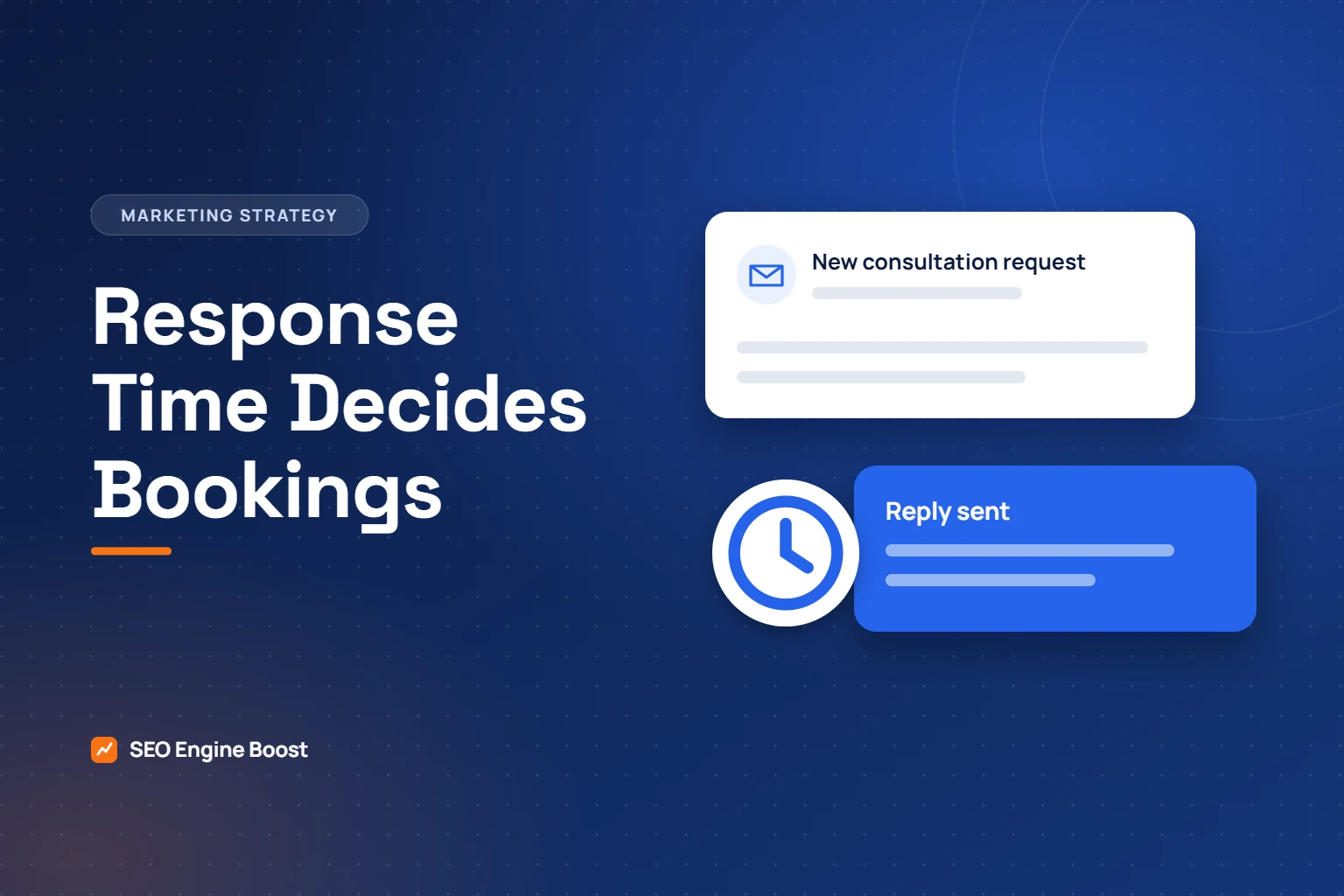
Consultation Request Follow-Up: Why Response Time Decides Bookings
Consultation request follow-up begins with a parent saying “I am ready to talk.” The longer that goes unanswered, the more likely they are to have booked elsewhere. Marketing can produce the inquiry, but only the practice can convert it, and response time is the part of that conversion most practices never measure.
Key takeaways
- Marketing produces the inquiry. Only the practice can convert it, and response time is rarely measured.
- For two weeks, record when each inquiry arrived, when someone replied and what happened.
- Name one owner, use one inbox, acknowledge at once and make three attempts.
In this article
- What the research says
- Why orthodontic inquiries are easy to lose
- Measure it first
- A consultation request follow-up routine that works
- What to say
- Make booking possible without a call
- Connect it to your marketing
- Map every way an inquiry can arrive
- Words you can adapt
- One inquiry, two outcomes
- Covering evenings and weekends
- Closing the loop on inquiries you cannot reach
- A weekly 15-minute check
- Write the routine down
- Mistakes that undo good follow-up
- Frequently asked questions
What the research says
Research published in Harvard Business Review on how companies handle online leads concluded that most “are not responding nearly fast enough.” The study covered businesses in general rather than orthodontic practices, so its exact figures should not be assumed to apply. The principle does: interest fades quickly, and a parent comparing practices tends to book with whichever one makes it easy first.
Why orthodontic inquiries are easy to lose
- Many arrive in the evening or at weekends, when parents have time to research and the office is closed.
- Parents often contact two or three practices at once.
- The front desk is busiest exactly when calls come in.
- Web forms land in an inbox nobody is assigned to watch.
Measure it first
For two weeks, record every new inquiry in a simple sheet:
| Column | What to record |
|---|---|
| Received | Date and time the call, form or message arrived |
| Channel | Phone, website form, profile message, email |
| First response | Date and time someone replied |
| Outcome | Booked, not reached, declined |
Then work out the typical gap between “received” and “first response”, separately for office hours and outside them. The out-of-hours gap is often longer than the team assumed.
A consultation request follow-up routine that works
- One owner. Name the person responsible for new inquiries each day, and a backup.
- One inbox. Route forms, profile messages and voicemail notifications to the same place.
- An immediate acknowledgment. An automatic reply that says when the office will call, and offers a number, sets expectations at once.
- A first-hour target in office hours. Treat a new inquiry like a patient standing at the desk.
- First thing next morning for overnight inquiries. Before the day’s appointments start.
- Three attempts. Call, then text or email, then call again over two or three days before closing the inquiry.
Are inquiries rising while consultations stay flat?
A free growth audit looks at the consultation path on your website as well as your visibility.
What to say
Keep the first call short and helpful: confirm who the treatment is for, offer two consultation times, explain what the first visit includes and whether there is a fee. Do not ask for clinical details over voicemail or email.
Make booking possible without a call
Some parents prefer not to phone. An online request with preferred days and times, answered by a confirmation, removes a step. If you use an online scheduling tool, check how it handles patient information.
Connect it to your marketing
If inquiries are rising but consultations are not, the answer is rarely more advertising. Compare inquiry-to-consultation rates before increasing a budget. We explain how to set that up in measuring orthodontic marketing.
Follow-up guidance is part of how we plan orthodontic marketing for the practices we work with.
Map every way an inquiry can arrive
A consultation request follow-up routine only works if it covers every door a parent can knock on. Before changing anything, list the channels and write down where each one lands today. Most gaps show up in this exercise without any software.
| Channel | Where it usually lands | The common gap |
|---|---|---|
| Phone call in office hours | Front desk | Calls that ring out while the desk is with a patient |
| Missed call or voicemail | Voicemail box | Nobody is assigned to clear it, or it is cleared at the end of the day |
| Website consultation form | An email inbox | The address belongs to someone who left, or it is checked once a day |
| Call button on your Google Business Profile | Main phone line | Same as any missed call, with no record of where it came from |
| Email to a general address | Shared inbox | New inquiries sit between supplier emails and invoices |
| Messages on social profiles | Whoever set up the page | No notification reaches the front desk at all |
Test each one yourself. Submit your own form from a phone on a Sunday evening. Call the office at lunchtime. Note what happens and when the first reply arrives. This takes less than an hour and often explains more than a month of reports.
A form can stop delivering without anyone noticing. Website updates, a changed email address or a spam filter can break delivery without any visible error. Send a test submission every month, and after every website change. We list related problems in orthodontic website mistakes.
Words you can adapt
The wording matters less than having it ready. These examples are deliberately plain. Adjust them to your practice, and keep clinical details out of every written message.
Automatic reply to a website form
Thank you for contacting [practice name]. We have received your request and a member of our team will call you by [time] on the next working day. If you would like to speak with us sooner, call [phone number] during office hours, [hours]. Please do not send medical details by email.
Voicemail greeting for new patients
You have reached [practice name]. If you are calling about a first visit, leave your name and number and we will return your call by [time] on the next working day. You can also request a consultation at any time on our website.
First call back
- Confirm who the consultation is for and the best number to reach the family.
- Offer two specific times, not an open question about availability.
- Explain in one sentence what the first visit includes, how long it takes and whether there is a fee.
- Say what to bring and where to park.
- Confirm how the family would like to receive the reminder.
Follow-up after an unanswered call
Hello, this is [name] from [practice name]. We tried to reach you about your consultation request. We have openings on [day] and [day]. Reply to this message or call [phone number] and we will hold a time for you.
Before sending text messages, make sure your form asks for permission to text and that your process meets the rules that apply to your practice. That is a question for your compliance contact, not for a marketing article.
One inquiry, two outcomes
The example below is invented to illustrate the routine. It does not describe a real practice or real results.
A parent submits a consultation form at 8:40 on a Tuesday evening, after reading about braces for a twelve-year-old. She sends the same request to two other practices in town.
| Time | Practice without a routine | Practice with a routine |
|---|---|---|
| Tuesday 8:40 pm | Form goes to an inbox checked each afternoon | Automatic reply confirms a call by 9:30 the next morning |
| Wednesday 8:15 am | Nothing yet | The named owner calls before the first appointment and offers two times |
| Wednesday 2:00 pm | Form is read, a call is made, no answer, no message left | Consultation is booked and a confirmation is sent |
| Thursday | A second call is planned and forgotten | Reminder is scheduled |
| The following week | The inquiry is still open with no outcome | The family attends the consultation |
Both practices paid the same to earn that inquiry. Neither one did anything unusual. The difference is that one had decided in advance who calls, when, and what happens after a missed call.
Covering evenings and weekends
You do not need a staffed phone line at nine at night. You need the parent to know what happens next. There are four common ways to cover the hours the office is closed, and they can be combined.
| Option | What it does | What to watch |
|---|---|---|
| Automatic reply with a promised call time | Sets an expectation at once | Only helps if the promise is kept every time |
| A protected call block each morning | Clears overnight inquiries before the day starts | Needs a backup for holidays and sick days |
| Online consultation request with preferred times | Lets the family finish the step without a call | Someone still has to confirm the time quickly |
| An answering service | A person answers out of hours | Cost, training, and how patient information is handled |
Start with the first two. They cost nothing beyond a decision, and they remove the longest waits. Add the others only if the numbers show that overnight inquiries are still slipping away.
If you add any third-party tool to your site, such as a chat widget or a scheduling service, find out what visitor information it collects and where it sends it. We explain why in tracking pixels and patient privacy.
Closing the loop on inquiries you cannot reach
Every inquiry should end with an outcome: booked, declined, or not reached after three attempts. An open inquiry with no outcome is where follow-up quietly fails, because nobody is sure whether someone else has already called.
- Keep one list, in one place, with a status column that is never left blank.
- Review open inquiries at the same time each day. Five minutes is enough.
- When an inquiry is closed as not reached, send one short message that leaves the door open and then stop. Repeated messages to someone who has not replied do more harm than good.
- Record the reason for a decline when a family offers one. Over a few months those reasons become useful feedback on fees, hours or location.
A weekly 15-minute check
- Count new inquiries for the week, by channel.
- Count how many were answered within your target.
- Read the list of inquiries not reached and look for a pattern in day or time.
- Send a test form and make a test call.
- Agree on one small change for the coming week.
Add the weekly totals to the monthly page described in measuring orthodontic marketing, so that response time sits beside inquiries, consultations and starts.
Write the routine down
Put the whole consultation request follow-up routine on one page: who owns new inquiries each day, where they arrive, the response targets, the three attempts and the wording above. Keep it at the front desk and review it when staff change. A routine that lives in one person’s head leaves with that person, and a new team member should be able to follow the page on the first day without asking anyone how inquiries are handled.
Mistakes that undo good follow-up
- Leaving no message. A missed call from an unknown number is ignored. Say who you are and why you are calling.
- Asking open questions. When would you like to come in creates work for the parent. Two specific times get a decision.
- Treating the form as less urgent than the phone. A parent who filled in a form has shown the same intent as one who called.
- Relying on one person with no backup. Follow-up stops the week that person is away.
- Sending long first messages. A first reply needs a name, a next step and a number. Everything else can wait for the call.
- Asking for clinical information in writing. Keep email and text to scheduling.
- Buying more advertising before fixing the delay. More inquiries entering a slow process produce more unanswered inquiries.
That last point is the one with the largest cost. If you run paid campaigns, read Google Ads for orthodontists alongside this article, because the two problems feed each other.
Want an outside view of your consultation path?
A free growth audit is a manual review of your visibility, website, reviews and content, with the findings in writing.
Frequently asked questions
How fast should a consultation request follow-up be?
There is no official standard for orthodontic practices, and we would not invent one. A practical target is within the first hour during office hours and before the first appointment of the next working day for anything that arrives overnight. What matters most is that the target is written down, measured and met consistently.
Is an automatic reply enough on its own?
No. It buys time and sets an expectation. A person still has to call when the reply said they would. An automatic reply followed by silence is worse than no reply, because it makes a promise the practice then breaks.
Should we follow up by phone, text or email?
Use the channel the family chose first, then one other. A common sequence is a call, a short written message the same day, and a second call a day or two later. Ask about the preferred contact method on your form so you do not have to guess.
How many times should we try?
Three attempts over two or three days is a reasonable limit for most practices. After that, close the inquiry with one polite message. Persistence beyond that point rarely changes the outcome and can leave a poor impression.
Would a chatbot solve this?
It can answer simple questions out of hours, and it also adds a tool that collects visitor information, needs supervision and can give wrong answers. Fix ownership, the shared inbox and the morning call block first. Those changes are free, and they tell you whether you still have a problem worth buying software for.
How do we know follow-up is the problem and not marketing?
Compare two numbers: inquiries received and consultations attended. If inquiries are steady or rising while consultations stay flat, the gap is after the inquiry. If inquiries themselves are low, the gap is earlier, in visibility or on the website. The method is set out step by step in measuring orthodontic marketing.
Who should own consultation request follow-up?
One named person each day, usually at the front desk or the treatment coordinator, with a named backup. Shared responsibility sounds safer and usually means each person assumes another has called.
Can an agency help with this?
An agency cannot answer your phone. It can test your forms, show where inquiries come from, and point out when inquiries and consultations are moving apart. That review is part of our process, and a free growth audit includes a look at the consultation path on your website.
Keep reading
Reviews and Compliance
How to Get More Google Reviews for Your Orthodontic Practice (Within the Rules)
See where your practice stands
If you would like a second pair of eyes on your own practice, we offer a free growth audit: a manual review of your local visibility, website, reviews and content, with a prioritized list of what to fix first.