Cosmetic Dentist Marketing: How to Attract Veneer, Whitening and Smile Makeover Patients
Short answer: cosmetic treatment is elective, so patients compare more, look harder at results and worry about price and the dentist’s skill. The practices that win give each treatment its own clear page with genuine consented photos, honest price ranges and financing, then reach the right local searchers through SEO, a strong Google Business Profile, reviews, and focused ads, and make the consultation easy to book.
By Dr. Mahmoud Elsheikh, a dentist completing an MSD in Orthodontics · Updated
How cosmetic patients choose a dentist
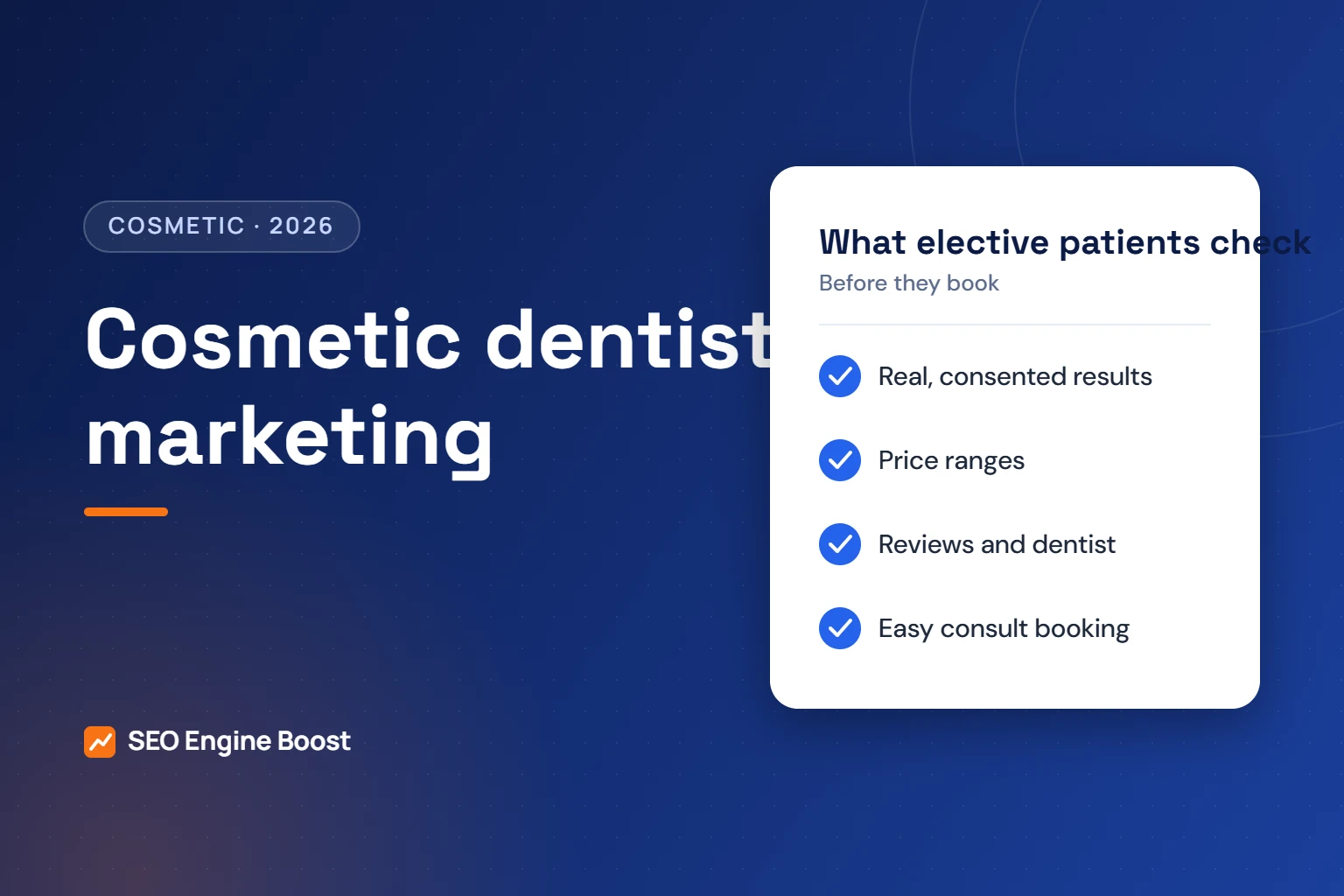
Most cosmetic patients do not need treatment; they want it. That changes the decision. They browse photos, compare prices, read reviews that mention the result and the experience, and look for a dentist they trust with their smile. Generic “we offer cosmetic dentistry” pages rarely convince them.
1. One page per cosmetic treatment
| Treatment | What the page must answer |
|---|---|
| Porcelain veneers | Who is a candidate, how many teeth, how long they last, price range per tooth, the process |
| Teeth whitening | In-office vs take-home, sensitivity, how long results last, price |
| Bonding | What it fixes, durability, price, when veneers are better |
| Smile makeover | How the plan is made, combined treatments, timeline, financing |
| Clear aligners | Who is a suitable case, who supervises treatment, retention, price range |
2. Show real results, properly
- Use only your own patients’ photos, with written consent.
- Keep lighting and angles consistent and avoid heavy editing.
- Add a short caption: treatment, number of teeth, time taken.
- Add the same photos to your Google Business Profile.
3. Rank for local cosmetic searches
Searches such as “veneers near me” and “cosmetic dentist [city]” are local. Link each treatment page from your homepage, add the cosmetic services to your Google Business Profile, and earn local mentions. See local SEO for dentists and dental SEO.
4. Reviews that mention the result
Ask every cosmetic patient for an honest review after the final visit. Never offer a discount or gift in return: the FTC’s rule on reviews and testimonials bans buying reviews. See how to get more Google reviews.
5. Ads and social, aimed at treatment pages
Run a separate Google Ads campaign for each high-value treatment and send each ad to its own page, not the homepage. Read Google Ads for dentists before you start. On Instagram and TikTok, short explainers and genuine consented results support search; they rarely replace it.
6. Make the consultation easy
Offer online booking or a short form on every treatment page, answer within one business hour, and send a clear written plan with price and financing after the consultation. Elective patients often need a second nudge.
7. Keep claims honest
Avoid “perfect smile guaranteed” or “painless” claims you cannot support, and follow your state dental board’s advertising rules. Describe credentials accurately; only use “specialist” where your state allows it.
What to measure
- Consultation requests per treatment page
- Consultation-to-treatment rate
- Average case value by source
- Reviews mentioning cosmetic treatment per month
Related: dental implant marketing · 20 dental marketing ideas · our dental marketing agency
Which cosmetic treatment to market first
Promoting every cosmetic service at once spreads budget and photos thin. Pick one treatment to lead with for the next quarter. The table shows when each one makes a sensible first focus and what must be in place before you promote it.
| Treatment | A good first focus when | Have this ready first | Watch out for |
|---|---|---|---|
| Teeth whitening | You want a lower-commitment entry treatment that brings in new cosmetic patients | Clear in-office and take-home options with prices | Competing on price alone |
| Bonding | You do bonding often and can show your own consented cases | Photos with captions and honest notes on durability | Implying bonding lasts as long as veneers |
| Porcelain veneers | You have a library of consented veneer cases and chair time for longer visits | A per-tooth range and a clear consultation process | Claims such as perfect smile guaranteed |
| Smile makeover | You can plan combined treatment and offer financing | A written plan template with price and timeline | A long decision time that needs patient follow-up |
| Clear aligners | You provide and supervise aligner treatment | Who is a suitable case, who supervises, retention and price | Brand names you are not entitled to use |
If two treatments look equally good, choose the one with the most consented photos of your own cases. Cosmetic patients judge results visually, and a page without real examples is hard to make convincing.
Revisit the choice each quarter. Once the first page books consultations steadily and your follow-up is consistent, move to the next treatment in the table and reuse the same page structure, photo standards and review routine. Keep each treatment on its own page and its own ad group, so you can see which one is paying back.
A 30-day plan for your lead cosmetic treatment
This plan is agency guidance. It assumes you picked one treatment from the table and want that page working before you spend on ads.
- Days 1 to 3: Record the baseline. Note consultation requests for that treatment over the last three months, the consultation-to-treatment rate and reviews that mention it.
- Days 3 to 7: Gather proof. Collect consented photos from your own cases with consistent lighting and angles, and check that every signed consent form is on file. Our guide to before-and-after photos covers consent in more detail.
- Week 2: Rebuild the treatment page. Answer the questions in the table in step 1, add a price range and financing, and put a short booking form near the top.
- Week 2: Update your Business Profile. Add the treatment as a service and upload the same consented photos.
- Week 3: Tighten consultation follow-up. Send a written plan with price and financing after each visit, and schedule one polite follow-up.
- Week 3: Ask for reviews. Contact patients who finished that treatment recently, with no discount or gift attached. Reply to each review without confirming treatment details; the review reply generator can help with wording.
- Week 4: Review claims. Read the page, ads and social posts for promises you cannot support and credentials described inaccurately.
- Day 30: Decide on ads. If the page converts visitors and calls are tracked, start a small campaign for that treatment alone. If not, fix the page first.
Want this done for your practice? We can put this into practice for you as part of our dental marketing services. Start with a free growth audit or see our published prices.
Frequently asked questions
How do cosmetic dentists get more patients?
Build a separate page for each cosmetic treatment with real consented photos, price ranges and financing, rank those pages locally, collect reviews from cosmetic patients, and make the consultation easy to book online.
Is Instagram worth it for a cosmetic dental practice?
It can help, because cosmetic patients look for visual proof. Post genuine consented results and short explainer videos, and link to treatment pages. Treat it as support for search, not a replacement.
Can I use before-and-after photos?
Yes, with the patient’s written consent, without heavy editing, and without implying every patient will get the same result. Check your state dental board’s advertising rules.
Should cosmetic dentists show prices?
A typical range per tooth or per treatment, what changes the price, and financing options help patients decide and reduce no-show consultations.
Can a dentist advertise as a cosmetic dentistry specialist?
Be careful. The ADA’s National Commission recognizes 12 dental specialties, and cosmetic dentistry is not one of them. Many states limit who may use the word specialist in advertising. Describing your training, experience and the treatments you provide is usually safer than claiming a specialty. Check your state dental board’s advertising rules before using any specialty wording.
Can we use patient testimonials about their results in ads?
Yes, with care. Under the FTC’s Endorsement Guides, if a testimonial implies typical results, you should have evidence that other patients generally achieve them, or clearly disclose the generally expected results. Get written HIPAA authorization before using a patient’s name, photo or story. Never pay or reward patients for testimonials or reviews.