
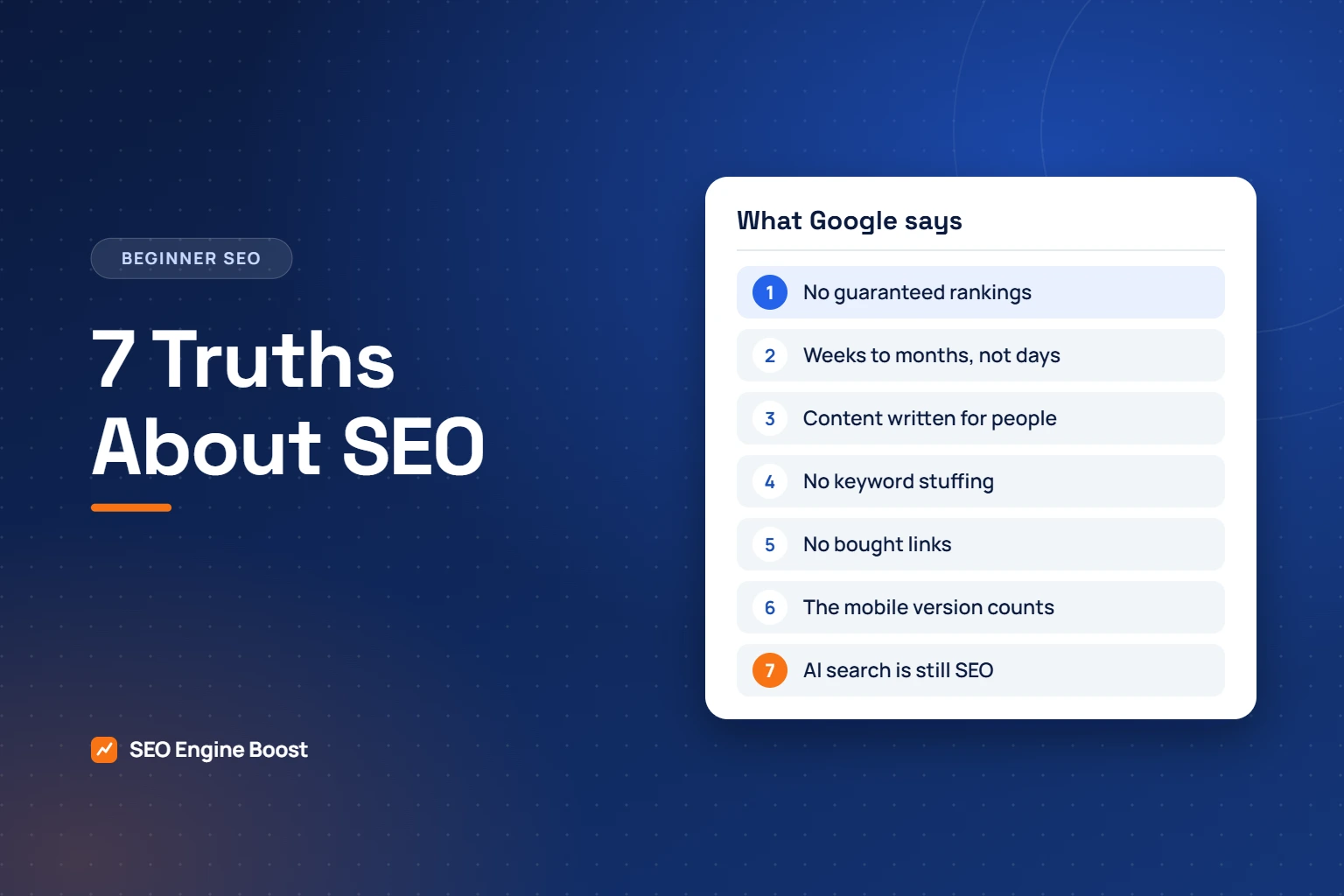
7 Truths About SEO You Need to Know Today
Most advice about SEO is opinion. These seven truths about SEO are not. Each one comes from Google’s own published documentation, and each changes what a practice or small business should expect from its website, its agency and its budget.
Key takeaways
- No one can guarantee a ranking, and paying Google does not buy one.
- Google’s systems prioritize helpful, reliable content created for people. Keyword stuffing and bought links break its spam policies.
- The mobile version of your site is the one Google indexes, and AI search runs on the same foundations.
In this article
- 1. No one can guarantee a ranking
- 2. Results take weeks to months
- 3. Google is trying to rank content written for people
- 4. Repeating keywords does not help
- 5. Bought links are a risk, not a shortcut
- 6. The phone version of your site is the one that counts
- 7. AI search is still SEO
- The seven truths about SEO at a glance
- Seven checks you can run this week
- Claims that should make you cautious
- What Google has not said
- A realistic sequence for the first six months
- How to tell whether your SEO is working
- Why this matters more for a healthcare practice
- Frequently asked questions
1. No one can guarantee a ranking
Google’s guidance on hiring an SEO says it plainly: “No one can guarantee a #1 ranking on Google.” The same page says Google never accepts money to include or rank sites in its search results, and that advertising with Google has no effect on where a site appears in them.
A guarantee in a proposal is a reason for caution, not confidence. We list the other questions worth asking in how to choose an orthodontic marketing agency.
2. Results take weeks to months
Google’s SEO Starter Guide says some changes take effect in a few hours and others could take several months. It suggests waiting a few weeks before judging whether a change helped.
Plan in quarters rather than days, and be wary of anyone who promises a result by a date. For how we sequence the work, see our process.
3. Google is trying to rank content written for people
Google states that its automated ranking systems are “designed to prioritize helpful, reliable information that’s created to benefit people”. It asks site owners to assess their own pages with questions such as “Is this content written or reviewed by an expert or enthusiast who demonstrably knows the topic well?”
Of the qualities Google groups as experience, expertise, authoritativeness and trust, it says “trust is most important”. For a healthcare practice, that points to accurate pages and clear information about who is behind them. See content marketing for orthodontists.
4. Repeating keywords does not help
Google Search does not use the keywords meta tag. Its starter guide says keywords in a domain name alone have hardly any effect on ranking, and its spam policies define keyword stuffing as “filling a web page with keywords or numbers in an attempt to manipulate rankings”.
Use the words your patients or customers use in the title and opening of the page, then answer their question properly.
Want these checked on your own site?
Request a free growth audit. We review your visibility, website, reviews and content by hand.
5. Bought links are a risk, not a shortcut
Google’s spam policies define link spam as “creating links to or from a site primarily for the purpose of manipulating search rankings”. The first example given is buying or selling links for ranking purposes. Sites that violate the policies “may rank lower in results or not appear in results at all.”
Links worth having are earned: local organizations you support, professional associations and useful content that others choose to cite. That is the basis of our off-page SEO work.
6. The phone version of your site is the one that counts
Google “uses the mobile version of a site’s content, crawled with the smartphone agent, for indexing and ranking.” Its advice is direct: make sure the mobile site contains the same content as the desktop site.
Speed is measured too. Google’s Core Web Vitals set three targets:
- Largest Contentful Paint of 2.5 seconds or less
- Interaction to Next Paint of 200 milliseconds or less
- Cumulative Layout Shift of 0.1 or less
Keep this in proportion. Google also says it “always seeks to show the most relevant content, even if the page experience is sub-par.” A fast page supports good content. It does not replace it. More in technical SEO and nine website mistakes that cost consultations.
7. AI search is still SEO
Google says that optimizing for its generative AI features “is optimizing for the search experience, and thus still SEO.” No special file or AI-specific markup is needed.
The businesses that appear in AI answers are, in the main, the ones that already do the basics well. We explain this in how AI search chooses which orthodontist to recommend.
The seven truths about SEO at a glance
| Truth | What to do about it |
|---|---|
| No one can guarantee a ranking | Treat any guaranteed ranking as a warning sign |
| Results take weeks to months | Judge progress by the quarter |
| Content is ranked for people | Publish accurate pages checked by someone who knows the subject |
| Repeating keywords does not help | Use your patients’ words naturally, then answer the question |
| Bought links are a risk | Earn links through local involvement and useful content |
| The phone version counts | Test your site on a phone and measure Core Web Vitals |
| AI search is still SEO | Get the foundations right before buying anything labeled AI |
Not sure where your practice stands? A free growth audit lists your top three fixes for Google, Maps and AI answers, in writing. Get a free growth audit · See our orthodontic SEO services
Seven checks you can run this week
Each of the seven truths about SEO leads to something you can check without special tools. None of these takes more than a few minutes.
- Read your current proposal or contract. If it promises a position or a number of rankings, ask the provider how that promise fits with Google’s statement that no one can guarantee one.
- Look at the date your SEO work began. If it is less than a quarter ago, it is too early to judge. If it is more than two quarters, ask to see inquiries, not positions.
- Open your three most important pages and ask who wrote them, who checked them and when. If nobody knows, that is the first thing to fix.
- Read your homepage aloud. If the name of your town or your main service is repeated in a way nobody would say in conversation, rewrite the sentence.
- Ask where your links have come from. A provider who built them should be able to name the websites and explain why each one would link to you.
- Open your site on a phone, on mobile data, away from the office. Find the phone number, the address and the consultation form. Count the seconds.
- Ask an AI assistant and Google the question a new patient would ask. Note which businesses are named and which websites are cited as sources.
Write down what you find. The list becomes the agenda for your next conversation with whoever handles your marketing.
Claims that should make you cautious
Most of the questionable promises in SEO contradict something Google has published. The table sets common claims beside the guidance that applies.
| The claim | What Google’s guidance says |
|---|---|
| We guarantee first place | No one can guarantee a first-place ranking |
| We have a special relationship with Google | Its guidance on hiring an SEO warns about providers who claim one |
| Advertising with Google improves your organic position | Advertising has no effect on where a site appears in organic results |
| You will see results in thirty days | Changes can take from a few hours to several months to show |
| We will build hundreds of links for you each month | Buying or selling links for ranking purposes is link spam |
| You need our special AI optimization file | No special file or AI-specific markup is needed for its AI features |
| More keywords on the page will fix it | Filling a page with keywords to manipulate rankings is keyword stuffing |
A provider who makes one of these claims is not necessarily dishonest. Some repeat what they were taught years ago. Either way, the claim tells you how closely they follow the source.
What Google has not said
Just as useful as the seven truths about SEO is knowing which popular rules have no official basis. We could not find Google guidance that supports any of the following.
- A required word count. Google has said there is no ideal page length for its systems. A page should be as long as the question needs.
- A required publishing schedule. Nothing in the guidance rewards posting on a fixed timetable for its own sake.
- A correct keyword percentage. The guidance describes writing naturally for readers and treats stuffing as spam. It gives no target figure.
- A score from a plugin or tool. SEO tools use their own checklists. They can be a helpful prompt, and they are not Google’s measurement of your page.
That last point deserves emphasis. A green score in a tool means the page meets that tool’s checklist. Whether the page helps a patient decide is a separate question, and it is the one Google says its systems are trying to answer.
A realistic sequence for the first six months
Because results take weeks to months, it helps to know what sensible work looks like along the way. This is a typical order, not a promise of outcomes. Every site starts from a different place.
| Period | What good work usually looks like | What you should be able to see |
|---|---|---|
| Month 1 | An audit, access to your own accounts, fixes to technical problems, an accurate Business Profile | A written list of findings and what was fixed |
| Months 2 to 3 | Core pages rewritten or created, checked for accuracy and linked to each other | New and improved pages you can read yourself |
| Months 4 to 6 | Supporting content, earned local links, a steady review process | Changes in impressions and clicks in Search Console, and a first read on inquiries |
If a provider cannot show you the work in the middle column, a ranking report tells you very little. The work is the part within anyone’s control. The ranking is Google’s decision.
For a practice, the same sequence in more detail is in our guide to SEO for orthodontists. What the work tends to cost is covered in orthodontic SEO cost.
How to tell whether your SEO is working
Use measures that connect to patients, in this order.
- Inquiries. Calls and consultation requests that came from search, counted by the practice itself.
- Clicks and impressions. Google Search Console shows how often your pages appeared and were clicked, and for which searches.
- Local actions. Your Business Profile reports calls, direction requests and website clicks.
- Positions. Useful as a diagnostic, misleading as a goal, and different for every searcher and location.
Search Console and the Business Profile reports are free and belong to you. Ask for access in your own name if you do not have it. The full method, from visibility through to treatment starts, is in measuring orthodontic marketing.
Why this matters more for a healthcare practice
The seven truths about SEO apply to any business. Three things raise the stakes for a dental or orthodontic practice.
- Health topics are held to a higher bar. Google says its systems give more weight to signs of experience, expertise, authoritativeness and trust for topics that could significantly affect a person’s health. Vague or inaccurate treatment content is a weakness in a way it might not be for a hobby site.
- Patient privacy limits the shortcuts. Tactics that are routine in other industries, such as detailed visitor tracking or replying to reviews with specifics, can create real problems for a provider. We cover the first in tracking pixels and patient privacy.
- Reputation is local and slow to repair. A practice draws from a small area, and a penalty or a misleading claim is noticed by the same families and referring dentists it depends on.
For those reasons, the cautious reading of each truth is usually the right one for a practice. Earn the visibility, state only what is accurate, and keep the accounts, the content and the data in the practice’s own name. Progress may feel slower at first. It is also much less likely to be undone by a policy change or a change of provider.
Not sure which of these applies to your site?
A free growth audit is a manual review of your visibility, website, reviews and content, with the findings in writing.
Want these principles applied to a practice? See our orthodontic SEO and dental SEO company services.
10 strategies that still grow organic traffic in 2026
This page replaces our older “10 proven strategies to boost SEO organic traffic” post. Here is the updated list, each linked to a deeper guide.
- One page per service or treatment. Match one search intent per page. See common orthodontic website mistakes.
- Answer cost questions honestly. Ranges and payment options keep comparison shoppers on your site. See prices and financing on your website.
- Win the map pack. A complete, active Google Business Profile with the right categories. See how to rank in Google Maps.
- Earn reviews steadily. Ask every satisfied patient, the same way, every time. See how to get more Google reviews.
- Fix speed on mobile. Meet Core Web Vitals on the phone version first. See the orthodontist website SEO checklist.
- Add structured data. Business, FAQ and article markup help search engines and AI read your pages.
- Write for people, then check with data. Use Search Console queries to see what people actually typed, and answer that.
- Earn links, never buy them. Local associations, community sponsorships and original data earn links that last. See white-hat link building.
- Link your own pages together. Guides to services, services to pricing, with descriptive anchors.
- Measure what matters. Track calls and forms, not just rankings. See how to measure marketing.
Frequently asked questions
How long does SEO take to work?
Google’s starter guide says some changes take effect within hours and others can take several months. In practice, plan to judge progress by the quarter, and be cautious about anyone who names a date.
Can I do SEO myself?
Yes, for the basics. Google publishes a free starter guide written for site owners. Accurate pages, a complete Business Profile and a site that works on a phone cover a great deal. The limit is usually time, not difficulty.
Is SEO a one-time job?
No. The foundation is built once, and then it has to be kept up: content reviewed, the profile kept current, new reviews answered, technical problems caught. Competitors and Google’s systems both keep changing.
Do reviews affect where a practice appears on the map?
Google’s help pages say that review count and review score are among the things that factor into local ranking, alongside relevance and distance. Reviews must be genuine and must not be rewarded. We cover both in how to rank on Google Maps and how to get more Google reviews.
Has AI search replaced SEO?
No. Google describes optimizing for its AI features as still SEO, and it says no special file or markup is required. The same clear, accurate, well-organized pages serve both.
Does paying for Google Ads help organic rankings?
No. Google says advertising has no effect on where a site appears in its organic results. Ads and SEO can support the same goal, and one does not buy the other.
What should I ask an SEO provider before signing?
Ask what they will do in the first ninety days, who owns the accounts and the content, how they report, and what happens if you leave. Our list of twelve questions is in how to choose an orthodontic marketing agency.
Where should I start?
With the seven checks above. If you would like a second opinion, a free growth audit reviews your visibility, website, reviews and content by hand, and our pricing is published so that you can compare before any conversation.
Sources
- Google Search Central: Do you need an SEO?
- Google Search Central: SEO Starter Guide
- Google Search Central: Creating helpful, reliable, people-first content
- Google Search Central: Spam policies
- Google Search Central: Mobile-first indexing best practices
- Google Search Central: Understanding page experience
- web.dev: Web Vitals
- Google Search Central: AI features and your website
Keep reading
See where your practice stands
If you would like a second pair of eyes on your own practice, we offer a free growth audit: a manual review of your local visibility, website, reviews and content, with a prioritized list of what to fix first.
