
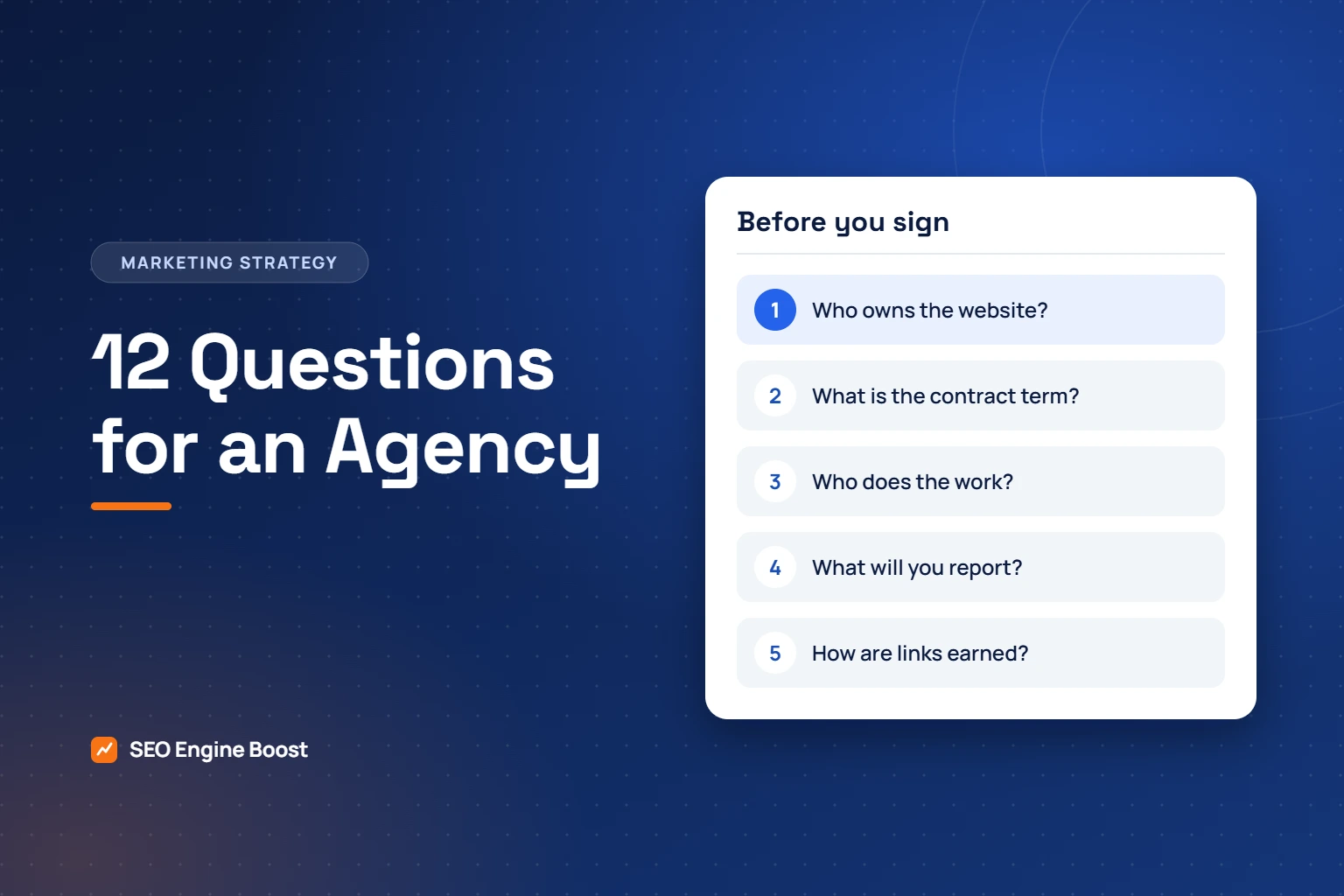
How to Choose an Orthodontic Marketing Agency: 12 Questions to Ask
Choosing an orthodontic marketing agency is less about finding the biggest name and more about finding one whose terms, methods and reporting you understand. These twelve questions bring out the differences quickly. We have written them so they can be used against us as easily as anyone else.
Key takeaways
- Confirm that you own the website, content, Business Profile, analytics and ad accounts.
- Ask for monthly deliverables in quantities, and for reporting that leads with inquiries.
- Guaranteed rankings, fixed backlink counts and client logos that cannot be verified are red flags.
In this article
- Ownership and terms
- Methods
- Results and reporting
- Working relationship
- Red flags
- A fair way to start with an orthodontic marketing agency
- The types of provider you will meet
- A simple way to run the selection
- What a good proposal contains
- A scorecard for comparing providers
- How to read a case study
- What the first ninety days should look like
- Being a client who gets good work
- When to end the relationship, and how to leave cleanly
- Frequently asked questions
- What to put in the brief
- An illustrative comparison
- How we answer these questions ourselves
Ownership and terms
1. Who owns the website, content and accounts?
A good answer: you do, including the domain, the Google Business Profile, analytics and any ad account. Ask what you keep if you cancel. More in do you own your practice website?
2. What is the minimum term?
Long contracts are not automatically bad, but ask what happens if the agreed work is not delivered.
3. What exactly is delivered each month?
Look for quantities: how many pages, how often the profile is updated, what the report contains.
Methods
4. How do you build links?
Google’s spam policies treat buying or selling links for ranking purposes as link spam. A good answer involves outreach, local relationships and content, with every link reported to you.
5. How do you handle reviews?
Listen for incentives or filtering. Google prohibits both, and the FTC’s rule on reviews allows civil penalties for knowing violations.
6. Who writes the content, and who checks it?
Orthodontic content needs to be clinically accurate. Ask to see a treatment page they have written and who reviewed it.
7. What do you do about tracking and patient privacy?
A good agency can explain which tools run on which pages and why. See tracking pixels and patient privacy.
Results and reporting
8. What do you report on?
The headline should be inquiries: calls, forms and direction requests. Rankings and traffic are supporting detail.
9. Do you guarantee results?
The honest answer is no. Google states there is no way to request or pay for a better local ranking.
10. Can I see evidence?
Ask for case studies with real numbers and, ideally, a client you can call. A newer agency may not have many. That is not disqualifying if they are open about it and the terms let you leave easily.
Put these questions to us
Book a strategy call and ask all twelve. Our terms and prices are published.
Working relationship
11. Who will I actually work with?
The person in the sales call is often not the person doing the work. Ask to meet whoever will manage your account.
12. Do you work with other orthodontists in my area?
Some agencies offer exclusivity by area. Others do not. Either can be fine, but you should know.
Red flags
- Guaranteed first-page rankings or patient numbers
- A fixed number of backlinks every month
- Reports that show only impressions and clicks
- Reluctance to give you account logins
- Client logos or statistics that cannot be verified
- Pressure to sign before you have seen the contract
A fair way to start with an orthodontic marketing agency
Ask for an audit before committing to a retainer. It shows how the agency thinks, and you keep the findings whatever you decide. Ours is described on the free growth audit page, and our terms are on the pricing page.
The types of provider you will meet
Before comparing names, decide which kind of orthodontic marketing agency suits the practice. Each type has real strengths and real limits.
| Type | Strengths | Limits |
|---|---|---|
| Large specialist agency | Deep experience in the field, a wide range of services, established processes | Higher fees, account managers between you and the people doing the work |
| Small specialist or consultant | Direct access to the person doing the work, flexible terms | Fewer hands, a shorter track record, less cover during holidays |
| Generalist agency | Broad marketing skills, often good local knowledge | May apply a general dental or small-business plan to an orthodontic practice |
| Freelancer | Good value for defined tasks | Depends on one person’s time and range |
| Software platform with bundled marketing | One bill, little to manage | You may be renting the website, and reporting can be automated |
No type is right for everyone. A multi-location group needs depth and capacity. A single-location practice often gets more from a small specialist who knows the account personally.
A simple way to run the selection
- Write a one-page brief. State what you want to grow, where your patients come from, what you spend now and what you count as success.
- Shortlist three providers. More than that becomes hard to compare fairly.
- Hold a first call. Ask who would do the work, and put some of the twelve questions above to them.
- Ask for a written proposal with quantities, terms and a sample report.
- Check evidence. Read case studies critically and, where possible, speak to a current client.
- Compare on the same scorecard, not on the quality of the presentation.
- Start with something small, such as an audit, before a long commitment.
The whole process can take three or four weeks. That is a reasonable investment for a relationship that may last years.
What a good proposal contains
A proposal tells you how a provider thinks. Look for these parts.
- A summary of your situation in their words, which shows whether they listened.
- The work they will do each month, with quantities.
- Who will do it, with names and roles.
- What they need from the practice, such as approvals, photographs and access.
- How results will be measured, with inquiries first.
- The fee, what it includes and what is charged separately.
- The term, the notice period and what you keep when it ends.
- What they will not promise.
Be cautious about a proposal that is mostly about the agency, that quotes large statistics with no source, or that is plainly a template with your name inserted.
A scorecard for comparing providers
Give each provider a mark from one to five on each row, and write down the reason. The reasons matter more than the total.
| Criterion | What good looks like |
|---|---|
| Ownership | The practice owns the website, content and every account |
| Clarity of deliverables | Quantities for each month, in writing |
| Orthodontic knowledge | Accurate treatment content, and a named person who checks it |
| Methods | No bought links, no review incentives, no doorway pages |
| Reporting | Calls, forms and direction requests before rankings |
| Access | You can speak to the person who does the work |
| Terms | A short minimum term and a clear way to leave |
| Evidence | Verifiable examples, or honesty about being new |
| Fit | They understood the brief and asked good questions |
If two providers score alike, choose the one whose answers were more specific.
How to read a case study
Case studies are useful when you know what to look for.
- Is the practice named? An anonymous “orthodontist in the Midwest” cannot be checked.
- What was measured? New patient starts and consultation requests mean more than traffic or impressions.
- Over what period? A large percentage rise from a very low starting point can describe a small change.
- What else changed? A new doctor, a second location or a large advertising budget may explain the result.
- Can you speak to the client? A provider confident in the work will arrange it.
Treat headline percentages with care. “Traffic up by a thousand percent” may mean ten visits became a hundred. Ask for the numbers behind the percentage.
What the first ninety days should look like
Once you have chosen, the first three months show whether you chose well.
| Period | What should happen |
|---|---|
| Weeks 1 to 2 | Access set up in the practice’s name, a kickoff call, a baseline of calls, forms and visibility |
| Weeks 3 to 4 | Audit findings delivered and priorities agreed in writing |
| Month 2 | The first fixes implemented and the first pages sent for your approval |
| Month 3 | The first full report, a review call and a plan for the next quarter |
You should never have to ask what was done. If the first report arrives late, or contains charts with no list of completed work, raise it immediately.
Being a client who gets good work
The relationship runs both ways. Agencies do their best work for clients who make it possible.
- Reply to approval requests within a few days. Content waiting for sign-off is the most common cause of delay.
- Name one contact in the practice, and give that person authority to decide.
- Share real numbers: consultations and starts by source, even if they are rough.
- Tell the agency about changes, such as a new doctor, new hours or a new treatment, before they happen.
- Ask questions when a report is unclear, and expect plain answers.
When to end the relationship, and how to leave cleanly
Give a provider a fair chance, which means at least two full quarters of agreed work. Then consider leaving if you see these signs.
- Work that was promised is repeatedly not delivered.
- Reports show activity and impressions, never inquiries.
- You cannot reach the person who does the work.
- Questions about methods get vague answers.
- You discover that accounts or the domain are not in the practice’s name.
If you decide to leave, do it in order.
- Read the notice period and give notice in writing.
- Confirm that the domain, website, Business Profile, analytics and any ad account are in the practice’s own accounts.
- Ask for a handover pack: logins, backups, a list of page addresses and original image files.
- Remove the provider’s access after the handover is complete.
- Give the new provider the same brief and the previous reports.
Ownership is what makes leaving simple. It is covered in do you own your practice website?
Want to see how we answer these questions?
Our process, plans and prices are published. A free growth audit comes first, with no obligation.
Frequently asked questions
Do we need a specialist orthodontic marketing agency, or will a general one do?
A general agency can do good work if it understands how orthodontic decisions are made and has someone who can check clinical content. Ask to see an orthodontic treatment page it has written. The differences are set out in dental SEO vs. orthodontic SEO.
How many agencies should we speak to?
Three is enough to compare without losing track.
Is a long contract a bad sign?
Not by itself. Ask what happens if the agreed work is not delivered, and what the notice period is. Month-to-month terms put the pressure where it belongs, on the provider.
What should it cost?
Prices vary with scope and market. We look at what moves them in how much orthodontic SEO costs.
Should we choose the agency with the most clients?
Size shows that an agency can win business. It does not tell you who will work on your account or how much attention it will get.
What if an agency is new and has few case studies?
Being new is not disqualifying if the provider is open about it, the terms let you leave easily and the first piece of work, such as an audit, is good.
Can we hire one agency for SEO and another for advertising?
Yes, as long as each knows what the other is doing and both work in accounts the practice owns. Name one person in the practice to coordinate them.
What is the best first step?
Ask for an audit. You see how the provider thinks, and you keep the findings whatever you decide.
What to put in the brief
A written brief makes every conversation shorter and every proposal easier to compare. One page is enough.
| Section | What to write |
|---|---|
| The practice | Locations, doctors, years open and the treatments you offer |
| Patients | Who decides, the ages you treat and the areas they travel from |
| What you want | The treatments or locations you most want to grow, and how many more starts you can take |
| What you have | The current website, who owns it, your Business Profile, review count and any advertising |
| What you spend | A rough monthly figure and what it buys now |
| How you measure | Whether you record consultations and starts by source |
| Limits | What you will not do, such as discounts, or claims you are not willing to make |
| Decision | Who decides, and by when |
Send the same brief to each provider on your shortlist. The differences in what comes back will tell you a great deal.
An illustrative comparison
The example is invented to show how the scorecard changes a decision.
A practice receives two proposals. The first comes from a well-known firm, with a polished presentation, a long list of services and a twelve-month term. It does not say how many pages will be written each month, the website would sit on the firm’s own platform, and the sample report leads with impressions.
The second comes from a smaller provider. It is four pages long. It lists the work for each of the first three months, names the person who will do it, states that the practice owns the website and every account, offers month-to-month terms and shows a report that begins with calls and forms. It has fewer case studies and says so.
On presentation the first wins easily. On the scorecard the second scores higher on ownership, clarity, access, terms and reporting, and lower on evidence. The practice decides to begin with an audit from the second provider and to judge the work before committing further. Whatever it chooses in the end, it is choosing on substance.
How we answer these questions ourselves
It would be unfair to publish twelve questions and not answer them.
- Ownership: the practice owns the website, content, profiles and logins.
- Term: plans run month to month, with no setup fee.
- Deliverables: each plan lists what is included, on our pricing page.
- Links and reviews: no bought links and no review incentives.
- Content: treatment pages are clinically reviewed before they reach you, and you approve every clinical statement.
- Reporting: inquiries first, with rankings as supporting detail.
- Guarantees: none. Nobody controls Google or AI answers.
- Evidence: we are a small, founder-led consultancy. We do not publish case studies we cannot verify, so you will not find a wall of logos here.
- Who you work with: the consultant doing the work.
If those answers suit you, the free growth audit is the place to start. If you prefer a large orthodontic marketing agency with a big team, that is a reasonable choice too, and the questions above will help you pick a good one.
Keep reading

See where your practice stands
If you would like a second pair of eyes on your own practice, we offer a free growth audit: a manual review of your local visibility, website, reviews and content, with a prioritized list of what to fix first.