
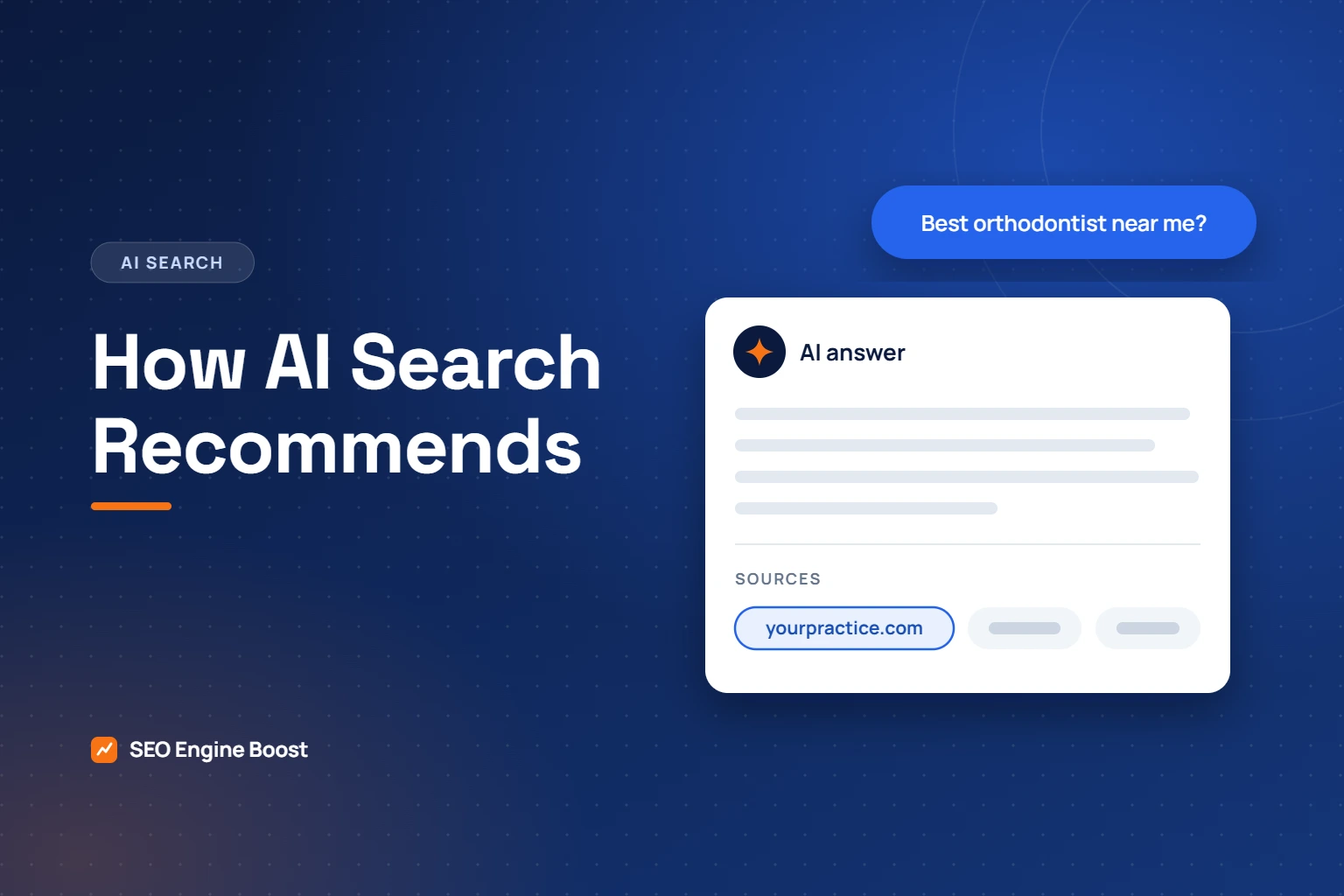
How AI Search Chooses Which Orthodontist to Recommend
When a parent uses AI search to ask which orthodontist to see, the answer is assembled from sources the system can read and trusts. Google has been direct about its own products: optimizing for its generative AI features “is optimizing for the search experience, and thus still SEO.” There is no secret file or special markup. The practices that appear are, in the main, the ones that already do the basics well.
Key takeaways
- Google says optimizing for its AI features is still SEO. No special files, schema or content chopping is needed.
- Consistent practice details, direct answers and earned local mentions make a practice easy to cite.
- Nobody can sell placement in AI answers. Track a fixed set of parent questions each month instead.
In this article
- What Google has said about AI search
- What this means for an orthodontic practice
- What to ignore
- How to track it
- How much attention does this deserve?
- Where AI search shows up for a parent
- Make your facts consistent everywhere
- The questions parents ask, and the page that should answer each
- How to write an answer that can be quoted
- A monthly test you can run yourself
- When AI search gets your practice wrong
- Claims to treat with caution
- What stays the same
- Frequently asked questions
- A short plan for the next ninety days
- Who should own this in the practice
What Google has said about AI search
- It is still SEO. Foundational practices remain the basis for visibility in AI features.
- No AI-specific files are needed. Files such as llms.txt will not hurt or help in Google Search, because Google Search does not use them.
- No need to chop content into fragments. Google’s systems can understand multiple topics on one page, and there is no ideal page length.
- No special schema. Structured data is still recommended as part of normal SEO, but there is no markup specific to AI.
- Manufactured mentions are not the shortcut they seem. Google says seeking inauthentic mentions is not as helpful as it might appear.
Other assistants, such as ChatGPT and Perplexity, publish less about how they select sources, so claims about exactly what they reward should be treated with caution.
What this means for an orthodontic practice
Be consistent about who you are
Your practice name, doctors, address, hours and treatments should read the same on your website, your Google Business Profile and every directory. Conflicting details make any system less confident.
Answer real questions directly
Parents ask full questions: “What age should my child first see an orthodontist?” A page that opens with a direct, accurate answer and then explains it is easy to quote. The American Association of Orthodontists recommends a first check-up by age 7; a page that says so plainly, and explains why, is useful to a parent and to a machine.
Be mentioned in the right places
Local news, school and community sites, professional associations and genuine reviews all describe your practice from the outside. These cannot be bought safely. They are earned by being involved.
Keep the website technically sound
If a page cannot be crawled or loads poorly, it cannot be used as a source.
What to ignore
- Products that promise placement in AI answers
- “AI visibility scores” that claim access to Google’s systems. Google warns that no third-party tool has access to its internal ranking or AI systems.
- Advice to rewrite every page into short question-and-answer fragments
How do AI assistants describe your practice today?
The free growth audit checks AI search readiness alongside your local visibility and website.
How to track it
- Write down fifteen to twenty questions a parent in your area would ask.
- Ask them in several assistants once a month, from a clean session.
- Record whether your practice is named, whether your website is cited and whether the details are correct.
- Review the Generative AI performance report in Google Search Console, which Google recommends for seeing how content performs in its AI features.
Answers vary by person, place and day, so look at the trend over several months rather than any single result.
How much attention does this deserve?
Enough to get the foundations right, not so much that it takes budget from your Business Profile, treatment pages and reviews. Those are what feed both the map results and the AI answers. For help, see AI search optimization for orthodontists.
Where AI search shows up for a parent
A parent can meet AI search in two places. The first is inside a search engine, where a generated answer may appear above or alongside the usual results. The second is a standalone assistant, such as ChatGPT or Perplexity, where the whole conversation is an answer. In both cases the system reads sources and summarizes them, and it may or may not show which sources it used.
For a practice, the consequence is the same either way. You do not submit your practice to an assistant. You make sure that whatever it can read about you is accurate, consistent and easy to quote.
Make your facts consistent everywhere
An assistant that finds three versions of your opening hours has no way of knowing which is right. Before anything else, write down one correct version of the facts below and check that every source matches it.
| Fact | Where it should match |
|---|---|
| Practice name | Website, Business Profile, directories, social profiles |
| Address and phone number | Website footer, contact page, Business Profile, every listing |
| Opening hours | Website, Business Profile, any booking tool |
| Doctors and their qualifications | About page, professional association directories |
| Treatments offered | Treatment pages, Business Profile services |
| Ages treated | Home page, first-visit page |
| Whether consultations are free | First-visit page, cost page, Business Profile |
This is ordinary housekeeping, and it is the most useful thing a practice can do for AI search. It is also what Google has asked of local businesses for years.
The questions parents ask, and the page that should answer each
Assistants are asked full questions. A website that answers those questions directly gives them something to work with.
| Question a parent might ask | Page that should answer it |
|---|---|
| What age should my child first see an orthodontist? | First visit or early treatment page |
| How long do braces take? | Braces page |
| Are clear aligners suitable for teenagers? | Clear aligners page |
| How much do braces cost, and do you offer payment plans? | Cost and payment page |
| What happens at the first appointment? | First visit page |
| Which orthodontists near me see adults? | Adult treatment page and location page |
| What should I do about a poking wire? | A short care or emergency page |
If a question in the left column has no page in the right column, that is the gap to fill first. The order in which to write pages is covered in content marketing for orthodontists.
How to write an answer that can be quoted
A good answer works for a hurried parent and for a machine in the same way.
- Use the question, or something close to it, as a heading.
- Answer in the first one or two sentences, in plain words.
- Explain the answer in the paragraphs that follow.
- State any limits honestly. Treatment time and cost depend on the case, and the page should say so.
- Name the clinician responsible for the content and the date it was last reviewed.
For example, a first-visit page might begin: “The American Association of Orthodontists recommends that children have a check-up with an orthodontist by age 7. Many children do not need treatment at that age, but an early look lets us see how the teeth and jaws are developing.” That is direct, accurate and easy to cite.
Google has said there is no need to chop content into fragments and no ideal page length. Clear writing is enough.
A monthly test you can run yourself
Tracking AI search does not need special software. It needs the same questions asked the same way every month.
- Write fifteen to twenty questions a parent in your area might ask. Include your town or neighborhood in some of them and leave it out of others.
- Choose two or three assistants, including the AI answers in Google Search.
- Ask each question from a fresh session, signed out where possible, so that earlier conversations do not shape the answer.
- Record four things: whether the practice is named, whether your website is cited, whether the details are correct, and which other practices appear.
- Repeat on the same day each month.
| Question | Assistant | Practice named? | Website cited? | Details correct? | Notes |
|---|---|---|---|---|---|
| Best orthodontist for teens near me | |||||
| What age for a first orthodontic visit | |||||
| How much do braces cost in our town |
Answers vary by person, place and day, so one result means little. Look at the trend across three or four months. Also open the Generative AI performance report in Google Search Console, which Google recommends for seeing how your content performs in its AI features.
When AI search gets your practice wrong
Assistants sometimes state an old address, the wrong hours or a service you do not offer. Treat it as a signal that a source somewhere is wrong.
- Search for the incorrect detail in quotation marks to find where it is published.
- Correct it at the source: your website, your Business Profile, a directory or an old social profile.
- Remove or redirect outdated pages on your own site that still mention it.
- Check again the following month. Corrections take time to be picked up.
You cannot edit an assistant’s answer directly. You can only fix what it reads.
Claims to treat with caution
AI search has attracted a great deal of marketing. Some of it is useful, and some promises more than anyone can deliver.
| Claim | Why to be careful |
|---|---|
| “We guarantee your practice will be recommended by AI” | Nobody controls what an assistant says. Google has made no such mechanism available. |
| “Our tool shows your AI visibility score” | A score can be a useful internal measure, but Google says no third-party tool has access to its internal ranking or AI systems. |
| “You need a special AI file on your website” | Google has said files such as llms.txt are not used by Google Search. |
| “Rewrite every page as short questions and answers” | Google says its systems understand pages with several topics, and that there is no ideal length. |
| “Buy mentions to build AI authority” | Google says seeking inauthentic mentions is not as helpful as it might appear. |
None of this means the subject is unimportant. It means the sensible response is steady work on accuracy, not a new product.
What stays the same
The practices that appear in AI answers tend to be the ones already doing the basics well: a complete Business Profile, clear treatment pages, a steady flow of real reviews and consistent details everywhere. If those are missing, start with SEO for orthodontists and the Google map pack before spending anything on AI search specifically.
Want the foundations checked on your own site?
A free growth audit is a manual review of your visibility, website, reviews and content, with the findings in writing.
Frequently asked questions
Is AI search replacing ordinary Google search for finding an orthodontist?
Parents use both. Many still search the map, read reviews and visit websites. AI answers add another place where your practice can be described, accurately or not. The same foundations serve both.
Do we need special markup or a new file for AI search?
Not for Google. Its guidance says no AI-specific file or schema is required, and that structured data remains part of normal SEO. Other assistants publish less about how they choose sources, so claims about what they require should be treated with caution.
Can we pay to appear in AI answers?
Not in the organic answer. Advertising products change often, and any paid placement should be clearly labeled as advertising. Be wary of anyone selling guaranteed inclusion.
How often does AI search get practice details wrong?
Often enough to check. Old addresses, outdated hours and former staff are the usual errors, and they nearly always trace back to a source that was never updated.
Do reviews matter for AI search?
They are part of how a practice is described across the web, and assistants may summarize them. Earn them fairly and reply to each one. Do not buy reviews or mentions. Apart from the rules against it, manufactured praise tends to read as manufactured.
Should we write content with AI tools?
A tool can help with a first draft. Clinical content still needs to be checked by someone qualified and approved by the doctor. Google’s spam policies warn against producing many low-value pages at scale, whatever tool is used.
How do we know whether AI search is sending us patients?
Ask new patients how they found you, and add “an AI assistant” as an option in your source field. Compare it with the trend in your monthly test. The numbers will be small at first, and that is useful to know too.
What is the first thing to fix?
Consistency. Make the practice name, address, phone number, hours, doctors and treatments identical on your website, your Business Profile and the main directories. Then make sure each common question has a page that answers it directly.
Is this something to hand to an agency?
The monthly test and the consistency check can be done in-house. Structured page planning, technical fixes and tracking are where practices usually want help. Our AI search optimization for orthodontists service covers that work, with no promise of inclusion.
A short plan for the next ninety days
| Month | What to do |
|---|---|
| 1 | Write down the correct facts and fix every source that disagrees. Run the first monthly test and save it as a baseline. |
| 2 | Add or rewrite the pages that answer the most common parent questions, each opening with a direct answer. |
| 3 | Check the test results and the Search Console report. Correct any wrong details at their source and plan the next pages. |
Three months of this is unglamorous work. It is also what the published guidance points to, and it improves the practice’s ordinary search visibility at the same time.
Who should own this in the practice
AI search does not need a new job title. It needs one person who keeps the practice’s facts straight. In most practices that is the practice manager. Their part takes about an hour a month: run the test questions, note any wrong details, and pass corrections to whoever manages the website and listings. The doctor’s part is to approve clinical content and to make sure the practice’s name, qualifications and treatments are described the same way everywhere. When a new doctor joins, a service is added or hours change, update the website and the Business Profile on the same day. Most errors in AI answers begin as a change that was made in one place and forgotten in another.
Keep reading
See where your practice stands
If you would like a second pair of eyes on your own practice, we offer a free growth audit: a manual review of your local visibility, website, reviews and content, with a prioritized list of what to fix first.