
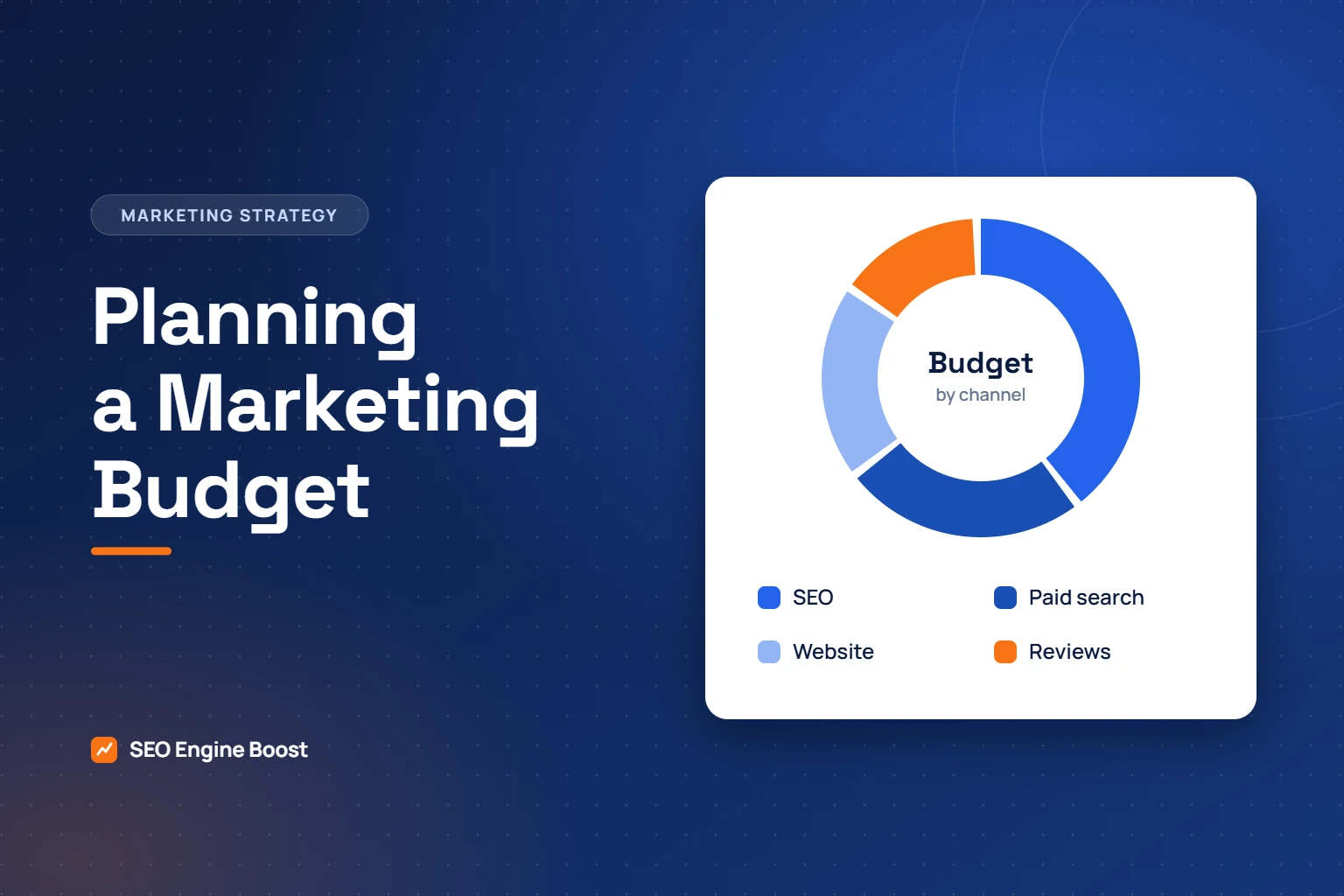
Orthodontic Marketing Budget: How to Plan What to Spend
There is no single correct orthodontic marketing budget. Published rules of thumb are a useful starting point, but the better method starts from your own capacity: how many additional patients you can treat, what one start is worth, and what you are willing to pay to gain it.
Key takeaways
- One agency benchmark puts marketing at 4 to 8 percent of gross revenue. Treat it as guidance, not research.
- A capacity-based budget is the number of additional starts multiplied by what you will pay to gain each one.
- Fix the foundation before paying for traffic, and review cost per start every quarter.
In this article
- What published benchmarks say
- A capacity-based orthodontic marketing budget
- Where the money usually goes
- A sensible order of spending
- What SEO typically costs within that
- New practices and growth phases
- Review every quarter
- Working through the numbers
- One-time, fixed and variable spending
- Questions to ask before approving any line
- How the split changes with the situation
- When to increase, hold or cut
- Budgeting mistakes to avoid
- Costs that sit outside the marketing line
- A planning calendar for the year
- Frequently asked questions
What published benchmarks say
One orthodontic marketing agency, Neon Canvas, suggests that “a reasonable range for marketing spend is 4 to 8 percent of gross revenue”, giving the example of a practice generating about $2 million a year investing roughly $80,000 to $160,000 annually. It adds that practices in a growth phase may spend more.
Treat figures like these as an agency’s guidance rather than independent research. Agencies have an interest in higher budgets. They are still a reasonable check on whether your own number is far outside the normal range.
A capacity-based orthodontic marketing budget
- Capacity. How many additional starts could you treat this year without lowering standards?
- Value of a start. Your average case fee, less the direct costs of treatment.
- Acceptable cost per start. What share of that value are you prepared to spend to gain the patient?
- Budget. Additional starts multiplied by acceptable cost per start.
For example, a practice that wants forty additional starts and is prepared to spend $400 to gain each one has a growth budget of $16,000 for the year, on top of what it spends to maintain its current position. The numbers are illustrative. Use your own.
Where the money usually goes
| Area | What it covers | Notes |
|---|---|---|
| Foundation | Website, photography, Business Profile, tracking | Mostly one-time; you own the result |
| Organic visibility | SEO, content, local listings | Slow to start, compounds over time |
| Paid search | Google Ads spend and management | Fast, stops when spending stops |
| Reputation | Review process and replies | Low cost, high influence |
| Community and referrals | Sponsorships, events, dentist relationships | Hard to measure, often valuable |
| Brand and social | Design, social media, print | Supports the rest |
A sensible order of spending
- Fix the foundation before paying for traffic.
- Fund the ongoing work that builds organic visibility.
- Add paid search to cover gaps and test demand.
- Keep a small amount unallocated for opportunities during the year.
Compare your budget with published prices
Our plans, and what each includes, are on the pricing page. A free growth audit comes first.
What SEO typically costs within that
In a survey of 439 SEO providers by Ahrefs, 79.1 percent of those in the United States and Canada charged at least $1,001 a month. Specialist healthcare work often costs more. We look at this in detail in how much orthodontic SEO costs.
New practices and growth phases
A new practice has little revenue to take a percentage of, so percentage rules break down. Budget from what must be built: website, profile, launch awareness. See marketing a new orthodontic practice.
Review every quarter
- Spend by channel against plan
- Inquiries, consultations and starts by channel
- Cost per start by channel
- What to increase, reduce or stop
Budgets set once a year and never revisited tend to fund habits rather than results. A quarterly review of cost per start, described in measuring orthodontic marketing, keeps spending tied to what works.
Our own fees are published on the pricing page.
Working through the numbers
The capacity method above is easier to trust once you have run it with real figures. The example below uses invented numbers for an imaginary practice. It shows the arithmetic and nothing else, so replace every figure with your own.
| Step | Question | Invented example |
|---|---|---|
| 1 | How many additional starts can we treat well this year? | 40 |
| 2 | What is the average case fee? | $5,800 |
| 3 | What are the direct costs of treating one case? | $1,800 |
| 4 | What is left per start? | $4,000 |
| 5 | What share of that are we prepared to spend to gain the patient? | 10 percent, or $400 |
| 6 | Growth budget for the year | 40 multiplied by $400, or $16,000 |
Two points are worth noticing. First, the budget follows from capacity and margin, not from what a competitor is rumored to spend. Second, step five is a judgment, not a formula. A practice with empty chairs and fixed costs already paid can justify a higher share than a practice that is nearly full.
Add the growth budget to what it costs to hold your current position: hosting, upkeep of the website and profile, the review process and any ongoing agency fee. The two together are your orthodontic marketing budget for the year.
One-time, fixed and variable spending
Budgets go wrong when different kinds of cost are added together and compared month to month. Separate them before you plan.
| Type | Examples | How to plan it |
|---|---|---|
| One-time | A new website, photography, a brand refresh | Budget once, and expect it to last several years |
| Fixed monthly | SEO and content, software, hosting, an agency retainer | Commit for a set period and review each quarter |
| Variable | Advertising spend, event sponsorship, print | Set a ceiling and adjust it as the numbers come in |
| Internal time | Front desk follow-up, the doctor reviewing content, replying to reviews | Count the hours, even if no invoice arrives |
The last row is the one most budgets leave out. A review process, a content calendar and prompt follow-up all need staff time. If that time is not planned, the work is the first thing dropped in a busy week, and the money spent around it is partly wasted.
Questions to ask before approving any line
- What is this meant to produce, and how will we know within three months whether it is doing so?
- Do we own what we are paying for? A website, an ad account and a profile should belong to the practice.
- What happens if we stop? Organic work tends to keep some of its value, and advertising stops the day the spending does.
- Is there a contract term, and what does it cost to leave?
- Does this depend on something that is not yet in place, such as a working form or a follow-up routine?
- Who in the practice is responsible for it?
If a line cannot answer the first question, it is a habit and not an investment. More on ownership is in own your practice website, and the contract questions are covered in how to choose an orthodontic marketing agency.
How the split changes with the situation
There is no correct allocation that fits every practice. What changes is the emphasis. The table describes direction, not percentages, because honest percentages would need your own figures.
| Situation | Where the emphasis usually moves | Why |
|---|---|---|
| New practice, no history | Foundation, local profile, launch awareness | Nothing can be measured until the basics exist |
| Established, schedule has room | Organic visibility, with paid search to fill gaps | There is capacity to absorb new starts |
| Established, nearly full | Reputation, referrals, upkeep | Growth spending would create a waiting list, not revenue |
| Adding a location | A separate foundation for the new office, then local visibility there | The new area has to be earned on its own |
| A new competitor has opened nearby | Reviews, profile completeness, content gaps | Protect the position you have before chasing more |
A nearly full practice is the case that is easiest to get wrong. Spending for growth with no capacity to treat the patients it brings is the most expensive kind of marketing. Maintenance spending still matters, because visibility that is neglected tends to fade.
When to increase, hold or cut
A budget is a plan, and the quarterly review is where the plan meets the numbers. These signals are a reasonable guide to the decision.
| What you see | Sensible response |
|---|---|
| A channel produces starts at a cost per start you accept, and you have capacity | Increase it gradually and watch whether the cost holds |
| Inquiries are rising and consultations are not | Hold spending and fix follow-up first |
| A channel has produced inquiries and no starts for two quarters | Find out why before continuing. The cause may be the consultation, not the channel |
| A channel has produced nothing measurable for two quarters | Reduce or stop, unless there is a clear reason it needs longer |
| You cannot tell which channel produced what | Spend on measurement before anything else |
Give organic work longer than advertising before you judge it. Google’s own guidance says the effect of SEO changes can take from hours to several months to appear, while an ad campaign shows its first numbers within days. Judging both on the same timetable can lead to cutting the slower channel too early. The method for getting those numbers is in measuring orthodontic marketing, and the follow-up problem is covered in consultation request follow-up.
Budgeting mistakes to avoid
- Copying a percentage. A share of revenue is a check on your number, not a way to arrive at it.
- Funding traffic before the website can convert it. Fix the page, the form and the phone path first.
- Spreading a small budget across every channel. Two things done properly usually beat six done thinly.
- Signing a long contract to get a lower monthly price before you have seen any results.
- Leaving out staff time, and then wondering why the plan was not carried out.
- Cutting everything in a slow month. Visibility takes time to rebuild, so reduce variable spending first and protect the foundation.
- Renewing last year’s budget without looking at what it produced.
Costs that sit outside the marketing line
Some of what makes marketing work is paid for elsewhere in the practice, and it is worth listing so that nothing is counted twice or forgotten.
- Domain and hosting renewals, which are small and must never lapse.
- Practice software that sends reminders or requests reviews.
- Professional photography of the team and the office, repeated when the team changes.
- Training time for the front desk on handling new inquiries.
- The doctor’s time for reviewing clinical content and approving messages.
- Memberships and community involvement that also build local reputation.
None of these is large on its own. Together they explain why two practices with the same stated orthodontic marketing budget can get very different results. The one that plans for this supporting work gets more from every dollar it spends on visibility, and the one that ignores it pays for inquiries that go unanswered.
A planning calendar for the year
An orthodontic marketing budget is easier to manage when the decisions have fixed dates. A simple rhythm is enough.
- Before the year starts: run the capacity calculation, separate one-time from ongoing costs and set a ceiling for variable spending.
- Each month: record spending, inquiries, consultations and starts by channel on one page.
- Each quarter: compare the last three months with the three before, and decide what to increase, hold or stop.
- Mid-year: check capacity again. If the schedule has filled, move growth spending toward maintenance.
- Year end: review what each one-time investment produced and whether it needs renewing.
Keep a short written note of each decision and the reason for it. A year later, those notes are more useful than any dashboard, because they show what you expected as well as what happened.
Want to know where your budget should go first?
A free growth audit shows where your visibility, website, reviews and content stand today, before you commit to any spending.
Frequently asked questions
What percentage of revenue should an orthodontic practice spend on marketing?
We have not found independent research that settles this for orthodontic practices. Agencies publish ranges, and the one quoted above is an example of that. Use a published range as a rough check, and base the real number on your capacity, your margin and what you are prepared to pay to gain a patient.
Is SEO or advertising a better use of a limited budget?
They do different jobs. Advertising can bring inquiries quickly and stops when spending stops. SEO and content take longer and tend to keep producing. With a limited budget, fix the foundation first, then choose one of the two and do it properly. The cost side of SEO is covered in orthodontic SEO cost, and the checks to make before paying for ads are in Google Ads for orthodontists.
Should the budget change through the year?
Fixed spending should stay steady, because the work it pays for builds over time. Variable spending can follow your own pattern of demand once you have a year of history to read it from. Until then, avoid large swings based on a guess.
What if the practice is already busy?
Then the budget is mostly for maintenance: keeping the profile accurate, replying to reviews, keeping content current and protecting referral relationships. A busy practice that stops all marketing often notices the effect only much later, when it is slower to reverse.
Should we hire in-house or use an agency?
It depends on volume and on the skills needed. One person rarely covers writing, technical SEO, advertising and design equally well. An agency brings a range of skills for part of a salary, and needs someone in the practice to supply information and approvals. Whichever you choose, keep ownership of the accounts and the data.
How long should we commit before judging the result?
For advertising, a few weeks of data shows whether the setup works. For organic work, allow at least two quarters, and judge it on inquiries and starts, not on rankings. Be wary of any provider that promises a result by a date. Google itself says that no one can guarantee a first-place ranking.
Does a bigger budget mean faster growth?
Only up to the point where something else becomes the limit: the website, follow-up, consultation capacity or chair time. Past that point, extra spending raises the cost of each start without adding many.
What does working with you cost?
Our plans and what each one includes are published on the pricing page. The first step is a free growth audit, which shows where your current spending is and is not reaching patients before you commit to anything.
Keep reading
See where your practice stands
If you would like a second pair of eyes on your own practice, we offer a free growth audit: a manual review of your local visibility, website, reviews and content, with a prioritized list of what to fix first.