
Google Ads for Orthodontists: What to Set Up Before You Spend
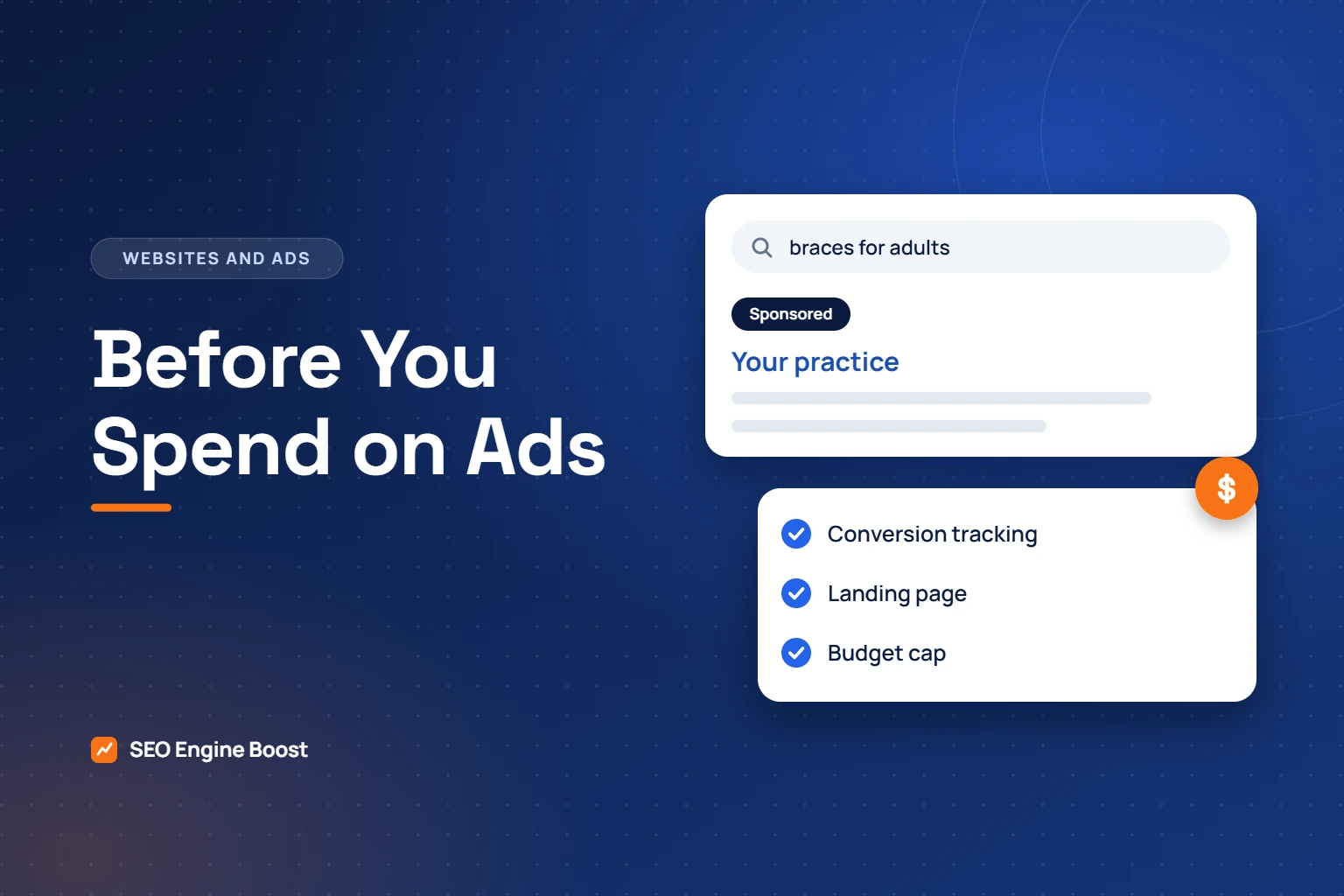
Google Ads for orthodontists can bring consultation requests within days, which makes it useful while organic visibility builds. It can also spend a budget with nothing to show for it. The difference is almost always in the setup. Five things should be in place before the first dollar is spent.
Key takeaways
- Set up conversion tracking for calls and forms before spending anything.
- Send each ad to a matching landing page, and organize campaigns by treatment.
- Start with a sixty-day test budget and judge it by cost per consultation request.
In this article
- 1. Conversion tracking
- 2. A landing page for each campaign
- 3. Campaigns organized by treatment
- 4. Negative keywords from day one
- 5. A sensible radius
- How much to budget for Google Ads for orthodontists
- What to look at each month
- Ads and SEO are not rivals
- Start with search campaigns
- What a landing page needs
- Choosing keywords and match types
- A starter list of negative keywords
- Writing the ad
- The sixty-day test, week by week
- Reading the results: a worked example
- Common ways the budget leaks
- Who should own the account
- Frequently asked questions
- After the test: three possible outcomes
- How ads and SEO share the work
- Questions to ask an agency that manages ads
1. Conversion tracking
Without it, the platform optimizes for clicks, and you cannot calculate what a consultation request costs. Track at least phone calls from ads and website, and consultation form submissions.
Be careful with what is tracked on a healthcare website. Guidance from the U.S. Department of Health and Human Services says HIPAA rules apply when a page collects identifiable health information, such as an email address or reason for care typed into an appointment form. Discuss your setup with your privacy counsel. We explain the background in tracking pixels and patient privacy.
2. A landing page for each campaign
An ad about clear aligners should lead to a page about clear aligners, with one action: request a consultation. Sending every click to the home page is the most common waste we see.
3. Campaigns organized by treatment
- Braces
- Clear aligners
- Early treatment for children
- Adult treatment
- Your practice name, to protect searches for you
Separate campaigns let you set separate budgets and see which treatment produces inquiries at an acceptable cost.
4. Negative keywords from day one
Without exclusions, ads appear for searches you never wanted. Typical exclusions for an orthodontic practice include jobs, salary, school, courses, free, do it yourself and the names of unrelated dental procedures. Review the actual search terms every week for the first two months.
Planning to run Google Ads?
Start with a free growth audit of your website and local visibility, then decide whether ads make sense.
5. A sensible radius
Target the area patients will realistically travel from. A wide radius buys clicks from people who will not make the drive twenty times over two years.
How much to budget for Google Ads for orthodontists
There is no universal figure. Costs depend on how many practices are bidding in your area. Start with a test budget you are comfortable spending for sixty days, measure cost per consultation request, then decide whether to increase, adjust or stop. For how advertising fits into overall spending, see planning an orthodontic marketing budget.
What to look at each month
| Number | What it tells you |
|---|---|
| Cost per consultation request | Whether the campaign is affordable |
| Requests by treatment | Where to move budget |
| Search terms | What to exclude next |
| Booked consultations from ads | Whether the inquiries are the right ones |
The last line requires your front desk to record outcomes. Without it, you are optimizing for inquiries rather than patients.
Ads and SEO are not rivals
Ads cover the gap while treatment pages and reviews build. The search terms report also shows exactly what local patients type, which is useful input for the next pages to write.
For managed campaigns, see Google Ads for orthodontists.
Start with search campaigns
Google Ads offers several campaign types. For a first test, a plain search campaign is the easiest to understand and control: your text ad appears when someone searches for a term you chose, and you pay when they click. More automated campaign types can work later, once you have conversion data for them to learn from. Starting with them means handing decisions to a system that has nothing to learn from yet.
What a landing page needs
The page an ad leads to does most of the work. For each campaign, build one page with one purpose.
- A headline that repeats what the person searched for, such as “Clear aligners for adults in” followed by your town.
- Two or three sentences on what the treatment is and who it suits.
- One action, repeated: request a consultation.
- A short form with three fields, and a phone number that can be tapped.
- Real photographs of the practice and the doctor.
- Honest answers to the obvious questions: cost factors, payment plans and whether the consultation is free.
- Genuine reviews, shown with permission and never edited.
- No navigation that leads the visitor away before they act.
Keep clinical claims accurate and modest. Do not promise results or treatment times. An ad that overpromises brings inquiries that the consultation cannot convert.
Choosing keywords and match types
Start narrow. A short list of specific searches, in tightly grouped campaigns, is easier to manage than hundreds of loosely related terms.
| Campaign | Example searches to target | What the searcher probably wants |
|---|---|---|
| Braces | braces near me, braces for teens, orthodontist braces cost | To compare providers and prices |
| Clear aligners | clear aligners near me, invisible braces for adults | An alternative to fixed braces |
| Early treatment | orthodontist for kids, first orthodontist visit age | Advice on whether a child needs to be seen |
| Adult treatment | adult braces, teeth straightening for adults | Discreet options and cost |
| Practice name | your practice name | To find you specifically |
Match types control how closely a search must resemble your keyword. Exact and phrase match keep you close to what you chose. Broad match reaches further and needs watching. For a first test, use phrase and exact match, and read the search terms report every week.
A starter list of negative keywords
Negative keywords stop your ads appearing for searches you do not want. Add these groups before the first click, and extend the list from the search terms report.
| Group | Examples |
|---|---|
| Jobs and careers | jobs, salary, hiring, assistant, careers |
| Education | school, course, degree, residency, training |
| Do it yourself | diy, at home, homemade, kit |
| Free and cheap | free, cheapest, donation |
| Other professions | oral surgeon, endodontist, periodontist, veterinarian |
| Research | definition, images, pictures, history |
| Unrelated treatments | dentures, root canal, wisdom teeth |
Review the list with care. If you do offer a free consultation, for example, do not exclude the word “free” outright. Exclude the combinations that never fit instead.
Writing the ad
A good ad is specific and true. Say what you offer, where, and what happens next.
- Put the treatment and the area in the headline.
- Mention something concrete, such as evening appointments, payment plans or a free consultation, if it is true.
- End with the action: request a consultation.
- Use the extra links and call options the platform provides, so that a parent can tap to call.
Avoid superlatives you cannot support, and never imply a guaranteed outcome. Healthcare advertising is subject to platform policies and to professional rules in your state. Read both before you publish, and be aware that Google limits some kinds of audience targeting for health-related services.
The sixty-day test, week by week
| Weeks | What to do | What to look at |
|---|---|---|
| Before launch | Install conversion tracking, build landing pages, add negative keywords, set the radius | A test call and a test form both register |
| 1 to 2 | Run with a modest daily budget and change very little | Search terms report, every few days |
| 3 to 4 | Add negatives, pause searches that waste money, check call quality with the front desk | Cost per consultation request, by campaign |
| 5 to 6 | Move budget toward the campaign that produces requests at an acceptable cost | Requests by treatment |
| 7 to 8 | Compare booked consultations with requests | Whether the inquiries are the right ones |
| End | Decide: increase, adjust or stop | Cost per booked consultation |
Resist the urge to change everything in the first fortnight. The system and you both need data, and constant changes reset what has been learned.
Reading the results: a worked example
These figures are invented to show the arithmetic. Use your own.
Suppose a practice spends $1,500 over sixty days and receives 30 consultation requests from ads: 18 calls and 12 forms. The cost per request is $1,500 divided by 30, which is $50. The front desk records that 15 of those requests became booked consultations, so the cost per booked consultation is $100. If five of those consultations start treatment, the advertising cost per start is $300, before management fees.
Whether $300 is acceptable depends on the value of a start in your practice and on how many more patients you can take. The point of the example is the chain: clicks mean nothing until you can follow them to requests, consultations and starts. If the front desk does not record outcomes, the chain stops at the first link. The method is in measuring orthodontic marketing.
Common ways the budget leaks
- Sending every click to the home page. The visitor has to start searching again.
- No negative keywords. Ads appear for job seekers, students and people looking for a general dentist.
- A radius that is too wide. Clicks from families who will never make the drive every few weeks.
- Bidding on your own name and nothing else. It looks efficient because those people were already looking for you.
- Counting page views as conversions. Only calls and form submissions should count.
- Running ads when nobody answers. Evening and weekend clicks need a plan for follow-up. See consultation request follow-up.
- Letting the platform’s suggestions run unchecked. Recommendations often raise spending. Accept the ones that fit your goal and decline the rest.
- Tracking that sends patient details to the ad platform. Count the conversion without passing personal or health information. See tracking pixels and patient privacy.
Who should own the account
The practice should own the advertising account, with an agency or freelancer added as a user. That way the history, the data and the campaigns stay with you if the relationship ends. Ask for the management fee and the advertising spend as two separate figures, and ask to see the search terms report, not only a summary.
Planning to spend on ads?
A free growth audit reviews the website your ads would send people to, before you commit a budget.
Frequently asked questions
Do Google Ads for orthodontists work?
They can bring consultation requests quickly, which SEO cannot. Whether they are worth it depends on the cost per booked consultation in your area and on how well inquiries are followed up. A sixty-day test with proper tracking answers the question for your practice.
How much should we spend?
There is no universal figure. Choose a test budget you are comfortable spending over sixty days, measure the cost per consultation request and decide from there. For the wider picture, see planning an orthodontic marketing budget.
Should we bid on our own practice name?
A small campaign on your own name protects searches for you, particularly if competitors advertise on it. Keep it separate so that it does not flatter the results of the other campaigns.
Can we advertise on a competitor’s name?
Platform rules and trademark law both apply, and the rules differ by situation. Many practices choose not to, on professional grounds. If you are considering it, take advice first.
How soon will we see results?
Clicks begin within hours of launch. Meaningful numbers on consultation requests take several weeks, and starts take longer still.
Do ads improve our organic ranking?
No. Google says advertising with it has no effect on a site’s presence in the search results. Ads and SEO are separate, although the search terms report is a useful source of ideas for new pages.
Can we run Google Ads ourselves?
Yes, if someone has time to check the account every week. The five steps in this article are the minimum. Practices usually bring in help for tracking, landing pages and ongoing management.
What is the first sign that a campaign is going wrong?
Search terms that have nothing to do with orthodontic treatment, and clicks that produce no calls or forms. Check both in the first week.
For managed campaigns, see Google Ads for orthodontists.
After the test: three possible outcomes
At the end of sixty days the numbers will point one of three ways.
| Outcome | What it looks like | What to do |
|---|---|---|
| It works | Requests arrive at a cost you can accept, and the front desk confirms they become consultations | Increase the budget gradually and keep watching the search terms |
| It nearly works | Requests arrive, but few become consultations | Fix the landing page, the follow-up or the radius before spending more |
| It does not work | Few requests, or a cost far above what a start is worth | Pause, and put the money into the profile, pages and reviews instead |
Stopping is a legitimate result. A test that tells you ads are not right for your market at the moment has saved you a year of spending on a hunch.
How ads and SEO share the work
The two channels are often sold as rivals. In practice they help each other.
- Ads fill the gap while organic visibility builds. A new practice or a new treatment page can be found on day one.
- The search terms report shows real demand. The exact phrases local parents type are the best source for the next pages to write.
- Landing pages become permanent pages. A good aligner landing page, with navigation restored, is also a good treatment page.
- SEO lowers the cost of ads over time. As more people find you through the map and organic results, you can narrow ads to the treatments and areas where you are still weak.
Our guide to SEO for orthodontists covers the organic side.
Questions to ask an agency that manages ads
- Will the advertising account be in the practice’s name?
- What is your fee, and is it separate from the ad spend?
- Which conversions will you track, and how do you keep patient details out of the ad platform?
- Will each campaign have its own landing page?
- How often will you review search terms and add negative keywords?
- What will the monthly report show first?
- What happens to the account and its history if we stop working together?
Good answers are specific. If the reply to the last question is that the account stays with the agency, treat that as a reason to look elsewhere. When you run Google Ads in an account you own, with tracking you understand, you can change provider without starting again.
Keep reading
See where your practice stands
If you would like a second pair of eyes on your own practice, we offer a free growth audit: a manual review of your local visibility, website, reviews and content, with a prioritized list of what to fix first.