Dental Marketing Ideas: 20 Practical Ideas for 2026 (Low Cost to High Impact)
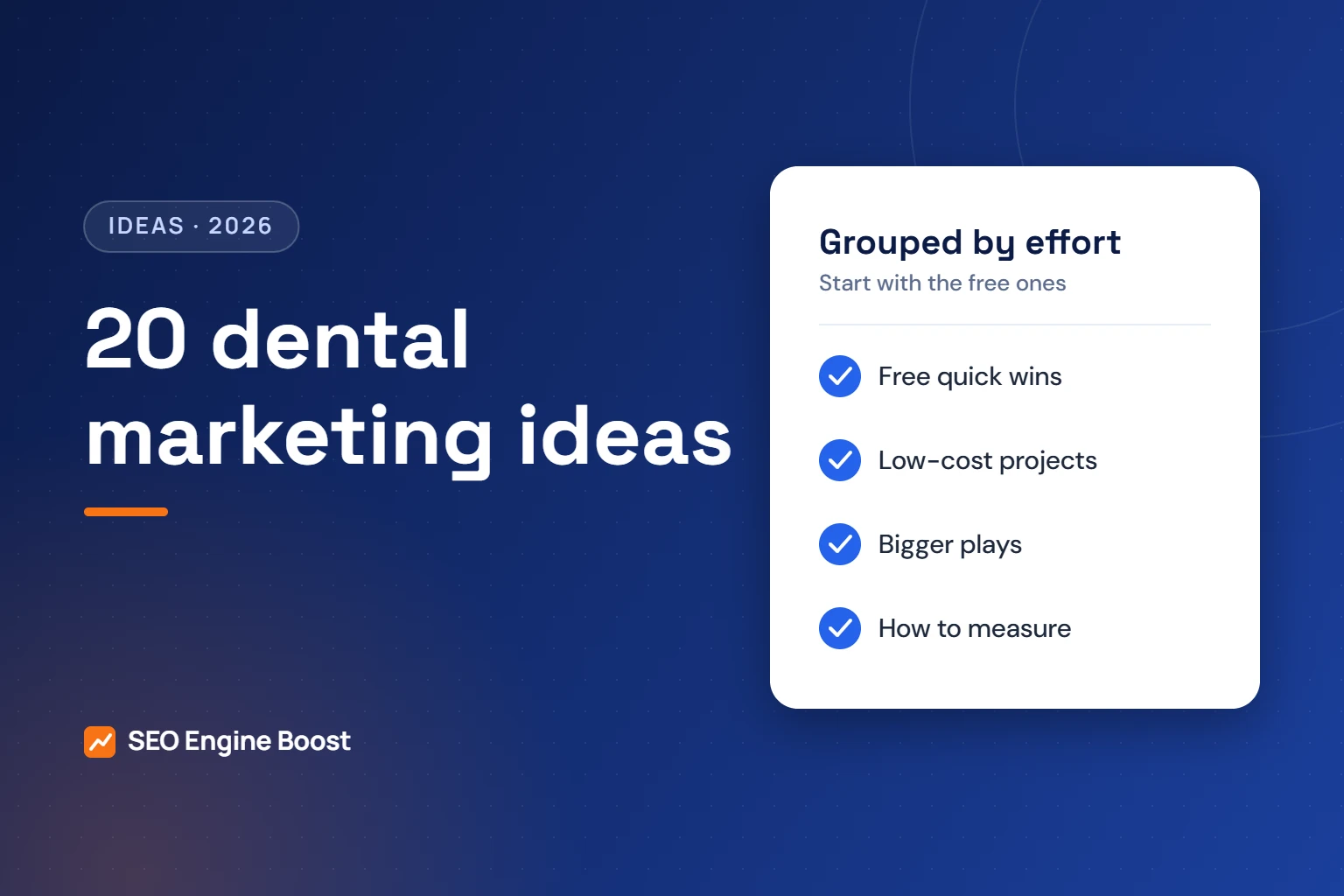
Short answer: the dental marketing ideas that pay back fastest are usually the free ones: a complete Google Business Profile, asking every patient for a review, answering every call, and following up on web requests the same day. After those, add low-cost projects such as service pages and referral thank-yous, then bigger plays such as paid search, video and community sponsorship. Measure every idea by booked appointments.
By Dr. Mahmoud Elsheikh, a dentist completing an MSD in Orthodontics · Updated
Free quick wins (this week)
1. Fix your Google Business Profile
Right primary category, every service, current hours, real photos, booking link. See Google Business Profile for dentists.
2. Ask every patient for a review
One short text after each visit. BrightLocal’s 2026 survey found 47% of consumers will not use a business with fewer than 20 reviews.
3. Reply to every review
Warm, brief and never revealing patient details. Try the review reply generator.
4. Answer the phone, and call back missed calls fast
See what missed calls cost with the missed call revenue calculator.
5. Follow up web requests the same day
Speed beats a perfect script.
6. Put tap-to-call at the top of every page
Most patients will see your site on a phone.
Low-cost projects (this month)
7. One page per service
Implants, emergency, Invisalign, whitening, pediatric care. Whitespark’s 2026 survey rated a dedicated page per service as the top local organic factor.
8. A first-visit page
What happens, how long it takes, what to bring, parking. It reduces nervous calls and no-shows.
9. Publish insurance and payment options
Patients compare this before calling.
10. Thank referring dentists and doctors personally
A handwritten note or a short call builds the relationship.
11. A simple patient referral thank-you
Thank patients who refer friends. Check your state’s rules before offering anything of value.
12. Real team photos
Replace stock images with your own people and office.
13. Consistent listings
Same name, address and phone on Apple Maps, Bing, Yelp and dental directories.
Bigger plays (this quarter)
14. A focused Google Ads campaign
One service, matching landing page, tracked calls. See Google Ads for dentists (and, for implant cases, dental implant marketing) and the budget calculator.
15. Short educational videos
Answer the five questions patients ask most, one minute each.
16. Community sponsorship with a web mention
Schools, sports teams and charities you already support.
17. Local press or podcast appearances
Seasonal topics such as sports mouthguards or back-to-school checkups.
18. A practice newsletter
Monthly, useful and short, to stay in touch with existing patients.
19. Make the practice easy for AI assistants to describe
Plain facts on every service page and consistent details everywhere. Read AI SEO for dentists.
20. Measure everything by booked appointments
Track source for every call and form, and drop what does not book patients.
Which ideas first?
| If your problem is… | Start with ideas |
|---|---|
| Few calls at all | 1, 2, 7, 13, then 14 |
| Calls but few bookings | 4, 5, 8, 9 |
| Patients but not the treatments you want | 7, 14, 15 |
| Good results but no growth | 10, 11, 16, 17, 19 |
For a full plan, see how to get more dental patients, or let our dental marketing agency run it for you.
Want this done for your practice? We help with dental marketing, dental SEO and local SEO for dentists. Prices are published and plans are month-to-month.
Not sure where your practice stands? A free growth audit lists your top three fixes for Google, Maps and AI answers, in writing. Get a free growth audit · See our dental marketing services
How to choose ideas by budget, time and team
The table above sorts ideas by the problem you have. This one sorts them by what each idea costs you: cash, staff time and setup. Pick the rows you can sustain, not the ones that sound biggest. An idea your team drops after two weeks rarely pays back.
| Idea | Cash cost | Team time | What you need first | First signal to watch |
|---|---|---|---|---|
| 1. Google Business Profile | None | Low after setup | Owner access to the profile | Calls and website clicks in the profile’s performance view |
| 2 and 3. Review requests and replies | None, or a texting tool | Low | Patient consent to text and one named owner | New reviews per month |
| 4. Missed-call callbacks | None | Medium | A call log or call tracking | Share of missed calls returned the same day |
| 5. Same-day web follow-up | None | Medium | Form alerts going to a staffed inbox | Time from request to first reply |
| 7. One page per service | Low to medium | Medium while writing | A list of the services you want more of | Inquiries that name that service |
| 8. First-visit page | Low | Low | Your real visit steps, timing and parking | Fewer “what should I expect” calls |
| 10 and 11. Referral thank-yous | Low | Low | A check of your state’s rules on anything of value | Referrals recorded by source |
| 14. Focused Google Ads | Ongoing ad spend plus management | Medium | Tracked calls and a matching landing page | Cost per booked appointment |
| 15. Short educational videos | Low to medium | Medium | The questions patients ask most | Inquiries from pages that host the videos |
| 16 and 17. Sponsorship and local press | Varies | Medium | A community tie you already have | Mentions and links earned |
If cash is tight, work down the rows with no cash cost first. If time is tight, choose the low team-time rows and give each one a named owner. If both are available, still start with ideas 1 to 5, because paid traffic sent to a practice that misses calls and replies slowly is wasted.
A 30-day plan to put the ideas to work
This plan suits a single-location practice starting from scratch. It is agency guidance, not a fixed formula. Adjust the order to the problem you picked in the table above.
- Days 1 to 2: Set a baseline. Write down last month’s new patients, calls, web requests and how each new patient found you. Without a starting point, you cannot tell which idea worked.
- Days 3 to 5: Fix the Business Profile (idea 1). Check the primary category, services, hours, photos and booking link. Make sure the practice, not a vendor, owns the profile.
- Days 3 to 7: Name owners for calls and web requests (ideas 4 and 5). Decide who returns missed calls and who answers forms, and by when. Our guide to consultation request follow-up covers timing and wording.
- Week 2: Start review requests (ideas 2 and 3). Send one short request after each visit and reply to every new review without confirming any patient details.
- Week 2: Clean up core listings (idea 13). Match your name, address and phone on Apple Maps, Bing, Yelp and the main dental directories.
- Week 3: Publish one service page and a first-visit page (ideas 7 and 8). Start with the service you most want more of, and link both pages from the menu.
- Week 4: Decide on paid search (idea 14). Only launch if calls are tracked and the matching page is live. Set the budget from what a new patient is worth to you; the patient lifetime value calculator helps you estimate it.
- Day 30: Review and choose the next ideas. Compare new patients, calls and requests with your baseline. Keep what moved bookings, fix what was not done properly, and pick two or three ideas for next month.
Frequently asked questions
What is the cheapest way to market a dental practice?
The free foundations: a complete Google Business Profile, a steady review request after each visit, fast replies to reviews and enquiries, and accurate listings. They cost time rather than money and support every other channel.
Which dental marketing ideas bring patients fastest?
Fixing missed calls, speeding up follow-up on web requests, and a focused Google Ads campaign on one service usually show results fastest. SEO and content build more slowly but keep working.
How do I know which idea worked?
Track calls and forms by source and record how each new patient found you. Compare cost per new patient by channel each month.
Does social media count as dental marketing?
Yes, but for most practices it supports trust and referrals more than it books new patients directly. Measure it by enquiries and bookings, not likes.
How many marketing ideas should we run at once?
As agency guidance, two or three new ideas a month is plenty for most practices, on top of the free foundations. Each idea needs an owner and a way to measure it. Running many at once makes it hard to tell which one booked patients, and half-finished projects rarely pay back. Finish, measure, then add the next one.
Should we run these ideas ourselves or hire an agency?
Many of the free and low-cost ideas, such as reviews, call handling and the Business Profile, depend on your own team, so keep them in-house. Outside help makes more sense for work that needs specialist time, such as paid search, service page writing and technical SEO. Whoever does the work, make sure the practice owns every account and login.