
Dental SEO vs. Orthodontic SEO: What Is Actually Different
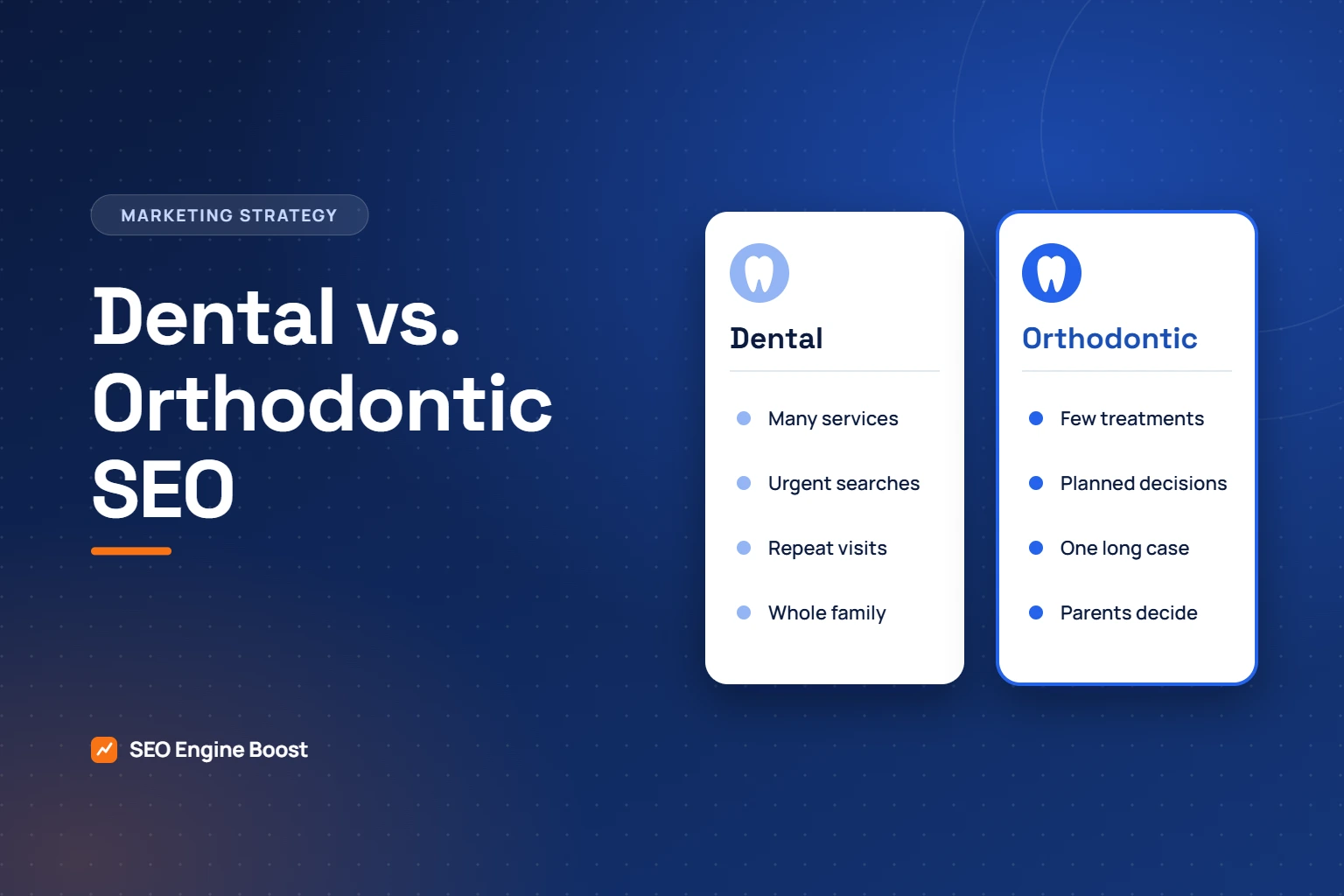
Dental SEO vs. orthodontic SEO comes down to the audience. The tools are the same, but they serve different patients making different decisions. A general dental practice is found by someone who needs care soon. An orthodontic practice is chosen, often by a parent, after weeks of comparison. A plan built for one usually underperforms for the other.
Key takeaways
- The orthodontic searcher is often a parent, and the decision takes weeks rather than hours.
- Content has to bridge patient words such as “overbite” and their clinical meaning.
- Set Orthodontist as the primary category, and build a steady, fair review process.
In this article
- Dental SEO vs. orthodontic SEO, side by side
- 1. The searcher is often not the patient
- 2. The decision is slower
- 3. The vocabulary gap is wider
- 4. The category is different
- 5. The competition is different
- 6. Reviews read differently
- What stays the same
- What this means when you hire help
- How the page plan differs
- How the searches differ
- How the Business Profile differs
- How measurement differs
- Practices that offer both
- What goes wrong when a dental plan is applied to an orthodontic practice
- What both have in common
- How to brief an agency as an orthodontist
- Frequently asked questions
- A quick self-test
- An illustrative example
Dental SEO vs. orthodontic SEO, side by side
| General dental practice | Orthodontic practice | |
|---|---|---|
| Who searches | The patient, usually an adult | Often a parent on behalf of a child or teen |
| Decision time | Hours to days | Weeks to months |
| Value of one patient | Spread across years of visits | Concentrated in one course of treatment |
| Typical searches | dentist near me, emergency dentist, teeth cleaning | orthodontist near me, braces cost, clear aligners for teens |
| Local competitors | Many general practices | Fewer specialists, plus general dentists offering aligners |
| Referral role | Smaller | Significant: general and pediatric dentists refer |
1. The searcher is often not the patient
Orthodontic content has to speak to a parent: when to bring a child, what early treatment involves, how appointments fit around school. The American Association of Orthodontists recommends a first check-up by age 7, a fact many parents do not know and actively search for.
2. The decision is slower
A family may visit two or three practices before choosing. That gives content more work to do. Pages about cost, treatment length, what the first visit involves and how you differ from the practice down the road all influence the choice long before the consultation.
3. The vocabulary gap is wider
Patients say “overbite”, “underbite” and “crooked teeth”. The clinical picture may be increased overjet, a Class III relationship or crowding. Pages need to meet the patient’s word and then explain it accurately. Generic dental copywriters often get this wrong, and patients who have done their reading notice.
4. The category is different
Google asks businesses to choose categories that are as specific as possible. For an orthodontic practice that means Orthodontist as the primary category, not Dentist. It is a small setting with a large effect on which searches the practice appears for.
Looking for SEO built for an orthodontic practice?
Start with a free growth audit of your local visibility, website, reviews and content.
5. The competition is different
Orthodontists compete with other specialists, with group-owned offices that have larger budgets, and with general dentists who offer clear aligners. Explaining clearly what a specialist does, without disparaging anyone, is part of the content plan.
6. Reviews read differently
Dental reviews tend to be about a visit. Orthodontic reviews are about a relationship that lasted a year or two. They are longer, more personal and more persuasive, which makes a steady, fair review process especially valuable.
What stays the same
- A complete Google Business Profile
- A fast, crawlable website
- One clear purpose per page
- Tracking calls and forms back to their source
What this means when you hire help
Ask any agency for an example of orthodontic content they have written, how they decide which treatment pages to build, and who checks clinical accuracy. For what our own approach looks like, see orthodontic SEO and, for general practices, dental SEO.
How the page plan differs
The clearest way to see dental SEO vs. orthodontic SEO is to put the two websites side by side. The same number of pages can be organized in completely different ways.
| Page type | General dental website | Orthodontic website |
|---|---|---|
| Core service pages | Many: cleanings, fillings, crowns, implants, whitening, emergencies | Few: braces, clear aligners, early treatment, adult treatment, retainers |
| Urgent pages | Emergency dentist, toothache, broken tooth | Rarely needed, apart from a short page on a poking wire or loose bracket |
| Decision pages | Insurance accepted, new patient offer | Cost and payment plans, first visit, how long treatment takes |
| Age-based pages | Family and children’s dentistry | First check-up by age 7, teens, adults |
| Problem pages | Tooth pain, gum disease, missing teeth | Crowding, spacing, overbite, underbite, crossbite, open bite |
| Referral pages | Seldom | A page and a form for referring dentists |
A dental site wins by covering breadth. An orthodontic site wins by going deep on a small number of treatments and on the questions a family asks during a long decision.
How the searches differ
General dental searches tend to be short, local and urgent. Orthodontic searches are more often questions.
| Stage | Typical dental search | Typical orthodontic search |
|---|---|---|
| Awareness | toothache at night | when should my child see an orthodontist |
| Comparison | dentist near me open saturday | braces vs clear aligners for teens |
| Cost | cost of a filling | how much do braces cost with insurance |
| Choice | best dentist in my town | orthodontist reviews near me |
Because the orthodontic journey is longer, one family may search many times over several weeks. A practice that appears at only one of those moments is easy to forget. A practice that answers each of them becomes the familiar name by the time the family is ready to book.
How the Business Profile differs
Both kinds of practice depend on their Google Business Profile, but the settings are not the same.
- Category. A general practice uses Dentist. A specialist practice should use Orthodontist as the primary category. Google asks for categories that are as specific as possible.
- Services. A dental profile lists many procedures. An orthodontic profile lists a handful of treatments, described in the words patients use.
- Photos. Orthodontic practices see many children and teenagers, so photographs of a welcoming reception and friendly team carry extra weight with parents.
- Reviews. Orthodontic reviews often describe a year or two of visits. They are longer and more personal, and they deserve a careful reply that reveals nothing about the patient.
The full list of settings is in our Google Business Profile checklist.
How measurement differs
A general practice often measures new patient calls and booked hygiene appointments. An orthodontic practice measures a longer chain: inquiry, consultation, and treatment start.
| Measure | General dental practice | Orthodontic practice |
|---|---|---|
| First goal | New patient appointment booked | Consultation requested |
| Time from first contact to revenue | Days | Weeks to months |
| Value of one new patient | Spread over years of care | Concentrated in one course of treatment |
| Key ratio | Calls to appointments | Consultations to starts |
| Role of follow-up | Helpful | Decisive, because families compare practices |
This is why reporting built for a dental practice can mislead an orthodontist. A month with few starts may follow a month with many consultations, and the two need to be read together. See measuring orthodontic marketing.
Practices that offer both
Many practices sit between the two models: a general dentist who provides clear aligners, a pediatric dental office with an orthodontist on staff, or a group with dental and orthodontic locations. Each needs a deliberate choice.
A general dentist offering aligners
Keep Dentist as the primary category, because that describes the practice. Build a dedicated aligner page that explains who provides the treatment and what cases are suitable. Be accurate about qualifications. Patients are entitled to know whether they will be treated by a general dentist or a specialist, and clear wording protects the practice as well as the patient.
A combined pediatric dental and orthodontic practice
The website needs two clear paths from the home page, one for each service, because the audiences overlap but the questions differ. Whether to run one Business Profile or more depends on how the practice really operates. Google’s guidelines describe when departments and practitioners can have their own profiles, so read them before creating anything new.
A group with separate dental and orthodontic offices
Treat each office as its own local business: its own profile, its own location page and its own reviews. Do not let the orthodontic office inherit a dental content plan, or the other way round.
What goes wrong when a dental plan is applied to an orthodontic practice
- A services page instead of treatment pages. One page listing everything cannot answer a parent’s questions about early treatment or aligners for teenagers.
- Emergency-style content. Urgent dental keywords bring visitors who need a general dentist, not an orthodontist.
- New patient specials as the main message. Orthodontic decisions rest on trust, outcomes and payment plans more than on a discount for the first visit.
- Reports that stop at calls. Without consultations and starts, nobody can tell whether the marketing worked.
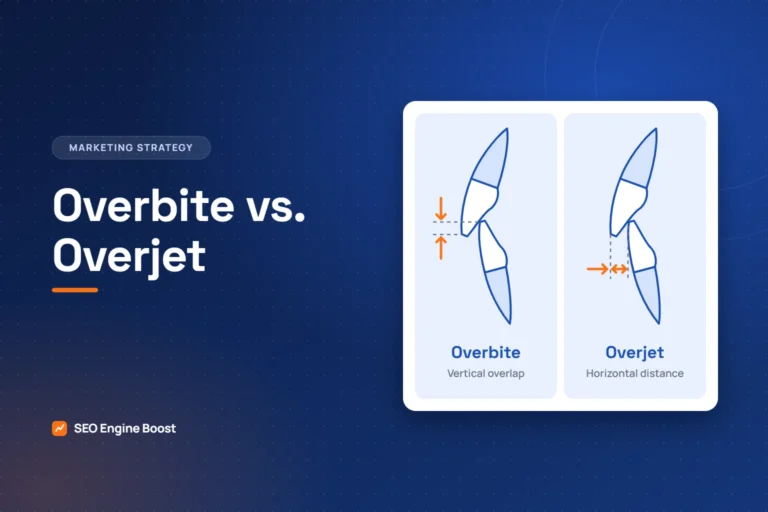
- Generic copy. Text written for any dental office blurs clinical terms and misses the questions parents actually ask. See overbite vs. overjet for a clear example.
- Ignoring referring dentists. General dental marketing has no equivalent of the referral relationship, so it is often left out altogether.
What both have in common
It would be wrong to overstate the difference. The foundations are shared, and a provider who is good at one usually understands the other.
- A complete, accurate Business Profile.
- A fast website that works on a phone and that the practice owns.
- One clear purpose and one clear next step on every page.
- Reviews requested fairly from every patient, with no incentives.
- Tracking that connects calls and forms to their source.
- No bought links, no doorway pages and no guarantees.
The difference in dental SEO vs. orthodontic SEO is in the emphasis and the content, not in the rules.
How to brief an agency as an orthodontist
If you are hiring, give the provider a short written brief. It saves weeks of misunderstanding.
- Who decides: usually a parent, sometimes an adult patient.
- Which treatments you most want to grow.
- Where your patients travel from.
- Which dentists refer to you.
- What you can and cannot say about results and treatment times.
- Who in the practice approves clinical content.
- What you count as success: consultations and starts, not traffic.
Then ask to see an orthodontic treatment page they have written, and who checked it.
Is your SEO built for an orthodontic practice?
A free growth audit reviews your visibility, website, reviews and content with orthodontic patients in mind.
Frequently asked questions
Is dental SEO vs. orthodontic SEO really a different service, or a different label?
The tools and rules are the same. The difference lies in the audience, the pages, the profile settings and what is measured. A provider can do both well, but should be able to explain how the plan changes between them.
Can a general dental marketing agency handle an orthodontic practice?
Some can. Ask for an example of orthodontic content, ask how they would structure your treatment pages, and ask who checks clinical accuracy. If the answers describe a general dental plan with the word “orthodontic” added, keep looking.
Do orthodontists compete with general dentists in search?
Yes, for some searches. General dentists who offer clear aligners appear for aligner searches, and group practices often advertise both services. An orthodontic practice should explain plainly what a specialist does, without disparaging anyone.
Which keywords matter most for an orthodontic practice?
Start with three groups: provider searches such as “orthodontist near me”, treatment searches such as “braces” and “clear aligners”, and question searches such as “what age for braces”. The right list for your practice depends on your area and the treatments you offer.
Is content more important for orthodontists than for dentists?
It carries more of the load, because the decision is slower and parents read before they call. Clear pages about cost, treatment length and the first visit influence the choice well before a consultation.
Does the referral relationship affect SEO?
Indirectly. A referring dentist who lists you on a partners or referral page provides a real local mention. More directly, referred patients often search your name and read your reviews before they call, so your profile and website still need to be in good order.
Should an orthodontist target the word “dentist”?
Not as a main term. The primary category should be Orthodontist, and content should reflect the specialty. People searching for a dentist usually want general care.
How long before an orthodontic practice sees results?
Profile corrections can show within weeks. Treatment pages and review momentum build over several months, and starts follow consultations by weeks or months again. Compare quarters, not weeks.
Where should a practice begin?
With an honest look at the profile, the main treatment pages and the reviews. Our guides to SEO for orthodontists and, for general practices, dental SEO set out the first steps for each.
A quick self-test
Answer yes or no.
- Is your primary category Orthodontist?
- Does each main treatment have its own page?
- Is there a page for parents about a child’s first visit?
- Does your site explain cost and payment plans, even without quoting a fee?
- Do you record consultations and starts by source?
- Is there a simple way for dentists to refer a patient?
Four or more “no” answers suggest the practice is being marketed like a general dental office. That is the gap this comparison is meant to show, and it is usually quick to close.
An illustrative example
The example below is invented to make the comparison concrete.
A family dental practice and an orthodontic practice open on the same street in the same month, and each hires a marketing provider.
The dental practice publishes pages for cleanings, fillings, crowns, whitening and emergencies, sets its category to Dentist, and promotes same-week appointments. Its first patients arrive within days, because someone with a toothache searches, calls and books on the same afternoon.
The orthodontic practice does well only if it does something different. It sets its category to Orthodontist, publishes a page for each treatment, a first-visit page and a clear explanation of costs and payment plans, and introduces itself to the dentist next door. Its first inquiries arrive more slowly. A parent reads the early treatment page, compares two other practices over a fortnight, reads the reviews and then requests a consultation. Treatment starts a few weeks after that.
If the orthodontic practice had copied its neighbor, with one services page, an emergency message and a new patient offer, it would have looked active and achieved very little. The lesson is not that one approach is better. Each fits the way its own patients decide.
Keep reading

See where your practice stands
If you would like a second pair of eyes on your own practice, we offer a free growth audit: a manual review of your local visibility, website, reviews and content, with a prioritized list of what to fix first.