Pending Orthodontic Patients: A 12-Month Follow-Up and Reactivation Plan
Pending orthodontic patients are people who had a consult, were recommended treatment and have not started or declined. The way to convert them is a written 12-month follow-up cadence: quick personal contact in the first two weeks, value-based touches over the next quarter, then seasonal reactivation campaigns, all with a named owner and a reason code for every patient. Below is the full cadence, scripts for each channel, campaign ideas and the numbers to track.
Key takeaways
- Give every pending patient an owner, a reason code and a next contact date before they leave the consult.
- Front-load personal contact: most of your effort belongs in the first 30 days.
- Match the message to the reason they paused (cost, timing, second opinion, decision-maker, unsure of need).
- Text and call only with the right consent, honor opt-outs quickly and keep health details out of messages.
- Measure pending-to-start conversion by month since consult, so you know when follow-up stops paying off.
What counts as a pending orthodontic patient?
Use a precise definition so your list is clean. A patient is pending when all three are true:
- They completed a consult (not just booked one).
- The doctor recommended treatment now, not observation or recall.
- They have not signed a contract, scheduled a start or clearly declined.
Keep observation/recall patients (for example, children the doctor wants to see again in six months) on a separate list. They need recall reminders, not “ready to start?” messages. Patients who clearly say no should be marked declined and moved to a low-frequency, consent-based newsletter at most.
Why do orthodontic patients go pending?
Record one primary reason code for each pending patient in your practice management system. These five cover most situations:
| Reason code | Typical signal at consult | Best first follow-up |
|---|---|---|
| Cost / monthly payment | Questions about down payment, financing or insurance | Revised payment options sent within 24 hours |
| Timing | “After the school year,” “after the wedding,” “after my new job starts” | Calendar the date they named; check in two weeks before it |
| Second opinion | Mentions another office or their general dentist | Comparison checklist (what’s included), then call after their other visit |
| Decision-maker absent | One parent attended; partner handles finances | Offer a short call or video recap for the other decision-maker |
| Unsure of need | “Is this really necessary?” “Can it wait?” | Doctor-recorded explanation of findings and the effect of waiting, if any |
Reason codes turn a vague “follow up with pendings” task into specific messages. They also show patterns: if cost dominates, review your payment options or fee presentation; if “unsure of need” dominates, the doctor’s explanation at the consult may need work. Review the consult process itself alongside this list, because a pending list that keeps growing usually points back to the consult.
The 12-month pending patient follow-up cadence
This cadence assumes you have the consent needed for each channel (see the compliance section below). Adjust spacing to your practice, but keep the shape: dense early, lighter later.
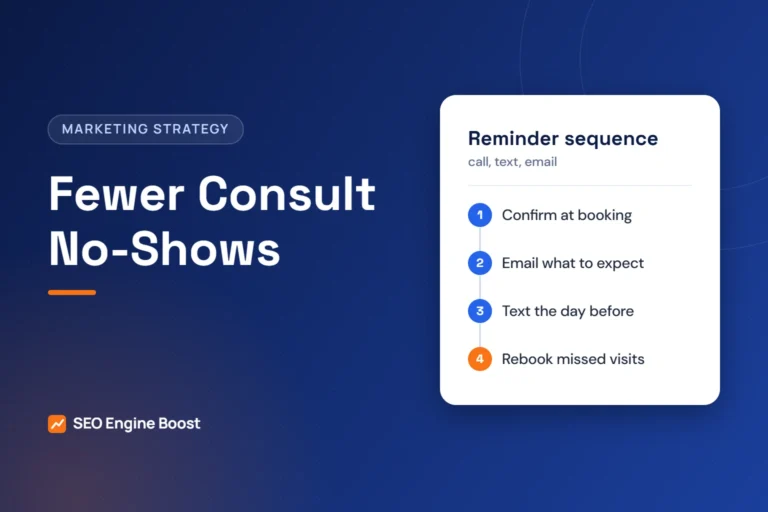
| When (after consult) | Channel | Owner | Purpose |
|---|---|---|---|
| Same day | Email or text | TC | Thank you, written summary of the plan and fee sheet, direct line to the TC |
| Day 2 to 3 | Phone call | TC | Answer questions, address the reason code |
| Day 7 | Text | TC | Short check-in with one useful item (payment option, video, FAQ) |
| Day 14 | Phone call | TC | Ask directly about the decision; offer a second visit |
| Day 30 | TC | Doctor note or short video about their type of case | |
| Day 45 to 60 | Phone call | TC or office manager | Fresh voice; check whether anything has changed |
| Month 3 | Practice | Patient stories (with written authorization), FAQs, what treatment involves | |
| Month 4 to 6 | Email or text (monthly) | Practice | Seasonal campaign aligned to their reason code |
| Month 6 | Phone call | TC | Offer a complimentary progress check or records update if the doctor agrees |
| Month 7 to 11 | Email (every 4 to 6 weeks) | Practice | Education and seasonal reminders |
| Month 12 | Phone call + letter or email | TC | Annual check-in; ask whether to keep them on the list |
Stop the sequence immediately when a patient starts, declines or asks you to stop contacting them.
Which channels work best for pending patient follow-up?
Phone
Best for the first two weeks and for anything involving money. A live conversation can uncover the real reason for the delay. Federal telemarketing rules prohibit telephone solicitations before 8 a.m. or after 9 p.m. in the called party’s local time, and state laws can be stricter, so keep calls within normal business hours.
Text messaging
Best for short, friendly check-ins and links to booking. Texting requires the right type of consent for the message type and a working opt-out. Our guide to orthodontic text message consent explains how to collect it on forms and at the front desk.
Best for longer content: the treatment summary, payment sheets, doctor videos and seasonal campaigns. Use your practice’s secure or HIPAA-appropriate email setup for anything that includes treatment details.
Useful at months 6 and 12 for patients who do not respond digitally. A handwritten note from the TC stands out.
Not sure where your practice stands? A free growth audit lists your top three fixes for Google, Maps and AI answers, in writing. Get a free growth audit · See our orthodontic marketing services
Follow-up scripts for pending patients
Day 2 to 3 call
“Hi [Name], it’s [TC] from [Practice]. I’m calling to see what questions came up after you got home. Sometimes families think of things in the car. Was there anything about the plan or the payment options you’d like me to go over?”
Day 7 text (cost reason code)
“Hi [Name], it’s [TC] at [Practice]. I put together a lower monthly option we talked about. Want me to send it here or by email? Reply STOP to opt out.”
Day 14 call
“I wanted to check where you are with the decision. Some families are ready to schedule, and some need a bit more time. Either is fine. What would help most right now?”
Month 6 call
“It’s been about six months since your visit, and Dr. [Name] asked me to reach out. If you’d like, we can do a quick complimentary check to see whether anything has changed. Would that be helpful?” Only offer this if the doctor agrees and your policy supports it.
Voicemail
Keep it short and non-specific about health details: “Hi, this is [TC] from [Practice] calling for [Name]. Please call me back at [number] when you have a minute. Thank you.”
Reactivation campaigns for older pending lists
Most practices have a list of pending patients older than a year that no one has contacted. Before reactivating, clean the list: remove anyone who started elsewhere, declined, moved or opted out, and confirm consent status for each channel.
- Export all consults from the last 12 to 24 months with no start, plus reason code if recorded.
- Segment by age group (child, teen, adult) and treatment type (aligners, brackets, phase I).
- Check consent for text and email; use mail or phone where consent is missing or unclear.
- Pick one reason to reach out: new payment options, new technology or appointment availability, or a seasonal window.
- Send in waves of a manageable size so the TC can call responders within a day.
- Route replies to one person and log outcomes (booked, not now, remove).
Seasonal campaign angles
- Before the school year for parents: schedule starts around summer break.
- New benefit year: many employer plans reset benefits annually; remind patients to check their own plan.
- Before milestones for adults: weddings, graduations, new jobs (only if the patient mentioned one).
- Year-end: patients with flexible spending or health savings accounts may want to plan ahead; tell them to confirm eligibility with their plan administrator.
Do not invent deadlines or “limited-time” discounts you would not honor. If you run a real promotion, check that it fits your state dental board’s advertising rules and our notes on orthodontic advertising rules.
How do you stay compliant when following up?
- Consent and opt-outs: under the FCC’s consent revocation rule (effective April 11, 2025), people can revoke consent by any reasonable means, replies such as “stop” or “unsubscribe” count, and requests must be honored within a reasonable time, no later than 10 business days. Build opt-outs into your texting platform and PMS.
- Minimum health detail: keep texts, voicemails and email subject lines free of diagnoses and treatment details. Our HIPAA marketing basics for orthodontists covers what to avoid.
- Patient stories: use photos or testimonials only with written authorization.
- Confirm with counsel: texting rules, state laws and marketing definitions change. Have your compliance advisor review your templates.
What should you track for pending patients?
| Metric | How to calculate | Why it matters |
|---|---|---|
| Pending list size | Count of pending patients at month end | Shows whether the list is growing faster than you convert it |
| Pending-to-start rate | Starts from the pending list / pending patients in that cohort | The core measure of follow-up quality |
| Starts by month since consult | Group starts by 0-1, 1-3, 3-6, 6-12, 12+ months | Shows where the cadence pays off and where it can be lighter |
| Starts by reason code | Starts / pending patients per code | Shows which objections your follow-up actually solves |
| Follow-up completion | Scheduled touches completed / scheduled touches | If touches are skipped, results are not the cadence’s fault |
| Opt-out rate | Opt-outs / patients messaged | A rising rate means messages are too frequent or not useful |
Illustrative example: if a practice has 120 pending patients from the past year and converts 12 of them through a reactivation campaign, that is a 10% pending-to-start rate for the campaign. To judge whether that is worth the effort, multiply starts by your average treatment fee, or estimate long-term value with our patient lifetime value calculator. To compare that with new-patient marketing, use your overall case acceptance rate as the baseline.
Pending patients also start upstream: if consult requests sit unanswered for hours, more people never reach a consult at all. Review your consultation request follow-up process alongside this list.
Want this done for your practice? We build the tracking that ties pending-patient follow-up and reactivation back to starts, alongside the marketing that fills your consult schedule. Start with a free growth audit or see our published prices. Learn more about our orthodontic marketing services.
Frequently asked questions
How long should you follow up with pending orthodontic patients?
Plan a structured cadence for at least 12 months, with most personal contact in the first 30 days. After a year, ask the patient whether they want to stay on your list and stop if they decline or opt out.
Who should own pending patient follow-up?
The treatment coordinator who saw the patient should own early follow-up because they have the relationship. Later automated emails can come from the practice, but every pending patient should have one named owner.
Can we text pending patients about treatment?
Only with the consent required for that type of message and a working opt-out. Keep diagnoses and treatment details out of texts, honor stop requests promptly and have your templates reviewed by your compliance advisor.
What is the difference between a pending patient and a recall patient?
A pending patient was recommended treatment now and has not decided. A recall or observation patient was told to return later for re-evaluation, so they need reminders to come back, not requests to start.
Should we offer discounts to pending patients?
Flexible payment options usually address cost concerns better than discounts. If you run a promotion, make it real, apply it consistently and confirm it fits your state dental board advertising rules.