Staying in Touch With Observation Patients, Without Pressure
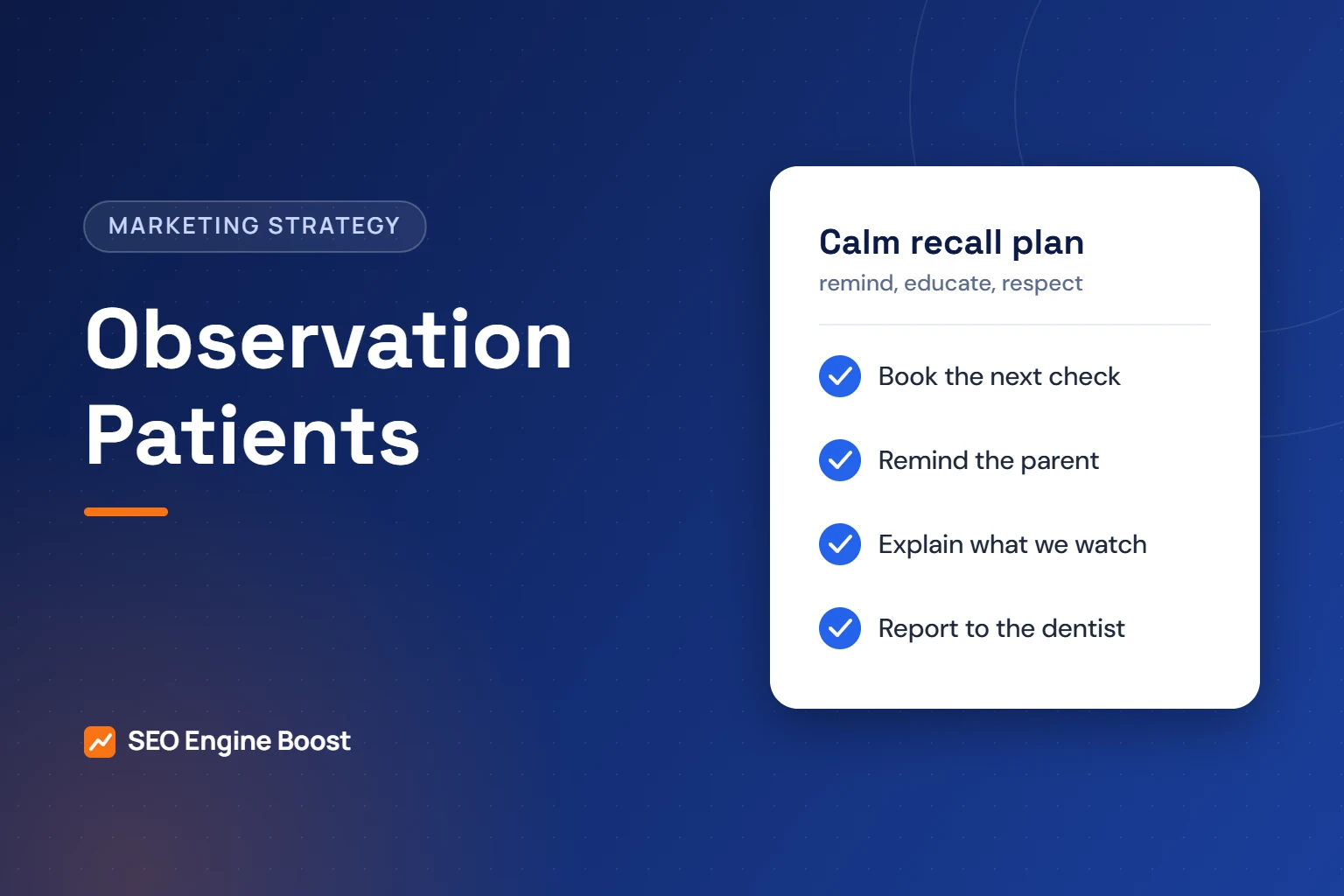
Orthodontic observation patients are children the orthodontist wants to monitor before deciding on treatment. Stay in touch by booking the next check before the family leaves, sending simple reminders, and explaining what each visit checks. The AAO says observation visits are often once or twice a year. Keep every message informational, not sales-driven.
Observation patients are easy to lose. The family hears “no treatment yet” and assumes nothing else is needed. Months later, the child may arrive elsewhere, or later than ideal. A calm recall system protects the child’s care and the practice’s relationship with the family. This guide covers what observation means, a recall plan, parent education, consent and how to measure it.
Key takeaways
- The AAO describes observation as following a child periodically while the face and jaws grow, often once or twice a year.
- Book the next observation visit before the family leaves, then remind the parent before it is due.
- HHS treats communications about an individual’s treatment as outside the definition of marketing. Keep recall messages about the child’s care.
- Measure recall attendance, not how fast observation patients convert to treatment.
In this article
- What observation means in orthodontics
- What happens at an observation visit
- Why practices lose observation patients
- A calm recall plan
- Parent education that builds trust
- Consent and privacy basics
- What “without pressure” looks like
- When the orthodontist recommends treatment
- Keep referring dentists in the loop
- How to measure your observation program
- Frequently asked questions
What observation means in orthodontics
The AAO recommends a first orthodontic check-up by age 7. At that age, a child has a mix of baby and permanent teeth. This lets the orthodontist spot developing problems early.
The AAO’s early treatment article describes three possible outcomes of that first visit:
- No treatment is expected to be necessary.
- Treatment may be needed in the future, so the child is followed periodically as the face and jaws grow.
- There is a developing problem that lends itself to early treatment.
The second group are observation patients. The orthodontist watches growth patterns and tooth eruption timing. Treatment is recommended only when it becomes beneficial. The AAO notes that a second course of treatment may still be recommended later. That usually comes after all permanent teeth erupt.
For marketing teams, this matters. Observation is clinical care in its own right. It is not a waiting room for a sale.
What happens at an observation visit
Parents are more likely to return when they understand the purpose of each visit. The AAO’s article on observation visits says they are often scheduled once or twice a year. It lists what the orthodontist checks:
- Baby teeth are being lost on schedule.
- Permanent teeth are coming in symmetrically, in the right sequence, at the right time and in the right position.
- Upper and lower jaws are developing correctly.
- Permanent teeth have enough room to come in.
- Whether treatment is needed to intercept a developing or existing problem.
The AAO also says some visits lead to simple steps, such as removing a baby tooth or helping a child stop a thumb-sucking habit. X-rays or other imaging may be used when needed.
Use this list in your parent materials. It turns a vague “come back in six months” into a clear reason to return.
Why practices lose observation patients
Recall gaps usually come from process, not from parents. The causes below are agency observation, not research:
- The next visit is not booked before the family leaves.
- Reminders go out once, by one channel, and then stop.
- Contact details change and nobody updates them.
- The parent never understood why the visits matter.
- The referring dentist is not told the child is being monitored.
Each of these can be fixed with a simple, written recall routine. It does not need a sales script.
A calm recall plan
Build a recall plan around the interval the orthodontist sets for each child. The touchpoints below are agency guidance, not research. Adjust them to your practice software and team.
| When | Touchpoint | Purpose |
|---|---|---|
| End of each visit | Book the next visit, or set a recall date | Keep the child on schedule |
| Same day | Short email or printed summary for the parent | Explain what was checked and why we will look again |
| About 4 weeks before due | Recall reminder by text or email | Prompt the parent to confirm or book |
| About 1 week before | Appointment reminder | Reduce missed visits |
| If no reply | One phone call | Update contact details and offer a time |
| After each visit | Note to the referring dentist | Keep the dentist informed |
Keep reminders short. Use the practice name and phone number. Leave out clinical details. HHS guidance says providers may send appointment reminders and leave messages, but should limit the information disclosed.
Our guide to reducing consult no-shows includes sample reminder wording you can adapt for recall visits.
Not sure where your practice stands? A free growth audit lists your top three fixes for Google, Maps and AI answers, in writing. Get a free growth audit · See our orthodontic marketing services
Parent education that builds trust
Parents return when they trust the plan. Give them simple, accurate education, and let the orthodontist set the clinical details.
- A one-page handout on what observation means, based on the AAO’s three outcomes.
- A website page that explains observation visits and the age 7 check.
- A short visit summary in plain language, such as “baby teeth are coming out on schedule”.
- Signs to call sooner, drawn from AAO guidance, such as early or late loss of baby teeth or difficulty chewing or biting.
Avoid fear-based content. Do not suggest that missing one visit will cause harm. Calm, factual education keeps families engaged far longer. Our guide to marketing early orthodontic treatment to parents covers tone and content in more detail.
Want a recall system that respects families?
We will review your observation recall, reminder wording and parent pages, and show where families drop off.
Consent and privacy basics
This section is general information, not legal advice. Check your process with a healthcare attorney and your state rules.
Treatment communications vs marketing
HHS guidance says a communication made for the treatment of the individual is not marketing under the HIPAA Privacy Rule. Its examples include refill reminders. A recall reminder about a child’s own observation visit fits this purpose.
Promotions are different. Messages about discounts, new services or third-party products may count as marketing. Keep them out of recall messages.
Texts and email
The FCC says autodialed texts to a mobile number need prior consent. It says informational texts may rest on oral consent, while commercial texts need written consent. Collect clear consent to reminder texts at the first visit, from the parent or guardian. See our guide to orthodontic text message consent.
Confidential communications
HHS says providers must accommodate reasonable requests to communicate by other means or at other locations. In separated families, note which parent receives reminders, and follow any written instructions on file.
What “without pressure” looks like
The line between helpful recall and sales pressure is mostly about language and frequency. Use this as a quick guide for your team.
| Helpful | Pressure |
|---|---|
| “It’s time for Emma’s growth check.” | “Don’t miss your chance to start treatment.” |
| “We’ll check how her teeth are coming in.” | “Limited-time offer for observation patients.” |
| Two reminders, then a call | Weekly texts until the parent books |
| “No treatment is needed right now.” | “Starting now could save you money later.” |
| Clear options when treatment is advised | Same-day start discounts after a check |
When the orthodontist does recommend treatment, the family will already trust the practice. That trust is worth more than any promotion.
When the orthodontist recommends treatment
At some point, the orthodontist may decide treatment would now help. This is where trust built during observation pays off. Handle the change with the same calm tone.
- Explain what has changed since the last visit, in plain language.
- Describe the recommended option and any reasonable alternatives, including waiting.
- Give a written summary of the plan, timing and fees to take home.
- Explain insurance and payment options, and help the family check their own coverage.
- Offer a follow-up call or visit to answer questions, with no deadline to decide.
Parents may want to talk with the other parent, the family dentist or a second orthodontist. Welcome that. A family that feels rushed may delay or go elsewhere.
If the orthodontist decides that no treatment is needed after all, say so clearly. Thank the family and explain any future checks. That honesty earns referrals from parents to friends and siblings.
Our guide to orthodontic case acceptance covers what happens after a treatment recommendation in more detail.
Keep referring dentists in the loop
Many observation patients come from general or pediatric dentists. Those dentists see the child more often than you do. Send a short note after each observation visit.
- Say the child is being monitored and when you plan to see them next.
- Note anything the dentist should watch for between visits.
- Ask the dentist to encourage the family to keep the next visit.
This keeps the referral relationship strong and gives the family a consistent message. Our guide to orthodontic referral marketing covers referral relationships in more depth.
How to measure your observation program
Measure whether children are seen on time. Do not measure how quickly observation patients start treatment. That metric pushes staff toward pressure.
- Active observation patients: how many children are currently being monitored.
- Recall attendance: the share of due visits that were kept within your target window.
- Lost to follow-up: children with no visit and no future appointment past their due date.
- Contact accuracy: the share of records with a working phone and email.
For example, a practice with 200 active observation patients might find 40 are past due with no visit booked. Those 40 families are the first priority. These numbers are hypothetical. Our guide to orthodontic marketing shows how recall fits into the wider patient journey.
Frequently asked questions
How often should observation patients be seen?
The orthodontist sets the interval for each child. The AAO says observation visits are often scheduled once or twice a year. Some children need closer monitoring during key stages of tooth eruption. Your recall system should follow the interval in the chart, not a single default for every patient.
Is a recall reminder considered marketing under HIPAA?
HHS guidance says communications made for an individual’s treatment are not marketing under the Privacy Rule. A reminder about a child’s own observation visit fits that purpose. Promotional content, such as discounts or new services, may change that. This is general information, not legal advice, so confirm your approach with counsel.
Should observation visits be free?
That is a practice decision. The AAO’s observation article does not discuss cost. Weigh the cost of the visit against the value of keeping families engaged. Whatever you decide, state the policy clearly at the first visit and on your website. Parents should never be surprised by a bill.
What if a family stops responding to reminders?
Try two reminders and one phone call, then pause. Update contact details if you can. Let the referring dentist know the child has not returned, so they can mention it at the next dental visit. Do not keep texting. Repeated messages feel like pressure and can damage trust.
Can we send newsletters to observation families?
You can, if the parent agrees to receive them. Keep newsletters separate from recall reminders. Give parents an easy way to unsubscribe, and check federal email rules before you send. Make sure the content is educational and appropriate for parents. Never use a child’s details or photos without written authorization.
Sources
- American Association of Orthodontists: Regular Pre-Orthodontic Treatment Visits: The Importance of Orthodontic Observation Appointments (November 18, 2024; last modified April 15, 2026)
- American Association of Orthodontists: What Are the Benefits of Early Orthodontic Treatment? (August 20, 2026)
- American Association of Orthodontists: Child Orthodontics (last modified September 30, 2026)
- U.S. Department of Health and Human Services: Marketing (HIPAA Privacy Rule guidance)
- U.S. Department of Health and Human Services: May health care providers leave messages for patients? (content last reviewed December 28, 2022)
- Federal Communications Commission: Stop Unwanted Robocalls and Texts (February 27, 2026)
Keep reading
See where your practice stands
If you would like a second pair of eyes on your own practice, we offer a free growth audit: a manual review of your local visibility, website, reviews and content, with a prioritized list of what to fix first.