
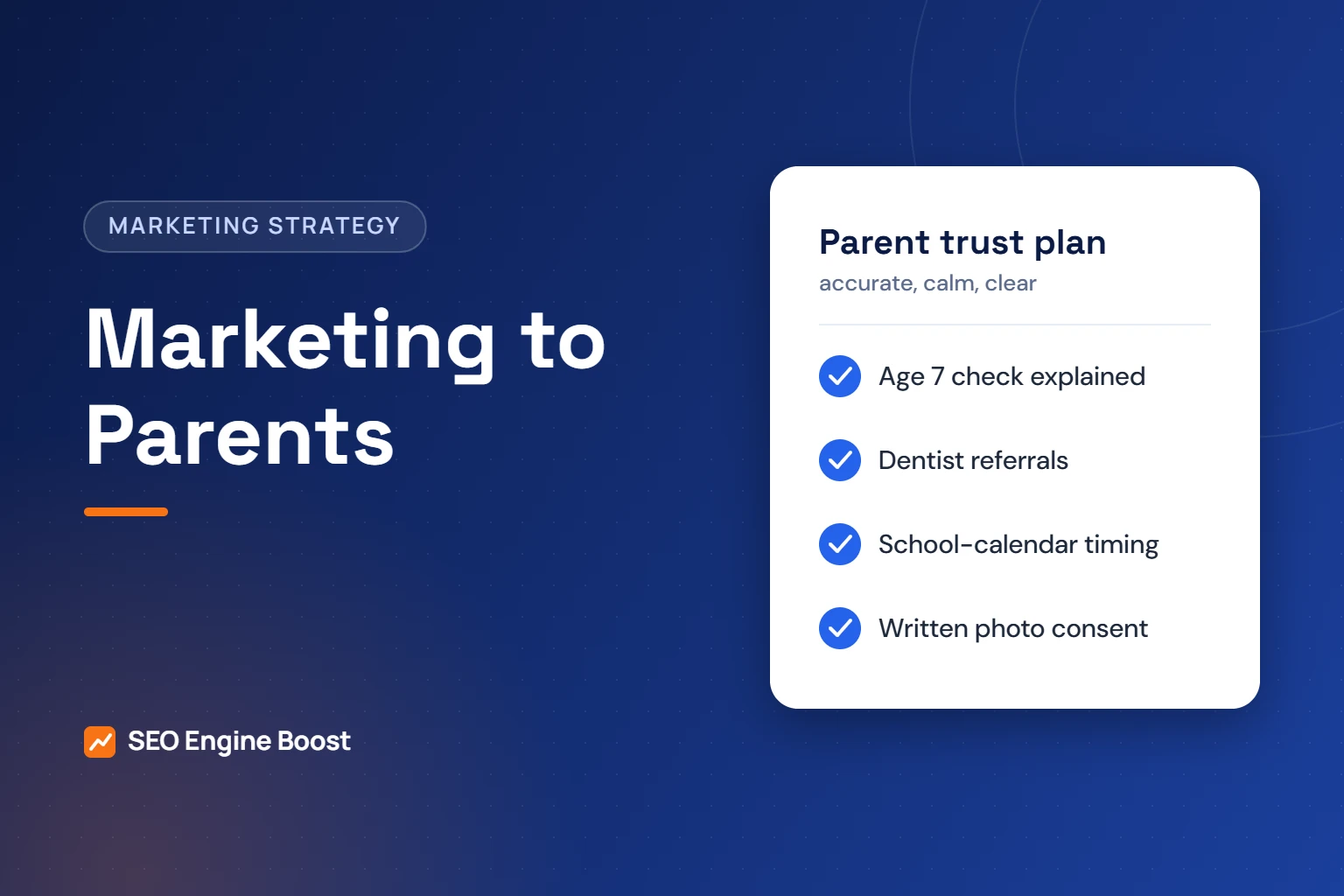
Orthodontic Marketing to Parents: Early Checks, Trust and Timing
Orthodontic marketing to parents works when you treat parents as careful buyers. Explain the AAO advice of a first orthodontic check by age 7. Make clear that many early visits end with monitoring, not treatment. Then earn dentist referrals, time campaigns to the school calendar, and publish clear insurance and payment information.
Parents are making a health decision for someone else. They worry about doing too much, too soon, or too little, too late. Calm, accurate content wins their trust. This guide covers what parents search, how to build trust, referral and timing tactics, and how to feature children safely and legally.
Key takeaways
- The AAO recommends a first orthodontic check-up no later than age 7. Many of those visits lead to monitoring, not treatment.
- Parents trust calm, accurate explanations. Never promise outcomes from early treatment.
- General and pediatric dentists, school-calendar timing and clear payment options drive many parent decisions.
- Never feature a child’s photo or story without the parent’s written authorization.
In this article
- Why parents are a different kind of buyer
- The age 7 check: what the AAO says
- What parents search for
- Building trust with parents
- Referrals from general and pediatric dentists
- Timing campaigns to the school calendar
- Insurance and payment plans
- Content for Phase 1 versus waiting
- Consent and privacy when featuring children
- Frequently asked questions
Why parents are a different kind of buyer
With children and teens, the patient and the buyer are different people. The parent books, pays and signs. The child has to wear the appliance and show up.
Parents usually want answers to four questions:
- Does my child need treatment, and when?
- Can I trust this orthodontist with my child?
- What will it cost, and what will insurance cover?
- How will visits fit around school and activities?
Your marketing should answer each one in plain language. A parent who feels pushed toward treatment will often seek a second opinion or wait.
The age 7 check: what the AAO says
The AAO recommends that a child’s first orthodontic check-up happen when a problem is first noticed, and no later than age 7. Its early treatment article explains why. By then, enough permanent teeth have come in for an orthodontist to assess tooth and jaw development.
The AAO also says an early check-up is often more about information than immediate treatment. It describes three possible outcomes:
- No treatment is needed.
- The child is monitored as the face and jaws grow.
- A developing problem may suit early treatment.
Use this framing in your marketing. Present the age 7 visit as a check, not a sales step. Say plainly that many children are simply monitored. That honesty is your strongest trust signal.
What parents search for
Parents search in their own words, not in clinical terms. The examples below are typical phrasings, not keyword volume data. Map each type of question to one page.
| Question type | Example phrasing | Page that answers it |
|---|---|---|
| Timing | “when should my child see an orthodontist” | Age 7 check-up page |
| Need | “does my 8 year old need braces” | Early treatment versus waiting page |
| Specific problem | “child crossbite treatment” | Problem pages reviewed by the orthodontist |
| Cost | “how much are braces for kids” | Cost, insurance and payment plans page |
| Teens | “Invisalign for teens vs braces” | Teen treatment options page |
| Local | “kids orthodontist near me” | Google Business Profile and location page |
Each page should start with a short, direct answer. Then add detail, photos of your team and a clear next step. Our content marketing guide for orthodontists explains how to plan and review these pages.
Building trust with parents
Parents look for signs that your office is safe, kind and honest. Small details matter.
- Introduce the orthodontist and team with real photos and short bios.
- Explain what happens at a first visit, step by step, and how long it takes.
- Say clearly that a check-up does not commit anyone to treatment.
- Show reviews from parents, and reply to them without sharing any patient details.
- Describe how you communicate with parents during treatment.
Avoid fear-based messages, such as warnings that waiting will cause harm. They may work once, but they erode trust with careful parents.
Referrals from general and pediatric dentists
Many families arrive because their dentist suggested an orthodontic check. That referral carries trust that no ad can buy. Treat referring dentists as long-term partners.
- Make referring easy: a short online form, a direct phone line and clear fax or email options.
- Send a timely report after each referred consult, with your findings and plan.
- Tell the dentist when you are only monitoring a child, so they hear from you, not the parent.
- Share plain-language handouts the dentist can give parents about the age 7 check.
Keep professional referrals relationship-based. Rules on referral incentives vary and can be strict. Our guide to orthodontic referral marketing covers referral programs and their legal limits.
Want a parent-focused marketing review?
We will check your early-treatment pages, Google Business Profile and referral flow, and list the fixes that matter most.
Timing campaigns to the school calendar
Parents plan around school. Your content and campaigns should follow the same calendar. The table below is agency guidance, not research.
| Period | Parent mindset | What to promote |
|---|---|---|
| Late spring | Planning summer schedules | Summer consults and starts |
| Summer | More free time for visits | Age 7 checks and longer appointments |
| Back-to-school | Routines, sports and photos | After-school hours and sports mouthguard tips |
| Late fall | Year-end benefits and budgets | Insurance and FSA reminders, where relevant |
| Winter break | Short window for visits | Consults and records appointments |
The AAO notes that FSAs often follow a “use it or lose it” policy within the calendar year. A late-fall reminder can help parents who have unused funds. Ask them to confirm their own plan rules.
Insurance and payment plans
Cost is a major parent concern, and clear information removes a big barrier. The AAO’s cost guide gives useful points to echo.
- Insurance typically covers a percentage of the fee or provides a fixed benefit, according to the AAO.
- Parents should check for lifetime maximums or age limits on orthodontic coverage.
- Many practices offer in-house payment plans, often with low or no interest, the AAO says.
- FSAs and HSAs let families use pre-tax dollars for eligible orthodontic treatment.
- Some charitable programs provide treatment to children under 18 at low or no cost.
Publish the plans you actually offer, the insurers you work with, and what your fees include. Our guide to showing prices and financing on your website covers layout and wording. If you offer free consultations, say so. The AAO notes most of its members offer low-cost or free initial consultations.
Content for Phase 1 versus waiting
Parents often ask whether to treat now or wait. Your content should present both paths neutrally. Let the consult decide for each child.
The AAO explains that many problems are best treated after all permanent teeth come in. It also says early treatment can help when a problem could become more serious over time. A later course of treatment may still be needed.
| Topic | Accurate framing | Avoid |
|---|---|---|
| Purpose of Phase 1 | May guide jaw growth or create space for incoming teeth | “Prevents braces later” |
| Who needs it | Only some children, after an exam | “Every child should start early” |
| Waiting | Monitoring is a valid, common plan | “Waiting will make it worse” |
| Outcomes | Depend on the child’s growth and cooperation | “Guaranteed results” or fixed timelines |
Have the treating orthodontist review each early-treatment page before it goes live. Add the reviewer’s name and the date.
Consent and privacy when featuring children
Photos of smiling kids are powerful. They also carry legal and ethical duties. This section is general information, not legal advice. Check your state’s rules and ask a healthcare attorney if unsure.
Under HIPAA, HHS says using protected health information for marketing generally requires the patient’s written authorization. HHS also says a parent or guardian is usually a minor’s personal representative. State law can change this in some cases.
- Never use a patient’s photo, name or story without written authorization.
- For minors, get written authorization from the parent or legal guardian.
- Use a specific form that names where the content will appear and for how long.
- Ask the child too, in age-appropriate words. Do not feature a child who does not want to be shown.
- Leave out full names, schools and anything that could locate the child.
- Make it easy to withdraw consent, and remove content promptly when asked.
Privacy also applies to your website. Our guide to tracking pixels and patient privacy explains the risks of ad tracking on patient pages.
Frequently asked questions
What age does the AAO recommend for a first orthodontic check?
The AAO recommends a first check-up with an orthodontist when a problem is first noticed, and no later than age 7. By then, enough permanent teeth are present to assess development. The AAO says this visit is often about information, and many children need no treatment or are simply monitored.
Should our marketing promote Phase 1 treatment?
Promote the age 7 check, not Phase 1 itself. Explain that early treatment helps some children with certain problems, and that many are monitored instead. The AAO notes a later course of treatment may still be needed. Avoid promises about outcomes, and let the exam decide what each child needs.
When should we run campaigns aimed at parents?
Follow the school calendar. Late spring and summer suit consults and starts, because families have more flexible time. Back-to-school suits after-school hours. Late fall suits reminders about insurance benefits and FSA funds, where relevant. This timing is agency guidance, so compare it with your own consult data.
Can we post photos of child patients on social media?
Only with written authorization from the parent or legal guardian. HHS says using health information for marketing generally needs written authorization, and parents are usually a minor’s personal representative. Use a specific consent form, leave out identifying details, and remove content promptly if consent is withdrawn. Check state law too.
How do we get more referrals from pediatric dentists?
Make referring easy, and report back quickly after each consult. Tell the dentist your findings and plan, including when you are only monitoring. Share simple parent handouts about the age 7 check. Keep the relationship professional, and review referral incentive rules before offering anything of value.
Sources
- American Association of Orthodontists: What Are the Benefits of Early Orthodontic Treatment? (August 20, 2026)
- American Association of Orthodontists: Child Orthodontics: Pediatric Braces and Early Treatment (last modified September 30, 2026)
- American Association of Orthodontists: How Much Do Braces Cost? Financing Options for Orthodontic Treatment (October 16, 2025)
- U.S. Department of Health and Human Services: Marketing (HIPAA Privacy Rule guidance)
- U.S. Department of Health and Human Services: Personal Representatives (content last reviewed January 5, 2024)
Keep reading
See where your practice stands
If you would like a second pair of eyes on your own practice, we offer a free growth audit: a manual review of your local visibility, website, reviews and content, with a prioritized list of what to fix first.