How to Handle Negative Reviews as an Orthodontist
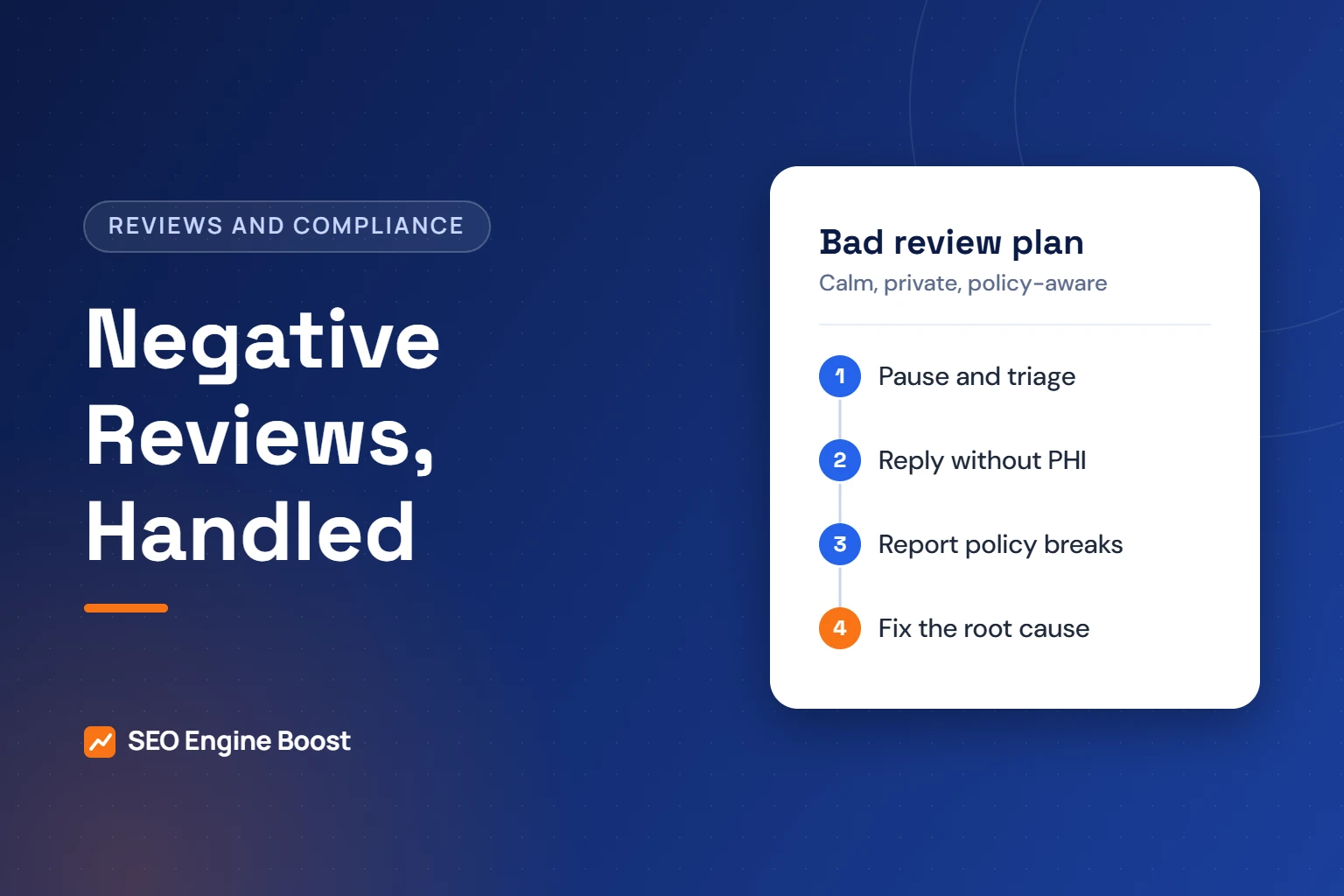
Handle orthodontist negative reviews in four steps. Pause and triage the review first. Reply briefly in public without confirming the person is a patient. Report it to Google only if it breaks a specific policy. Then take the conversation offline and fix the underlying problem. Never share treatment details or pressure anyone to remove a review.
This guide covers each step for practice owners and managers. It explains what HHS enforcement says about review replies, which Google policies allow removal and what the FTC prohibits. It is general information, not legal advice. Check with your attorney and state dental board for your situation.
Key takeaways
- A public reply must never confirm that the reviewer is a patient or mention treatment, billing or insurance details.
- HHS settled with a Dallas dental practice in 2019 and a New Jersey provider in 2023 over review replies that disclosed patient information.
- Google removes reviews only for policy violations, such as conflicts of interest or off-topic content, not because a review is negative.
- Under the FTC’s 2024 reviews rule, unfounded legal threats and intimidation to remove reviews are prohibited.
In this article
- Step 1: Pause and triage the review
- Why HIPAA limits what you can say in a reply
- Step 2: Write a HIPAA-safe public reply
- Step 3: Report reviews that break Google’s policies
- What not to do: FTC and Google red lines
- Step 4: Take the conversation offline
- Step 5: Learn from the pattern, not just the review
- Step 6: Recover with a steady flow of genuine reviews
- Write it down: a simple review response policy
- Frequently asked questions
Step 1: Pause and triage the review
A negative review stings, especially after months of careful treatment. Replying within minutes is the most common way practices make it worse. Set a rule that no one replies until the review is triaged.
Triage means answering three questions. Is this a real patient or parent? Does the review break a Google policy? Is there a real service problem behind it? The answers decide what you do next.
| Review type | Example | What to do |
|---|---|---|
| Genuine complaint | A parent says the office never called back about a broken bracket | Reply publicly with a short, PHI-free message. Call the family privately. |
| Unclear identity | A one-star rating with no text and an unfamiliar name | Reply with a neutral, general message. Do not try to identify the person in public. |
| Possible policy violation | A review from a former employee or a competing office | Report it in Google’s tools. Reply only if the review stays up. |
| Abusive or personal | Profanity, threats or personal attacks on a team member | Report it. Document it. Do not reply in kind. |
Log every negative review in a simple spreadsheet. Record the date, platform, theme and action taken. That log becomes your improvement data later.
Why HIPAA limits what you can say in a reply
The reviewer chose to share their story. That does not give the practice permission to share anything back. HHS has acted on review replies more than once.
- Elite Dental Associates (Dallas, 2019). HHS’s resolution agreement describes a Yelp reply by the practice. It included a patient’s “last name, details of her treatment plan, insurance and cost information.” The practice paid $10,000 and adopted a corrective action plan.
- Manasa Health Center (New Jersey, 2023). HHS cited “impermissible disclosures of patient protected health information in response to negative online reviews.” The provider paid $30,000 and agreed to a corrective action plan.
Both cases also cited missing policies for handling patient information. Elite’s agreement specifically named a failure to have policies about “releasing PHI on social media/public platforms.”
The ADA Code of Ethics points the same way. Section 1.B says dentists “are obliged to safeguard the confidentiality of patient records.” A review reply is a public record that anyone can read and screenshot.
For more on reply rules, see our guide to responding to patient reviews under HIPAA and our HIPAA marketing basics for orthodontic practices.
Step 2: Write a HIPAA-safe public reply
A safe reply is short, polite and generic. It shows future patients that you listen. It does not argue the facts in public.
What a safe reply does and avoids
| Do | Avoid |
|---|---|
| Thank the person for the feedback | Confirming they are, or were, a patient |
| State your general standard of care or service | Mentioning treatment type, appliances, dates or results |
| Invite them to call a named role, such as the office manager | Discussing balances, insurance or payment plans |
| Keep it to two to four sentences | Correcting their account point by point |
| Sign as the practice | Naming staff members the reviewer criticized |
Three reply templates
- General complaint: “Thank you for sharing this. We take every concern seriously and want every family to feel heard. Please call our office manager at [main number] so we can talk privately.”
- Wait time or scheduling: “We are sorry this visit felt frustrating. Respecting your time matters to us, and we are reviewing how we schedule. Please call [main number] if you would like to talk.”
- Unknown reviewer: “We could not match this feedback to a conversation with our team. We would welcome a call at [main number] to learn more.”
Note what the third template avoids. It does not say “we have no record of you as a patient.” Confirming or denying patient status in public can itself reveal information.
Our free HIPAA-safe review reply generator drafts replies in this style. Have a trained team member check every draft before posting.
Treat every reply as permanent. Prospective patients may read it for years, and anyone can screenshot it.
Step 3: Report reviews that break Google’s policies
Google’s Business Profile help page is direct: “Do not report a review just because you disagree with it or dislike it.” Only reviews that violate Google’s policies are eligible for removal.
These categories from Google’s prohibited and restricted content policy come up most often for practices:
- Rating manipulation from conflicts of interest. Google lists “current or former employment” and “industry competitors” as conflicts.
- Fake engagement. Content not based on a real experience, including posts on a competitor’s listing to damage its reputation.
- Off-topic content. Content not based on an experience at the location, such as general political commentary or personal rants.
- Harassment and offensive content. Threats, doxxing, personal attacks and unsubstantiated accusations of unethical or criminal conduct.
- Personal information. Sharing someone’s personal details without consent.
How to report and appeal
- Open your Business Profile, go to Read reviews and use the report option next to the review. You can also use Google’s Reviews Management Tool.
- Pick the policy reason that matches the review. Keep screenshots and notes on why it qualifies.
- Check the status in the Reviews Management Tool. Google says evaluation “typically takes several days.”
- If the status says no policy violation, you can submit a one-time appeal. Google emails the final decision.
If the review stays up, reply to it with a calm, PHI-free message. A measured reply often helps a reader more than a removal would.
Want a second pair of eyes on your reviews?
Our free growth audit checks your review profile, reply habits and Business Profile alongside your search visibility.
What not to do: FTC and Google red lines
Frustration can push a practice toward tactics that create new legal or policy problems. The FTC’s Trade Regulation Rule on consumer reviews and testimonials took effect October 21, 2024.
- Review suppression. Section 465.7 prohibits using unfounded legal threats, intimidation or knowingly false public accusations to stop or remove a review.
- Hiding negative reviews on your own site. The same section covers suggesting your displayed reviews represent all reviews while hiding negative ones by rating or sentiment.
- Buying sentiment. Section 465.4 prohibits offering incentives for reviews that express a particular sentiment, positive or negative.
- Review gating. Google’s policy prohibits businesses that “discourage or prohibit negative reviews, or selectively solicit positive reviews from customers.”
- Incentives on Google. Google also prohibits offering payment, discounts or free goods or services for reviews.
A real defamation claim is a matter for your attorney, not your front desk. Do not send threatening messages to reviewers on your own.
Step 4: Take the conversation offline
The public reply opens a door. The phone call is where you solve the problem. Assign one trained person, usually the office manager or treatment coordinator, to make that call.
- Call within one business day of the review, if you can identify the family through your own records.
- Listen first. Ask what outcome they want. Do not debate the timeline.
- Offer a concrete next step, such as an appointment with the doctor or a billing review.
- Document the call in the patient record under your privacy policies.
- Do not ask them to delete or change the review. If they choose to update it, that is their decision.
Some families will update a review after a good conversation. Some will not. Either way, the call often protects the treatment relationship, which matters more than one star rating.
Step 5: Learn from the pattern, not just the review
One review is an anecdote. Five reviews about the same issue are a process problem. Review your log monthly and group complaints by theme.
| Complaint theme | Process to check | Possible fix |
|---|---|---|
| Long waits at adjustments | Schedule templates and appointment lengths | Adjust block lengths for common visit types |
| Surprise costs | How fees and financing are explained at the consult | Give a written fee summary before the start date |
| Hard to reach the office | Missed calls and voicemail response times | Track missed calls and set a callback standard |
| Emergency access | Instructions for broken brackets or poking wires | Publish clear after-hours guidance on your website |
| Parents feel uninformed | Updates after visits for minors | Use a short visit summary for parents |
These themes are agency guidance on where problems often hide, not research findings. Your own log is the real source. If calls are a theme, our guide on orthodontic missed calls shows how to measure them.
Step 6: Recover with a steady flow of genuine reviews
The best long-term answer to a negative review is more honest reviews from your whole patient base. Ask every patient or parent at natural moments, such as debond day or a retainer check.
Ask everyone the same way. Selecting only happy patients is review gating, which Google prohibits. Our guide to getting more Google reviews covers compliant request scripts and timing.
Reputation work sits inside a broader local strategy. Our orthodontic reputation management service covers review requests, reply drafting and monitoring, with your team approving every reply.
Write it down: a simple review response policy
Both HHS cases above cited missing policies. A one-page written policy is the cheapest protection you can add this month.
- Who replies: one or two trained people, not every team member with login access.
- Approval: a second person checks each negative-review reply before posting.
- Content rule: no patient status, treatment, appointment, billing or insurance details.
- Timing: triage within one business day; reply after triage, never in anger.
- Escalation: threats, legal claims or media contacts go to the owner and attorney.
- Training: review the policy with new staff and once a year with everyone.
Handling reviews well is part of a wider reputation plan. Our orthodontic marketing agency work includes review requests, HIPAA-safe replies and monitoring.
Frequently asked questions
Should an orthodontist reply to every negative review?
Usually yes, with a short and generic message. A calm reply shows future patients that the practice listens. Skip the reply only while a report to Google is pending, or when replying could escalate harassment. Never confirm the reviewer is a patient or mention any treatment, billing or insurance details in a public reply.
Can I say a reviewer was never our patient?
It is safer not to. Confirming or denying patient status in public can reveal information about a person. Instead, say you could not match the feedback to a conversation with your team and invite them to call. If you believe the review is fake, report it through Google’s tools with your evidence.
Will Google remove a negative review if it is unfair?
Not for unfairness alone. Google’s help page says not to report a review just because you disagree with it. Google removes reviews that break its policies, such as conflicts of interest, fake engagement, off-topic content or harassment. You can appeal a decision once through the Reviews Management Tool.
Can we offer a discount if a patient updates a bad review?
No. Google’s policy prohibits offering incentives such as discounts or free services for reviews. The FTC’s 2024 rule also prohibits incentives tied to a particular sentiment. Resolve the patient’s concern on its own merits. If they choose to update the review afterward, that is their decision.
Who in the practice should answer negative reviews?
One or two trained people, usually the owner or office manager, with a second person checking each reply. Give them a written policy that bans patient details in replies. HHS settlements with a dental practice in 2019 and a provider in 2023 both cited missing policies for protecting patient information.
Sources
- HHS Office for Civil Rights: Elite Dental Associates Resolution Agreement and Corrective Action Plan (September 30, 2019)
- HHS Office for Civil Rights: Agreement with Health Care Provider in New Jersey That Disclosed Patient Information in Response to Negative Online Reviews (June 2023)
- Google Maps: Prohibited and restricted content policy
- Google Business Profile Help: Remove reviews from your Business Profile
- eCFR: 16 CFR Part 465, Use of Consumer Reviews and Testimonials (FTC rule effective October 21, 2024)
- American Dental Association: Principles of Ethics and Code of Professional Conduct (revised to October 2024)
Keep reading
Reviews and Compliance
How to Get More Google Reviews for Your Orthodontic Practice (Within the Rules)
See where your practice stands
If you would like a second pair of eyes on your own practice, we offer a free growth audit: a manual review of your local visibility, website, reviews and content, with a prioritized list of what to fix first.