Orthodontic Online Booking: Should Families Book Their Own Consult?
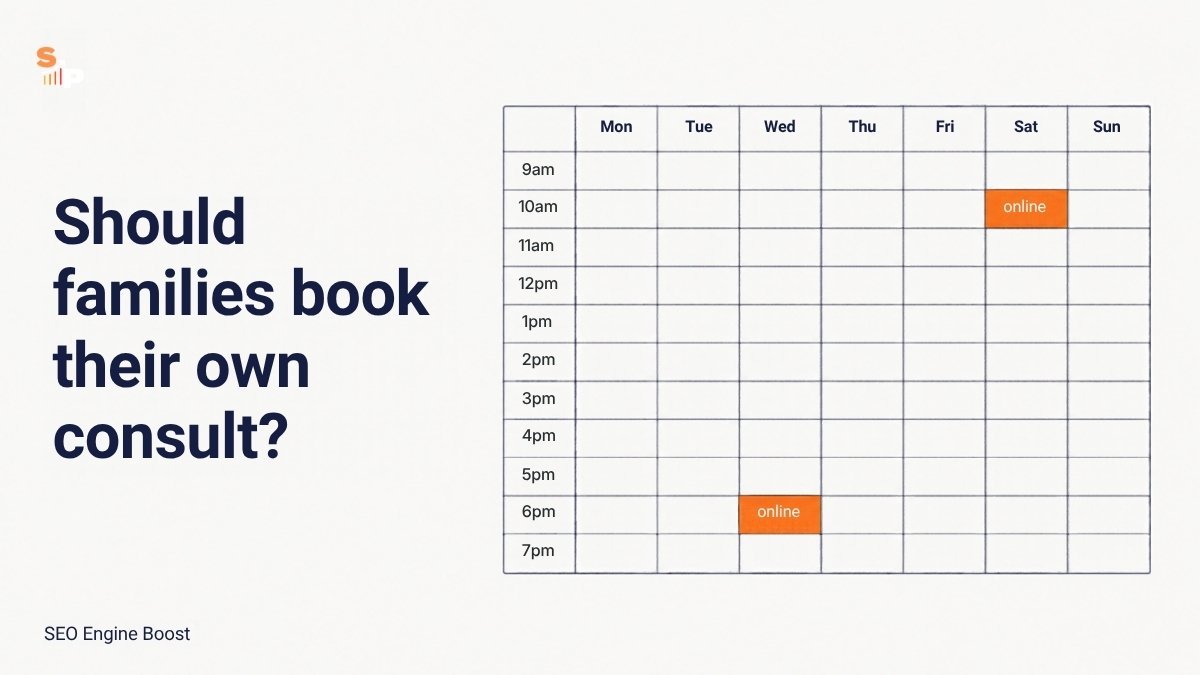
Yes, most orthodontic practices should let new families book a consult online, as one option next to the phone. It works best when bookings land straight in your practice software and the page tells parents what the visit costs. Don’t expect it to fix no-shows on its own. The evidence for that is thin.
This guide is for owners and office managers deciding whether to turn self-booking on, or wondering why their widget is quiet.
This is general information, not legal advice. Talk to your compliance contact before you add a tool that handles patient information.
Does online booking reduce consult no-shows?
Not by much, based on the best study we found with children. A Mayo Clinic study of well-child visits found a 3.07% no-show rate for self-scheduled visits and 4.12% for staff-scheduled ones. The difference was not statistically significant. Offer online booking because some parents want it. It won’t cure no-shows.
The study covered 13 months of well-child appointments for children aged 2 to 12, published in JMIR Medical Informatics in 2021. Two numbers matter. The no-show gap (3.07% vs 4.12%) had a p value of .12, so it could be chance. And among families registered for the patient portal, who could book online, only 912 of 17,740 finalized appointments were self-scheduled. That is about 5%. Even with the option in hand, most parents still booked through staff.
Well-child visits are not orthodontic consults, so read it as a hint for your office. Online booking adds a door for the parent who is up at 10 p.m. and won’t call. In the same study, 29.5% of self-scheduling actions happened outside weekday hours of 7 a.m. to 5 p.m. It does not replace the phone or the follow-up on missed consults, which our guide to orthodontic consult no-shows covers.
You may see the claim that 80% of patients prefer providers with online scheduling. We traced it to a 2017 HealthLeaders article tagged as sponsored content. It was about physician appointments, not dentistry, so we left it out.
Self-booking, request-a-time or phone only: which fits your office?
Real-time self-booking suits practices whose software can expose a few new-patient slots safely. A request-a-time form suits offices that want a person to check every booking first. Phone only makes sense when consult time is so tight that each slot needs triage. A sensible path is to start with request-a-time and switch to real-time once you trust the setup.
| Model | What the parent does | Front desk work | Main risk | Fits when |
|---|---|---|---|---|
| Real-time self-booking | Picks an open consult slot and gets a confirmation on screen | Review new bookings each morning; confirm by text or call | Wrong appointment type, wrong location or a slot that should have been held | Your practice software integrates directly and you can limit which slots show |
| Request-a-time form | Chooses preferred days and times, then waits for a reply | Call or text back quickly, book in the software | Slow replies; the family books elsewhere while waiting | You want a person to screen every new patient before the slot is held |
| Phone only | Calls during office hours | Answer, book, confirm | Evening and weekend inquiries go nowhere | Consults need heavy triage (for example, complex transfers) or the team is very small |
With request-a-time, reply speed decides everything. See our guide to consultation request follow-up.
What to ask your practice software and booking vendor
Ask whether bookings write directly into your practice software, which appointment types and slots you control, whether the vendor will sign a business associate agreement, what data reaches analytics or ad pixels, and whether each booking carries a confirmation number your team can record as the referral reference.
This is the checklist we’d take into a demo, whether the tool comes from your practice software (Cloud 9, Dolphin, OrthoTrac, Edge Cloud or another) or a separate company. We have not tested each integration, so get the answers in writing.
- Does a booking land in our schedule automatically? Or does someone retype it?
- Can we expose only new-patient consult slots? You should choose the days, times, chairs and doctor, and keep adjustments and emergencies off the online calendar.
- Can we set minimum notice and a daily cap? For example, 24 hours’ notice and three a day.
- Who is notified, and how fast? The treatment coordinator should know the same day.
- Will you sign a business associate agreement? The tool stores your patients’ names, birth dates and contact details.
- What goes into page URLs, analytics and ad pixels? Ask for a list. Names, emails, phone numbers and the reason for the visit should never appear there.
- Does each booking have a confirmation number? Pasted into the chart’s referral note, it links the booking to a started case later.
- How do families cancel or move the visit? A self-serve link should free the slot for someone else.
What should an orthodontic booking page show?
A booking page should answer what a parent wonders just before choosing a slot. That means a treatment cost range or starting price, what happens at the consult and how long it takes, who needs to attend, whether there is a fee, and, for parents of young children, the American Association of Orthodontists’ age-7 check-up advice.
Many practice websites leave this out. In October 2026 we reviewed 30 orthodontic homepages in the 10 largest US cities. Twenty-five showed no treatment cost figure, and 26 never mentioned the age-7 check. The full method is in our orthodontic website study.
Put these beside the calendar:
- Cost. A typical range or a “treatment starts from” figure, plus whether the consult is free and whether you offer monthly payment plans.
- What the visit includes. Say plainly what happens in your office (for example, an exam, any photos or X-rays you take, and a conversation about options) and roughly how long it lasts.
- Age 7. The AAO recommends a first orthodontic check-up no later than age 7. One line telling parents they can book a check for a young child, even if treatment may not start yet, answers a question many of them have.
- Who should come. Usually a parent or guardian with any child under 18. Check your state’s consent rules.
- A fallback. “No time that works? Call us or request a time,” with the phone number and a short form.
Keep the form itself short. Name, date of birth, phone, email and preferred location are usually enough to book. Don’t ask for the reason for the visit in a free-text box. Parents will type clinical details into it.
What are the HIPAA and text-message basics?
Have a business associate agreement with the booking vendor. Keep ad and analytics pixels from collecting what parents type on the booking page, because HHS guidance names scheduling pages as a place where tracking can reach patient information, even though a court vacated part of it in 2024. And get clear consent before you send appointment texts.
The HHS Office for Civil Rights bulletin on online tracking technologies gives an example that fits this page exactly. Tracking on a public page that lets people schedule appointments “may have access to PHI in certain circumstances,” such as an email address or a reason for care typed into the form. A federal court vacated part of that bulletin in June 2024 (American Hospital Association v. Becerra), so ask your compliance contact how it applies. The practical step is the same: keep ad pixels off the booking and confirmation pages unless compliance has cleared them. See tracking pixels and patient privacy.
Reminder texts follow separate rules. Our guide to orthodontic text message consent explains what to put next to the phone field.
How do you track booked consults in GA4 without patient data?
Count the booking and leave the family’s details out. Fire one GA4 event, such as consult_booked, when the confirmation screen loads, and mark it as a key event. Send no name, email, phone or visit reason in the event, the page URL or the page title. Then record the booking’s confirmation number in the chart.
Google’s own rule is strict here. Its help page on avoiding personally identifiable information says the URL path, its parameters and page titles must be free of PII, and warns that visitors sometimes type PII into form fields. Check whether your booking tool puts the patient’s email or name in the confirmation URL. Test it with a made-up name and read the address bar.
If your widget runs in an iframe on the vendor’s domain, GA4 may see the click on “Book” but not the finished booking. Ask the vendor to send families to a thank-you page on your own site after booking, which gives you a clean event to count. Our orthodontic GA4 setup guide covers key events.
Want a second pair of eyes on your booking page? A free growth audit is a short written review, done by a person, with a prioritized list of what to fix first.
Worked example: a 60-day online booking pilot
You don’t need to open the whole calendar to test this. The figures below are invented to show the arithmetic. They are not client results.
- Open a small block. Make four new-patient consult slots a week bookable online: two on a weekday evening and two on Saturday morning, if you open then.
- Tag the source. Every online booking gets the referral source “Online booking” and its confirmation number in the chart.
- Compare after 60 days. Look at show rate and consult-to-start for online bookings against phone bookings in the same period.
| Measure (60 days, invented) | Online bookings | Phone bookings |
|---|---|---|
| Consults booked | 14 | 58 |
| Attended | 12 (86%) | 50 (86%) |
| Booked outside office hours | 9 of 14 | 0 |
| Started treatment by day 90 | 5 of 12 attended | 21 of 50 attended |
How to read it: online booking did not change the show rate in this example, and it should not have to. Its value is the 9 families who booked when nobody could answer the phone. If online bookings attend about as often as phone bookings, keep the slots and add more. If they attend far less, add a confirmation call first. Either way, check starts again after a full quarter, because families who book online may start months later.
Frequently asked questions
- Should an orthodontic practice offer online booking for new patients?
- For most practices, yes, alongside the phone. Start with a few dedicated consult slots, make sure bookings write into your practice software, and check results after a quarter.
- Will online booking reduce our consult no-shows?
- Probably not much on its own. In a Mayo Clinic study of children’s well-child visits, self-scheduled appointments had a slightly lower no-show rate, but the difference was not statistically significant. Keep your confirmation texts and treatment coordinator follow-up in place.
- Is it HIPAA compliant to let patients book online?
- It can be. The usual basics are a business associate agreement with the booking vendor, no ad or analytics pixels collecting what families type, and no patient details in URLs. Ask your compliance contact to review the specific tool before launch.
- Should we let families book any appointment type online?
- No. Limit it to new-patient consults. Adjustments, emergencies and debonds need the team’s judgment about chair time.
- How do we know if online bookings turn into starts?
- Give online bookings their own referral source in your practice software and paste the confirmation number into the chart. Run your referral report by start date each quarter and compare online bookings with phone bookings.
Sources
- North F, et al. Impact of Web-Based Self-Scheduling on Finalization of Well-Child Appointments in a Primary Care Setting. JMIR Medical Informatics, 2021;9(3):e23450
- HHS Office for Civil Rights: Use of Online Tracking Technologies by HIPAA Covered Entities and Business Associates (checked Nov 23, 2026)
- Google Analytics Help: Best practices to avoid sending Personally Identifiable Information (PII)
- American Association of Orthodontists: Child orthodontics
Not sure your booking page is doing its job?
Ask for a free growth audit. A person reviews your local visibility, website and AI search readiness and sends you a short written list of what to fix first. No patient data needed.