Google AI Overviews and Orthodontic Searches: What Changes
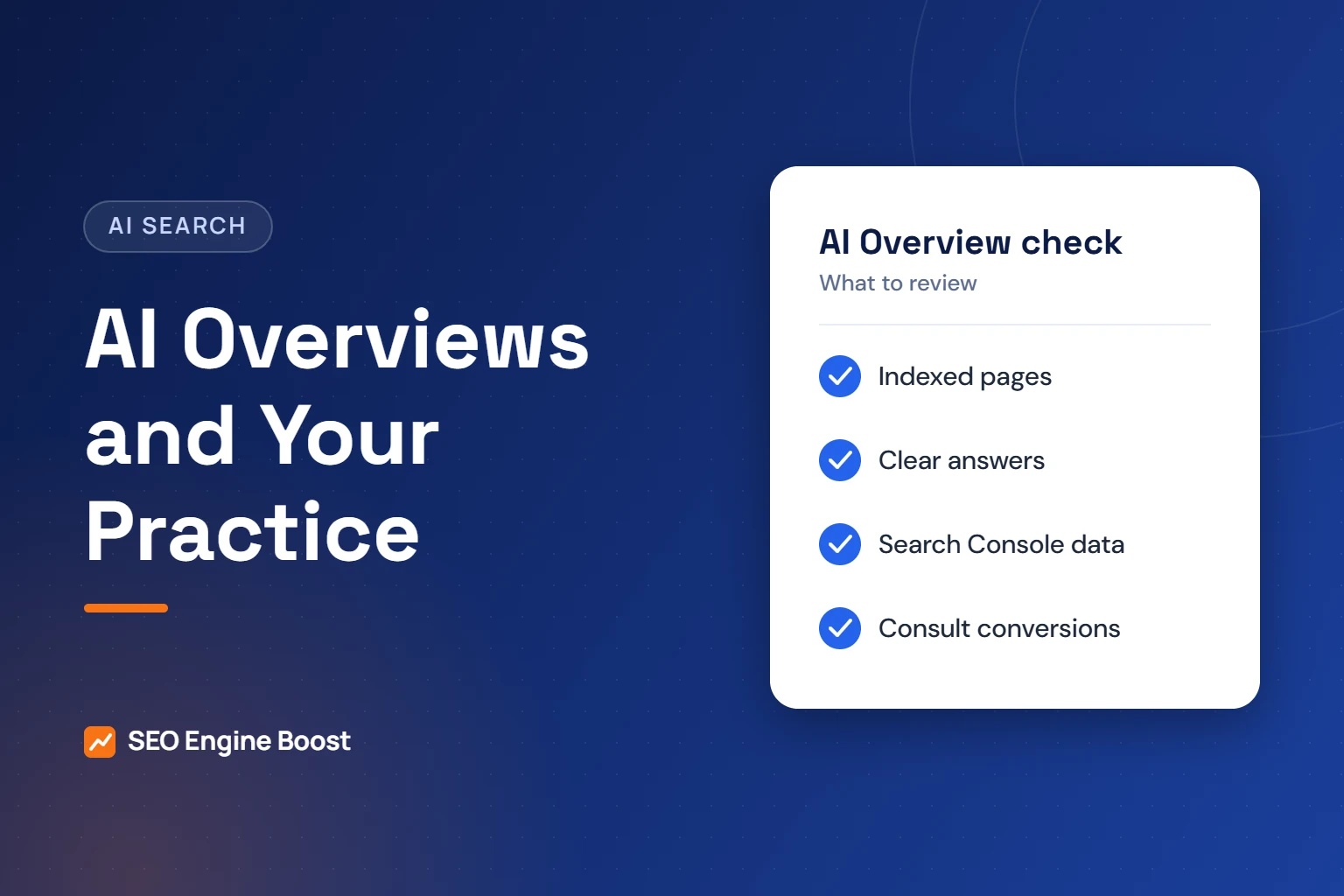
Google AI Overviews place a generated summary above the usual results for some searches, including many orthodontic questions. Fewer searchers may click through to your site. Google says there is no special markup or extra optimization needed to appear. Indexed, helpful pages remain the path, and Search Console plus GA4 show the effect.
This guide explains how AI Overviews work, what independent research says about clicks and citations, and what Google itself recommends. It ends with a simple way to measure the change on your own site, so you can act on your data instead of headlines.
Key takeaways
- Google says no special schema, AI text files or extra optimization are needed to appear in AI Overviews.
- Pew Research found users clicked a regular result on 8% of visits with an AI summary, versus 15% without one (March 2025 data).
- AI Overviews draw on related sub-searches (query fan-out), so pages outside the top 10 can be cited.
- Measure the effect with Search Console and consult conversions, not traffic alone.
In this article
- What an AI Overview is and when it appears
- Which orthodontic searches are most affected
- What research says about clicks
- Where AI Overview citations come from
- What Google says helps you appear
- How to write orthodontic pages a summary can use
- What does not move the needle
- How to measure the effect on your practice
- A 30-day plan for orthodontic practices
- Frequently asked questions
What an AI Overview is and when it appears
An AI Overview is a short generated answer at the top of some Google results pages. It includes links to supporting pages on the web. Searchers can still scroll past it to the regular results.
Google also describes a technique called query fan-out. In its May 2025 AI Mode announcement, Google said the system breaks a question into subtopics and runs many searches at once. Its Search Central documentation says both AI Overviews and AI Mode may use this technique.
For an orthodontic practice, that means one patient question can trigger several hidden searches. A question about adult braces may also pull in pages about cost, treatment time and aligner options.
Which orthodontic searches are most affected
We have not found a public study that measures AI Overviews for orthodontic searches specifically. The table below is agency guidance. It sorts common searches by intent and suggests what to check on your own site.
| Search intent | Example search | What the searcher wants | Page that should answer it |
|---|---|---|---|
| Question | how long do braces take for adults | A clear, general answer | Treatment page or guide |
| Comparison | clear aligners vs braces | Pros, cons and fit | Comparison page |
| Cost | how much do braces cost | A range and what changes it | Pricing and financing page |
| Local | orthodontist near me | A nearby office to call | Business Profile and location page |
| Brand | [practice name] reviews | Proof and contact details | Home page, reviews, Business Profile |
Question and comparison searches are where a summary can satisfy the searcher without a click. Local and brand searches still lead to a call, a map listing or a visit. Watch both groups separately when you measure.
What research says about clicks
The most cited independent data comes from Pew Research Center. Pew studied the March 2025 browsing of 900 US adults who agreed to have their activity tracked.
| Pew finding (March 2025 data) | Result |
|---|---|
| Searches that produced an AI summary | 18% of 68,879 unique searches |
| Clicked a regular result, page with AI summary | 8% of visits |
| Clicked a regular result, page without AI summary | 15% of visits |
| Clicked a link inside the AI summary | 1% of visits |
These are general search numbers, not orthodontic data. Google offers a different view. In May 2025, Google wrote that clicks from results pages with AI Overviews are higher quality. It said those users are more likely to spend more time on the site. Google did not publish the underlying numbers in that post.
Pew’s sample covered every kind of search. Health and dental questions may behave differently. We could not find published click data for orthodontic searches, so treat these numbers as context, not a forecast.
The practical point is simple. Some informational traffic may fall, while visitors who do click may be closer to booking. Your own data decides which effect is larger.
Where AI Overview citations come from
Ahrefs has tracked which pages AI Overviews cite. In a July 2025 study, about 76% of cited pages also ranked in the top 10 for the search. In an update published in March 2026, that share fell to about 38%.
The March 2026 update analyzed 863,000 keyword results and 4 million AI Overview URLs. Ahrefs links the drop to query fan-out, since citations come from the sub-searches as well as the main one. Ahrefs also notes its method improved between studies, so the two numbers are not a perfect like-for-like comparison.
For a practice, this is mostly good news. A thorough page on one treatment topic can be cited for related questions, even if it does not rank first for the main search. Coverage of the full topic matters more than one keyword.
What Google says helps you appear
Google’s documentation is direct. It says there are no additional requirements to appear in AI Overviews or AI Mode, and no special optimizations are necessary. A page must be indexed and eligible to show a snippet.
Google’s May 2025 Search Central post lists the same basics it recommends for all search:
- Unique, valuable content. Write for patients, not for a keyword tool.
- A good page experience. Pages should work well on phones, load quickly and make the main content easy to find.
- Technical access. Googlebot must not be blocked, and the page must return a working status code.
- Preview controls. Tags such as nosnippet and max-snippet limit how your content appears, including in AI features.
- Structured data that matches the page. Markup must describe content people can see.
- Images, video and an up-to-date Business Profile. Google mentions these for multimodal searches.
For an orthodontic site, this points to clinically accurate treatment pages, real photos, a clear cost section and a complete Google Business Profile. Our AI search optimization for orthodontists service is built around these basics.
How to write orthodontic pages a summary can use
Google has not published a checklist for AI Overview citations. The points below are agency guidance. They follow Google’s advice on helpful content and the way fan-out searches break a question into parts.
- Answer first. Open each treatment page with a two or three sentence answer to the main question. Add detail below it.
- Cover the related questions. A braces page should also address time, cost range, discomfort, food rules and retainers.
- Use plain headings. A heading such as “How long do clear aligners take?” tells readers and search engines what follows.
- Keep it clinically accurate. Have a doctor review each page. Avoid promises such as guaranteed results or set treatment times.
- Show who wrote and reviewed it. A named reviewer and a review date help patients judge the page.
- Add your own photos and facts. Office photos, real financing terms and your actual process are details other sites cannot copy.
This is the same work that helps chat tools describe you correctly. Our overview of how AI search picks orthodontists to recommend covers the off-site signals, such as reviews and listings.
What does not move the needle
Many vendors sell special tricks for AI search. Google’s documentation says no new machine-readable files, AI text files or special schema.org markup are required.
Schema deserves a closer look, because it is often oversold. In a controlled test published in May 2026, Ahrefs compared 1,885 pages that added JSON-LD schema with 4,000 similar pages that did not. Adding schema produced no meaningful lift in citations in AI Overviews, AI Mode or ChatGPT.
Schema still has real uses, such as describing your offices to search engines. Our guide to schema markup for orthodontic practices covers what to add and what to skip.
Want to know how AI search sees your practice?
We can review your treatment pages, Business Profile and Search Console data to show where AI Overviews affect you.
How to measure the effect on your practice
Google says AI Overview and AI Mode traffic is counted in the Search Console Performance report under the Web search type. It sits together with your other search traffic. Use these steps to find the change.
- Split your pages into two groups. Group one is informational guides and treatment explainers. Group two is the home page, location pages and contact pages.
- Compare impressions and clicks. Look at the same months year over year, so seasonality does not mislead you.
- Watch click-through rate on stable rankings. If position holds but clicks fall, a summary may be answering the question.
- Check the queries yourself. Search your top 10 questions and note whether an AI Overview appears and whether you are cited.
- Follow conversions in GA4. Track consult requests and calls from organic search, not just sessions.
Here is a hypothetical example. A practice sees guide traffic drop by a fifth over a year. Over the same period, organic consult requests hold steady. That pattern suggests the lost clicks were early researchers, not ready patients. Our guide on how to measure orthodontic marketing explains which conversions to track.
Keep a simple monthly log. One row per question, with the date, whether an AI Overview appeared and whether your site was cited. After a few months, you will see a trend.
A 30-day plan for orthodontic practices
You do not need a new strategy for AI Overviews. You need the basics done well, then measured. This plan is agency guidance.
- Week 1: Confirm your key pages are indexed in Search Console. Fix any blocked or broken pages.
- Week 2: List the 10 questions new patients ask most. Check that each has a clear, accurate answer on your site, reviewed by your clinical team.
- Week 3: Update your Google Business Profile, photos and office hours. Make sure the website matches.
- Week 4: Record a baseline. Note which questions show an AI Overview and whether you are cited. Repeat monthly.
AI answers also appear outside Google. To see whether chat tools name your practice, follow our guide on how to check whether ChatGPT recommends your practice.
Clear facts and orthodontic schema markup help AI Overviews understand a practice. Our orthodontic SEO service builds both.
Frequently asked questions
Do AI Overviews show up for orthodontic searches?
They can. Pew Research found an AI summary on 18% of the Google searches it studied in March 2025. Questions about braces, aligners and cost are likely candidates. We have not found a public study of orthodontic searches specifically, so check your own top questions in Google and record what you see.
Do I need special schema to appear in AI Overviews?
No. Google’s documentation says no special schema.org markup, AI text files or extra optimization are required. A page must be indexed and eligible to show a snippet. A May 2026 Ahrefs test also found that adding schema did not meaningfully raise AI citations. Schema still helps describe your offices to search engines.
Will AI Overviews reduce my website traffic?
They may reduce clicks on some informational pages. Pew Research found users clicked a regular result on 8% of visits with an AI summary, versus 15% without one, in March 2025 data. Local and brand searches behave differently. Measure your own pages in Search Console and watch consult requests, not traffic alone.
Can I see AI Overview traffic in Search Console?
Google says AI Overview and AI Mode traffic is included in the Search Console Performance report under the Web search type. It is counted with your other search traffic. To estimate the effect, compare click-through rates on pages whose rankings stayed stable, and check your top questions by hand each month.
Can I stop Google from using my pages in AI Overviews?
Google says you can limit how your content appears with nosnippet, data-nosnippet, max-snippet or noindex. More restrictive settings also limit how your pages appear in regular results. For most practices, blocking is not helpful. Being cited with accurate information is usually the better goal.
Sources
- Google Search Central: AI features and your website (last updated Dec 10, 2025)
- Google Search Central Blog: Top ways to ensure your content performs well in Google’s AI experiences on Search (May 21, 2025)
- Google: AI in Search: Going beyond information to intelligence, Elizabeth Reid (May 20, 2025)
- Pew Research Center: Google users are less likely to click on links when an AI summary appears in the results (July 22, 2025)
- Ahrefs: Update: 38% of AI Overview Citations Pull From The Top 10 (Mar 2, 2026)
- Ahrefs: We Tracked 1,885 Pages Adding Schema. AI Citations Barely Moved. (May 11, 2026)
Keep reading
See where your practice stands
If you would like a second pair of eyes on your own practice, we offer a free growth audit: a manual review of your local visibility, website, reviews and content, with a prioritized list of what to fix first.
Check your starting point: use our free AI visibility checker to score how ready your practice is for AI search in 15 questions.