
Independent Orthodontist vs DSO: How to Compete Locally
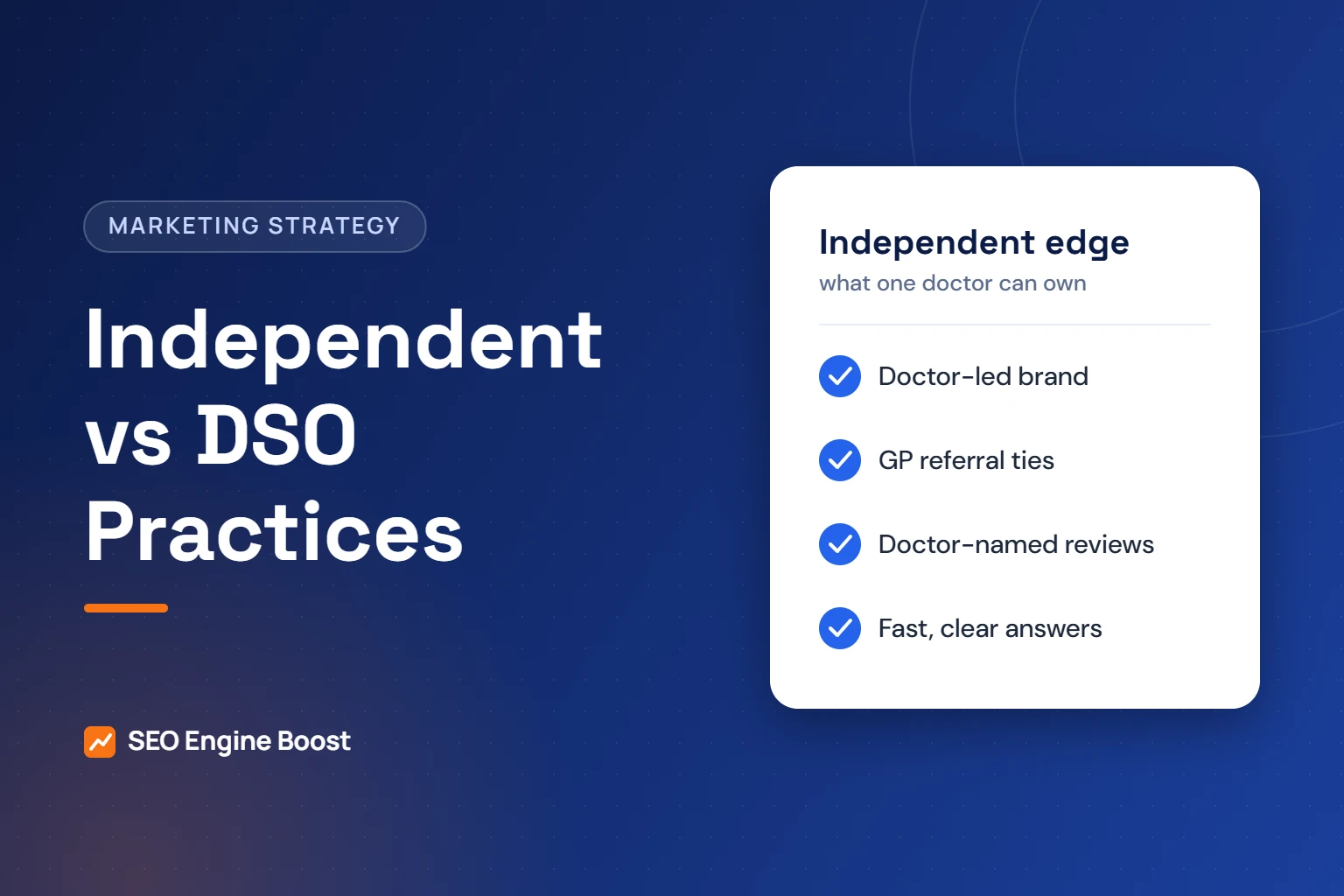
An independent orthodontist competes with a DSO or OSO by owning what a multi-location brand finds hard to copy. Offer one named doctor from consult to retention. Build close GP referral ties, doctor-named reviews and a complete Google Business Profile. Reply fast and price clearly. Scale buys reach, but continuity and local trust win the consult.
This guide starts with verified consolidation data. It then compares what DSOs and OSOs typically bring with where independents are strong. You will get a comparison table, local SEO tactics based on Google’s own guidelines, and a way to measure your position. A short, neutral section covers the questions to ask if you ever consider affiliating.
Key takeaways
- ADA HPI data show 20.7% of orthodontists were DSO-affiliated in 2023, the highest share of any specialty it reported.
- OSOs bring capital and central support. Smile Doctors reported 591 locations in 36 states and $125 million in new growth capital in 2026.
- Independents win on continuity with one doctor, GP referrals, doctor-named reviews, fast response, transparent pricing and niche content.
- Track map pack visibility grids, review velocity and share of consults by source to see whether you are gaining or losing ground.
In this article
- The consolidation picture, with verified numbers
- What DSOs and OSOs typically bring to a local market
- Where independent orthodontists can win
- Comparison table: strengths and the marketing move for each
- Local SEO tactics for competing with multi-location brands
- How to measure your competitive position
- When joining an OSO or affiliating might make sense
- A 90-day plan for independents
- Frequently asked questions
The consolidation picture, with verified numbers
Orthodontics is the most consolidated dental specialty in ADA data. The ADA Health Policy Institute (HPI) reported that 20.7% of orthodontists were affiliated with a DSO in 2023, up from 18.2% in 2022. That was the highest rate among the specialties in its report.
The same HPI report shows two other shifts for orthodontists between 2022 and 2023:
- Solo practice fell from 40.8% to 39.3%.
- The share in practices with 100 or more locations rose from 12.0% to 13.6%.
The HPI has since released 2024 affiliation data. Its September 2025 workforce report says DSO affiliation among all US dentists more than doubled, from 7.2% in 2015 to 16.1% in 2024. That report does not break out orthodontists. We could not find a published 2024 figure for orthodontists alone, so 20.7% (2023) is the newest one we can cite.
How big the largest OSOs are
Smile Doctors is one of the largest orthodontic support organizations (OSOs) in the US. LevinPro Healthcare M&A reported in July 2026 that it had 591 affiliated locations in 36 states. It expects to pass 600 by year-end. It secured an additional $125 million in growth capital in the second quarter of 2026. The same report says it is backed by THL Partners and Linden Capital Partners. Its 2025 acquisition of myOrthos added more than 70 locations.
Other OSOs grow through partnerships with established practices. Orthodontic Partners, for example, describes a service center that handles accounting, HR, marketing and cash flow management for its partner practices. We could not verify a current location count for it, so we leave that out.
The takeaway is simple. Roughly four in five orthodontists were still outside DSOs in 2023. Independents remain the majority. But in many markets, at least one well-funded group is now competing for the same local searches.
What DSOs and OSOs typically bring to a local market
Being fair about a competitor’s strengths helps you choose where to compete. Some points below come from what OSOs publish. Others are general observations that vary by organization.
- Central marketing support (published). Orthodontic Partners lists marketing in its service center support. It also lists playbooks for digital and referral marketing.
- Capital to grow (published). Smile Doctors grows through affiliations, joint ventures and de novo offices, backed by private equity and new growth capital.
- Brand recognition (general observation). One name across many offices builds familiarity through repetition. It can also earn many reviews across locations.
- Call centers (general observation). Many groups route calls or web leads through a central team. Practices may handle this differently.
- Extended hours (general observation). Groups with several offices may offer evening or Saturday hours at some locations.
- Financing (general observation). In-house payment plans are common across orthodontics. Groups often promote them prominently.
None of this makes a group better or worse for a given patient. It does mean your plan should not depend on outspending them.
Where independent orthodontists can win
Independents have advantages that budget alone does not replicate. Each one below is something patients and parents can see before they book.
A doctor-led brand and continuity
Make the orthodontist the face of the practice. Use real photos, a detailed bio and a short welcome video. State plainly that the same doctor plans and checks every case from consult to retention, if that is true. Continuity is a concrete promise, not a slogan.
Local relationships and GP referrals
As a general observation, referring dentists build trust with a person more easily than with a logo. Visit offices, share case updates and make referral forms easy. Our guide to orthodontic referral marketing covers the process and its legal limits.
Reviews that name the doctor
Google says more reviews and positive ratings can help local ranking. Reviews that mention your doctor by name also give searchers a reason to choose a person. You can ask happy patients to describe their experience. Never script, filter or reward reviews. See how to get more Google reviews for a compliant system.
Practitioner and practice listings
Google’s guidelines allow an individual practitioner to have a dedicated Business Profile in some cases. More on the rules below.
Fast response and transparent pricing
Answer calls live during business hours and reply to web forms within minutes. Publish typical price ranges and payment plan basics. Our guide to orthodontic prices and financing on your website shows how to do this without overpromising.
Niche content and community presence
Write pages for the cases you know best: adults, complex cases and early treatment for children. Show up locally through school events, sports sponsorships and study clubs. These build real-world prominence that also appears online.
Comparison table: strengths and the marketing move for each
Use this table to pick your battles. The left column describes common scale advantages, not weaknesses.
| DSO/OSO strength | Independent strength | Marketing move for the independent |
|---|---|---|
| Central marketing budget | Focused local spend | Target a tight radius and a few high-intent searches, not the whole metro |
| Brand recognition across offices | A named doctor patients meet every visit | Put the doctor’s name, photo and training on every key page and profile |
| Call center coverage | A team that knows each family | Answer live, reply to forms in minutes and track missed calls |
| Extended hours at some offices | Flexible scheduling at one office | Publish your real hours and any early or late slots on your Business Profile |
| Promoted financing | Simple, direct pricing talks | Publish price ranges, down payment basics and what affects cost |
| Many reviews across locations | Reviews that name the doctor | Ask every finished patient for an honest review, with no scripts or rewards |
| Corporate referral programs | Personal GP relationships | Visit referring offices, send case updates and thank-you notes |
| Broad service menus | Depth in specific case types | Build pages for adults, complex cases and early treatment |
Local SEO tactics for competing with multi-location brands
Start with Google’s own rules. They apply to everyone, and they cost nothing to follow. Google states there is no way to pay for a better local ranking. It uses relevance, distance and prominence to rank local results.
What Google’s guidelines say
- Use your real-world name. Google says your name should reflect your business’s real-world name. Taglines and extra keywords in the name are not permitted.
- Practitioner listings. Google says an individual practitioner should have a dedicated profile if they are public-facing and contactable at the verified location during stated hours.
- Practices with several doctors. The organization should have its own profile for the location, separate from the practitioners. A practitioner’s profile title should use only their name.
- Solo practitioner, one listing. Google says to create a single profile named “[brand/company]: [practitioner name]”.
- One profile per location. Google says not to create more than one page for each location. P.O. boxes and remote mailboxes are not acceptable.
- Chains must match. Google requires all locations of a chain to share the same name and category, unless the real-world signage differs. This is one reason group brands look uniform in results.
- Accurate hours and full details. Google says businesses with complete and accurate information are more likely to appear in local results.
Agency guidance for independents
The following is our agency guidance, not Google policy or research:
- Choose the most accurate primary category and keep it consistent with your website.
- Build a strong location page with your address, hours, map, doctor bio and service links.
- Create service pages for adults, early treatment and complex cases. Link them from your homepage.
- Earn local mentions from schools, clubs and community groups. These support prominence.
- Post real photos of your office, team and doctor regularly.
For the full process, see our local SEO for orthodontists service. If general dentists offering aligners are your closer rival, read how orthodontists compete with general dentists on clear aligners.
See where you stand against local groups
We map your visibility, reviews and profiles against the brands in your area, then give you a clear action list.
How to measure your competitive position
You cannot manage what you do not measure. The three measures below are agency guidance. They are practical tools, not research benchmarks.
Map pack visibility grids
A grid tool checks your rank for one search, such as “orthodontist near me”, from many points around your office. It shows where you appear in the top three and where a group brand outranks you. Run it monthly for the same searches and grid size, so results stay comparable.
Review velocity
Review velocity is how many new reviews you earn per month. Compare your pace with the nearest competing location, not the whole group. For example, a practice that earns 6 reviews a month while a nearby location earns 10 is falling behind, even with a higher total.
Share of consults by source
Ask every new patient how they found you and record it in your practice software. Group answers into Google search, Google Maps, GP referral, patient referral, community and other. A rising share from referrals and Maps usually means your local strategy is working.
| Measure | How often | What it tells you |
|---|---|---|
| Map pack grid | Monthly | Where you show in the top three vs nearby groups |
| Review velocity | Monthly | Whether your review pace keeps up locally |
| Consults by source | Monthly | Which channels actually bring new patients |
| Call answer rate | Weekly | Whether leads are lost before a consult is booked |
When joining an OSO or affiliating might make sense
Some owners choose to affiliate, and others stay independent. Both are valid choices. This is a business and legal decision, not a marketing one. This section is general information, not financial or legal advice. Talk to an attorney and an advisor with orthodontic transaction experience.
Questions owners often ask before any decision:
- What clinical decisions stay with the doctor, and how is that put in writing?
- Who controls the practice name, website, Google Business Profile and patient communications?
- What happens to the team, systems and referral relationships?
- How long is the commitment, and what are the exit and non-compete terms?
- How are marketing budgets set, and who decides local priorities?
- What does state law allow on practice ownership and fee arrangements?
If you run or market a group, our SEO for orthodontic groups page covers multi-location work.
A 90-day plan for independents
This is agency guidance. Adjust it to your market and team size.
- Weeks 1 to 2: Audit your Business Profile against Google’s guidelines. Fix name, category, hours and photos. Run a baseline visibility grid.
- Weeks 3 to 4: Rewrite your doctor bio and homepage around the doctor and continuity of care. Add price ranges and payment basics.
- Weeks 5 to 8: Start a steady review request at debond. Visit your top referring GP offices with a short case update.
- Weeks 9 to 12: Publish one niche page each for adults, early treatment and complex cases. Re-run the grid and compare consults by source.
Frequently asked questions
What share of orthodontists are affiliated with a DSO?
The ADA Health Policy Institute reported that 20.7% of orthodontists were DSO-affiliated in 2023, up from 18.2% in 2022. That was the highest share of any specialty in its report. The HPI’s 2024 data show 16.1% of all dentists were affiliated, but we found no published 2024 figure for orthodontists alone.
Can an independent orthodontist outrank a DSO in Google Maps?
Yes, it is possible in many local searches. Google ranks local results by relevance, distance and prominence, and says you cannot pay for a better local ranking. A complete, accurate profile, steady reviews and strong local mentions can help a single office compete with a multi-location brand near its own address.
Should the orthodontist have a separate Google Business Profile?
It depends on your setup. Google allows a dedicated practitioner profile when the doctor is public-facing and contactable at the verified location. In a multi-doctor practice, the practice keeps its own profile too. A solo practitioner can use one profile named “[brand]: [practitioner name]”. Check the current guidelines before creating anything.
What is an OSO?
An orthodontic support organization, or OSO, provides business services to affiliated orthodontic practices. Services can include accounting, HR, marketing and IT. Smile Doctors and Orthodontic Partners are examples. Models differ, so owners should read each organization’s published terms and agreements carefully, with advice from an attorney, before making any decision.
How do I know if I am losing patients to a group practice?
Track three things monthly. Run a map pack visibility grid for your main searches. Compare your review velocity with the nearest competing location. Record how every new patient found you. If Maps visibility, review pace or referral share falls while total calls drop, a nearby group is likely gaining ground.
Sources
- ADA Health Policy Institute: The Evolving Dental Practice Model: Data Update for 2023 on Practice Size and DSO Affiliation (2024)
- ADA Health Policy Institute: The U.S. Dentist Workforce (data as of August 2025)
- LevinPro Healthcare M&A: Smile Doctors Nears 600 Locations Following New Orthodontic Affiliations and Expansion (July 15, 2026)
- Orthodontic Partners: Home page (partner services)
- Google Business Profile Help: Guidelines for representing your business on Google
- Google Business Profile Help: Tips to improve your local ranking on Google
Keep reading
See where your practice stands
If you would like a second pair of eyes on your own practice, we offer a free growth audit: a manual review of your local visibility, website, reviews and content, with a prioritized list of what to fix first.