
Marketing to Adult Orthodontic Patients: What Adults Need to See
Marketing to adult orthodontic patients works when you answer adult concerns directly. Adults want to know how treatment looks at work, how long it takes, and what it costs. They also ask how visits fit their schedule. Adults research alone, read reviews closely and compare aligners with braces before they book.
Adults are a large group, not a niche. The AAO says 1 in 3 orthodontic patients today are adults. Its 2025 member survey estimated about 1.91 million adults in treatment in the US, up from 1.64 million in 2022. This guide covers the concerns, channels, pages and booking fixes that turn adult research into consults.
Key takeaways
- Adults are the patient and the buyer. They decide alone and research on their own schedule.
- Five concerns drive adult decisions: appearance, time, cost, work schedules and relapse after earlier treatment.
- Build dedicated pages for aligners versus braces, cost and financing, relapse and retreatment, and treatment time.
- Remove booking friction with online scheduling, real after-hours availability and fast replies.
In this article
- How adults research differently from parents
- The five concerns adults bring to the consult
- Where adults look: search, AI answers and reviews
- The pages adults need on your website
- Writing about relapse and retreatment
- Messaging do’s and don’ts for adults
- Removing consult-booking friction
- Measuring adult patient marketing
- Frequently asked questions
How adults research differently from parents
A parent researches for a child, often with a dentist’s referral in hand. An adult researches for themselves, often after years of thinking about it. That changes what they look for and when they act.
| Factor | Parents of children and teens | Adult patients |
|---|---|---|
| Who decides | Parent, often with the other parent | The patient alone or with a partner |
| Trigger | Dentist referral or school-age timing | A life event, relapse, or a long-held wish |
| Main worry | Is treatment needed now? | How will it affect my work and life? |
| Research style | Asks other parents and the dentist | Searches, reads reviews and asks AI tools |
| Booking window | School breaks and after school | Lunch, evenings and Saturdays |
Many practice websites are built mainly for parents. Adults land on pages about early checks and teen braces. They may leave because nothing speaks to them.
The fix is not a separate brand. It is a clear path for adults: a menu link, an adult section on the home page, and pages written for their questions. Use adult photos, with written authorization, on those pages.
The five concerns adults bring to the consult
Adult patients tend to raise the same few concerns. Each one should have a clear answer on your website before the consult.
- Appearance during treatment. Will people at work notice? Explain clear aligners, ceramic braces and any other options you offer.
- Time. How many months, and how many visits? The AAO notes that adult treatment may take longer than treatment for children.
- Cost. What is the total, and what is the monthly payment? The AAO notes that most dental plans do not cover adult orthodontics.
- Work schedules. Can visits fit around a full-time job, travel or shift work?
- Previous treatment relapse. Many adults had braces as teens. They want to know why teeth moved and what retreatment involves.
Answer these without judgment. An adult who stopped wearing a retainer years ago should not feel blamed by your website.
Where adults look: search, AI answers and reviews
Adults use several channels before they call. Plan for each one.
Search
Adults search for specific questions, such as “Invisalign cost for adults” or “braces again after relapse.” These are example phrasings, not keyword volume data. Pages that answer one question clearly tend to match these searches better than a general services page.
AI answers
Many adults now ask AI tools to compare options or recommend a local provider. These tools draw on clear, factual pages and on review sites. Our guide to how AI tools recommend orthodontists explains what they look for.
Reviews
Adults read reviews for signs that people like them were treated well. A review from a working adult who mentions aligners carries weight. See our guide on how to get more Google reviews without breaking platform rules.
Availability
If you offer evening or Saturday hours, show them everywhere. Put them on your Google Business Profile, your contact page and your booking page. Do not advertise hours you cannot staff.
The pages adults need on your website
Adults want specific answers, not a list of services. These four pages cover most adult questions.
| Page | Questions it answers | Must include |
|---|---|---|
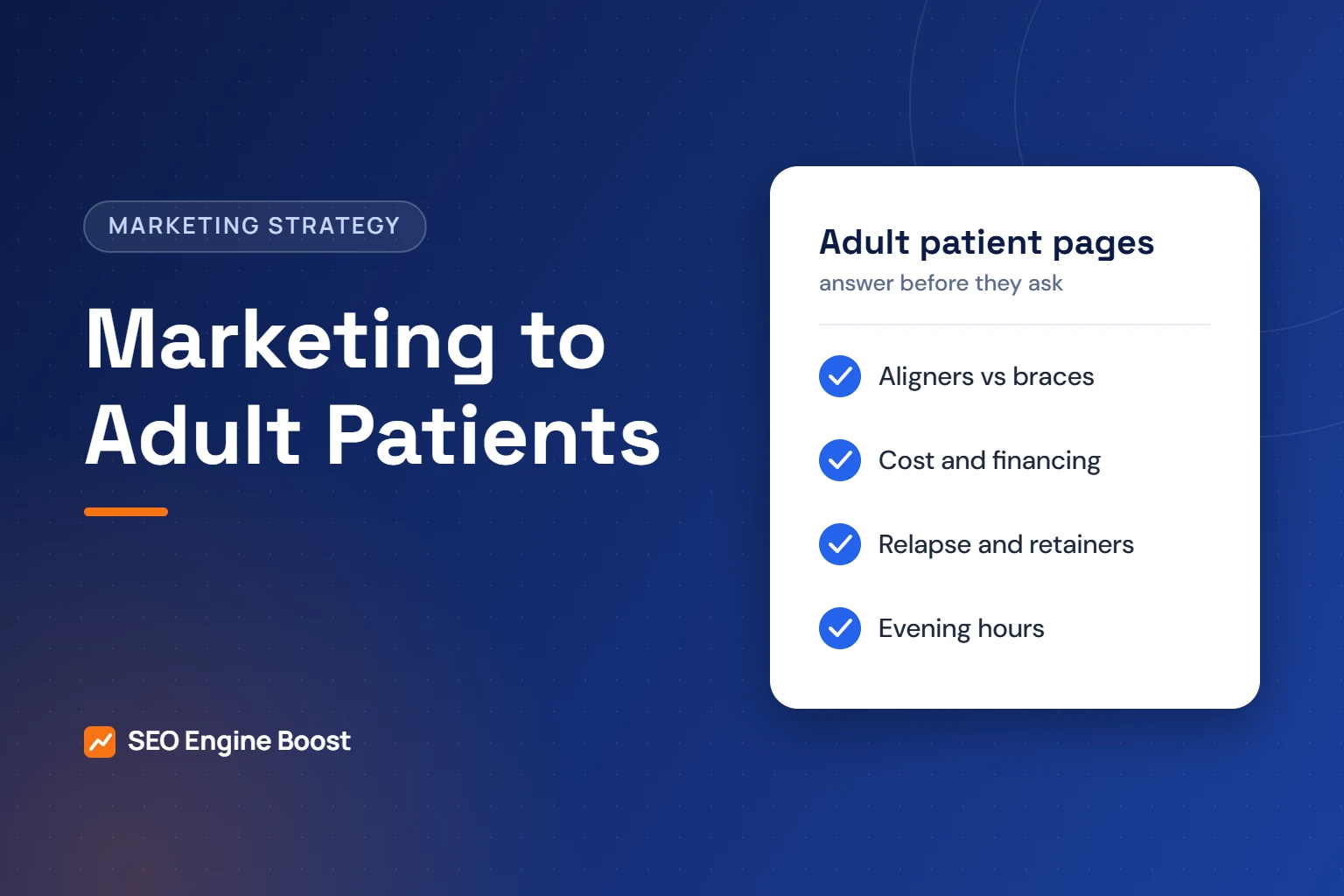
| Aligners versus braces for adults | Which option fits my case and lifestyle? | How each works, wear time, visits, and when one may suit better |
| Adult cost and financing | What will I pay in total and per month? | Fee ranges, what is included, payment plans, HSA or FSA use |
| Relapse and retreatment | My teeth moved after braces. What now? | Why teeth can shift, how retreatment is assessed, retainer options |
| Treatment time for adults | How long will this take? | Typical ranges, factors that change length, visit frequency |
For the cost page, our guide on showing prices and financing on your website covers layout and wording. The AAO’s own cost page says insurance often covers a percentage or a fixed benefit, with possible lifetime maximums or age limits. Explain how this applies to adults in your office.
Have the treating orthodontist review each page for clinical accuracy. Add the reviewer’s name and the review date.
Writing about relapse and retreatment
Relapse is one of the most common reasons adults return to orthodontic care. It is also a sensitive topic. Write about it plainly and kindly.
- Explain that teeth can shift over time. The AAO notes teeth can naturally shift as we age.
- Explain the role of retainers. The AAO says retainers help maintain the results of braces or aligners.
- Describe how a consult assesses a relapse case, including records and options.
- Say that options and length depend on the case, and that the consult will decide.
- Show your retainer replacement policy and fees, if you offer them.
Avoid language that blames the patient or the previous provider. Never suggest that earlier treatment was done badly.
Messaging do’s and don’ts for adults
Adults respond to respect, clarity and evidence. They tune out hype and age-based pressure.
| Do | Don’t |
|---|---|
| Use photos of real adult patients, with written authorization | Use stock photos of teens on adult pages |
| Explain options and trade-offs plainly | Promise a perfect smile or a fixed timeline |
| Show prices or ranges and payment terms | Hide all costs behind “call for pricing” |
| Speak to health and function as well as looks | Shame people about their teeth or age |
| Mention evening or Saturday hours if you have them | Imply that treatment needs no time or effort |
The AAO frames adult treatment as being about health, confidence and well-being, not vanity. That framing works well in marketing too.
Is your website built for adults or only for parents?
We will review your adult-focused pages, hours and booking flow, and show you what to fix first.
Removing consult-booking friction
Adults often research late in the evening. If booking needs a phone call during work hours, many will put it off. Every extra step loses some of them.
- Offer online booking with real open slots, including early, late or Saturday times if you have them.
- Keep the request form short: name, contact, preferred time and main concern.
- Reply to web requests the same business day. Our guide to consultation request follow-up covers the process.
- Let patients choose text or email for reminders.
- Explain what happens at the consult and how long it lasts.
For example, a practice that only books by phone between 9 and 5 asks a working adult to call from their desk. Adding evening online booking removes that barrier. This is a hypothetical example, not a measured result.
Measuring adult patient marketing
You cannot improve what you do not track. Add a simple field to your intake process that records adult or child, and the first source the patient names.
- Count adult consults per month, by source.
- Track adult case acceptance separately from teen case acceptance.
- Watch traffic and conversions on each adult page.
- Note which questions adults ask most at the consult, and add answers to your pages.
Review these numbers with your treatment coordinator each month. Coordinators hear the real objections first. Their notes often point to the next page you should write.
Compare adult results over several months before changing your plan. Seasonal shifts can hide real trends. Patients comparing you with general dentists may also find our guide on competing on clear aligners useful.
Frequently asked questions
What share of orthodontic patients are adults?
The AAO’s adult orthodontics page says 1 in 3 orthodontic patients today are adults. Its 2025 Economics of Orthodontics and Patient Census Survey estimated about 1.91 million adults being treated by AAO members in the US. That was up from 1.64 million in 2022. Check the AAO site for the latest figures.
Should we build separate pages for adult patients?
Yes, in our experience as an agency. Adults have different concerns from parents, including work schedules, appearance and relapse. A general braces page rarely answers them. Start with four pages: aligners versus braces, cost and financing, relapse and retreatment, and treatment time. Have the orthodontist review each one.
Do adults care more about aligners than braces?
Many adults ask about aligners first because of appearance during treatment. But the right option depends on the case. Your aligners versus braces page should explain how each works, the wear time and visit schedule, and when one may suit better. Let the consult make the final call.
How do we market to adults who had braces before?
Write a relapse and retreatment page that explains why teeth can shift and how retainers help. Describe how a consult assesses the case. Avoid blaming the patient or the earlier provider. Show your retainer replacement options and fees if you offer them, so returning patients know what to expect.
Do evening and Saturday hours really matter for adults?
They matter for many working adults who cannot leave work easily. Only advertise hours you can staff. If you offer them, show them on your Google Business Profile, your website and your booking page. Track how many adult consults book into those times to judge whether they are worth keeping.
Sources
- American Association of Orthodontists: Adult Orthodontics: Smile with Confidence at Any Age (last modified September 30, 2026)
- American Association of Orthodontists: Member Survey Indicates Orthodontic Patient Numbers at All-Time High (July 9, 2025)
- American Association of Orthodontists: How Much Do Braces Cost? Financing Options for Orthodontic Treatment (October 16, 2025)
Keep reading

See where your practice stands
If you would like a second pair of eyes on your own practice, we offer a free growth audit: a manual review of your local visibility, website, reviews and content, with a prioritized list of what to fix first.