Invisalign Marketing for Orthodontists: Trademark Rules, Adult Targeting and a Landing Page That Converts
Good Invisalign marketing starts with two things most guides skip: using Align Technology’s trademark the way your provider agreement allows, and being honest about which aligner system you actually use. Get those right, then build one strong adult-focused landing page, run tightly themed Google Ads, and measure consultations rather than clicks. This guide gives you the rules, the page outline, the keyword groups and the comparison language.
Key takeaways
- “Invisalign” is a registered trademark of Align Technology. Only market it if you actively treat with it, and only in the ways your current provider terms allow.
- Align has sued a practice it said used the Invisalign name to promote a competing aligner, so mixing brands on one page is a real legal risk.
- Provider tier badges describe case volume under Align’s program. Do not present them as a clinical credential.
- Adults are the core aligner audience. Speak to discretion, scheduling, cost clarity and the specialist difference.
- Google Ads lets you bid on trademarked terms as keywords, but ad text and landing pages must be accurate about what you offer.
What are the trademark rules for using “Invisalign” in your marketing?
INVISALIGN is a U.S. registered trademark owned by Align Technology. Your right to use the name and logo in marketing comes from your relationship with Align, not from the fact that patients search for the word. Align’s provider-facing brand terms live inside its doctor portal and change over time, so treat the list below as safe general practice and confirm details against your current agreement.
General trademark practice that keeps you out of trouble
- Use it as a brand name, not a generic word. Write “Invisalign clear aligners” or “Invisalign treatment,” not “an Invisalign” or “invisaligns.”
- Capitalize it and mark it. Use the registered mark symbol on the first prominent use on a page, and add an attribution line in the footer (“Invisalign is a registered trademark of Align Technology, Inc.”).
- Do not put it in your identity. Avoid Invisalign in practice names, domain names, social handles or Google Business Profile names. Align’s public social media guidelines ask people not to use the Align, Invisalign or Vivera names in any online identity, including usernames and handles.
- Do not imply you are Align. No wording or design that suggests Align endorses or operates your practice.
The eligibility point most practices miss
In a June 2025 Orthodontic Products podcast on Align’s trademark enforcement, the guests described brand-asset use as tied to licensing terms and to placing a qualifying number of case orders in the current quarter. The cleanup they described touched website copy, URLs, meta and alt tags, social accounts, print materials, ads, and listings such as Google Business Profile, Yelp and Bing. If your Invisalign volume has dropped, check your status before your next campaign, not after a letter arrives.
Why brand mixing is the biggest risk
In May 2024 Align filed suit in federal court in Oregon against an orthodontic practice, alleging it used Invisalign trademarks to promote a competitor’s aligners and reporting it sought $28 million (DrBicuspid coverage). Those are allegations, not findings, but the lesson is simple: never let a page, ad or post read as if a different aligner is Invisalign.
How should you describe your provider tier?
Align ranks providers in tiers such as Platinum and Diamond. Patients often assume the badge means a doctor is clinically better. The tier reflects participation and case volume within Align’s program, and it can change. That gap is where marketing gets into trouble with state advertising rules on misleading claims.
| Wording | Risk level | Why |
|---|---|---|
| “Invisalign Diamond Provider” (current, accurate, per Align’s display rules) | Low | Factual, and it is the program’s own label. |
| “Our Diamond status reflects the number of Invisalign cases our team has treated.” | Low | Explains what the badge means without inflating it. |
| “Top 1% Invisalign doctor” | High | A ranking claim you probably cannot substantiate for your area. |
| “Invisalign expert” or “Invisalign specialist” | High | “Specialist” has regulated meaning in dentistry in many states. See our guide to specialty advertising rules for orthodontists. |
| Last year’s tier still on the site | High | Outdated status is a false claim. Assign someone to check it every quarter. |
Your strongest differentiator is usually not the badge. It is the fact that an orthodontist plans and supervises the case. That is a truthful, specific message, and it matters when you compete with general dentists offering clear aligners.
Who should Invisalign marketing target?
Teens matter, but adults are the group most likely to search for aligners on their own, compare prices, and decide without a referral. Build the message around their real objections.
| Adult segment | Main worry | Message that answers it | Proof to show |
|---|---|---|---|
| Working professionals | Looking unprofessional, time off work | Discreet treatment, early and late appointments, visit frequency explained | Your actual hours, virtual check-in options if you offer them |
| Relapse patients (had braces as teens) | “I already paid once” | Often a shorter, simpler case; a consult tells you | Consented before and after photos of similar cases |
| Parents considering treatment for themselves | Cost on top of a child’s treatment | Payment plans, family scheduling, clear pricing ranges | Plain-language financing page |
| Former mail-order aligner users | Trust after a bad experience | In-person supervision, records, a doctor who monitors progress | Your process, step by step |
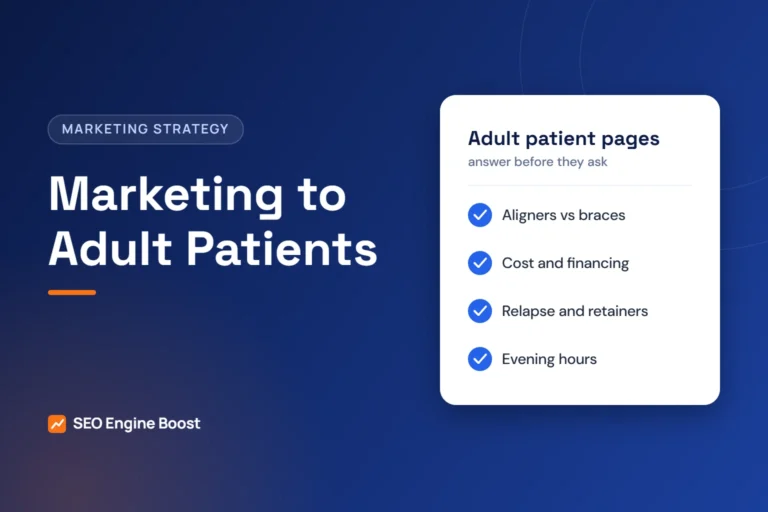
For a deeper look at this audience, see how to market to adult orthodontic patients.
Not sure where your practice stands? A free growth audit lists your top three fixes for Google, Maps and AI answers, in writing. Get a free growth audit · See our orthodontic marketing services
What should an Invisalign landing page include?
One dedicated page beats a paragraph buried on a services page. Build it in this order:
- Headline with the city and the answer. Example: “Invisalign clear aligners in [City], planned by an orthodontist.”
- Who it suits. Three or four sentences on the bite and spacing problems you treat with aligners, and an honest line that some cases need braces or a hybrid approach.
- The process. Consult, scan, treatment plan review, aligner fitting, check-ins, retainers. Numbered and short.
- Cost and financing. A typical range or “starting at” figure if your board rules permit price advertising, plus payment plan details and an insurance note.
- Proof. Consented before and after photos, real reviews, and the doctor’s credentials. Follow our before and after photo guidelines.
- FAQ. Wear time, discomfort, eating, refinements, retainers, what happens if aligners are lost.
- One clear call to action. A short form and a click-to-call number, both tracked.
- Trademark attribution in the footer.
Keep the URL simple, such as /invisalign/, and only if you are a current provider. If you use another system, name the page after that system or after “clear aligners.”
Which Google Ads keywords work for Invisalign?
Search volume for aligner terms varies a lot by market, so pull your own numbers from Google Ads Keyword Planner before setting budgets. The structure below is what matters. Google’s trademark policy does not restrict trademarks used as keywords, but it can restrict trademarks in ad text, and your ad and landing page must not be misleading about what you offer.
| Ad group | Example keywords | Landing page | Notes |
|---|---|---|---|
| Brand + location | invisalign [city], invisalign near me, invisalign orthodontist [city] | /invisalign/ | Only if you are a current provider. |
| Generic aligners | clear aligners [city], invisible braces, clear braces for adults | /clear-aligners/ or /invisalign/ | Often less competitive; good for any aligner system. |
| Cost intent | invisalign cost [city], how much is invisalign, invisalign payment plans | Pricing section of the page | Answer the cost question on the page or this group will waste spend. |
| Comparison | invisalign vs braces, invisalign or braces for adults | Comparison article or page section | Research-stage traffic; judge on consults, not on click volume. |
Negative keywords to add on day one: jobs, careers, training, course, lawsuit, stock, diy, at home, cheap mail order, retainer cleaning, and any competitor practice names you do not want to target. For the full campaign build, see our guide to Google Ads for orthodontists.
How do you compare Invisalign with other aligners honestly?
Patients will ask about other brands, mail-order options and aligners printed in-office. You can discuss them, as long as every claim is accurate and you are clear about which system you use.
- Do say: which system or systems you offer, why you chose them, and that the orthodontist’s diagnosis and supervision drive results more than the brand.
- Do not say: that another aligner “is Invisalign,” “works just like Invisalign,” or that a competitor is unsafe, unless you can substantiate it.
- Keep pages separate. If you offer two systems, give each its own clearly labelled section so no photo, review or headline blurs the brands.
- Avoid absolute comfort claims. Several state dental practice acts restrict “painless” style language. Prefer “most patients adjust within a few days” if that matches your experience.
Invisalign marketing checklist: what to do first
- Confirm your current Align provider status and the brand-use terms that apply to it.
- Audit the site, ads, GBP and social for Invisalign mentions; fix outdated tiers and any brand mixing.
- Add the footer trademark attribution and use the name correctly in every heading.
- Build or rebuild the dedicated aligner landing page using the outline above.
- Set up call tracking and form tracking before you spend on ads. Our orthodontic call tracking guide covers the setup.
- Launch the four ad groups with negatives, and review search terms weekly for the first month.
- Ask aligner patients for reviews at debond and retainer visits.
- Report monthly on consults booked, consults attended, and starts from aligner traffic.
What should you measure?
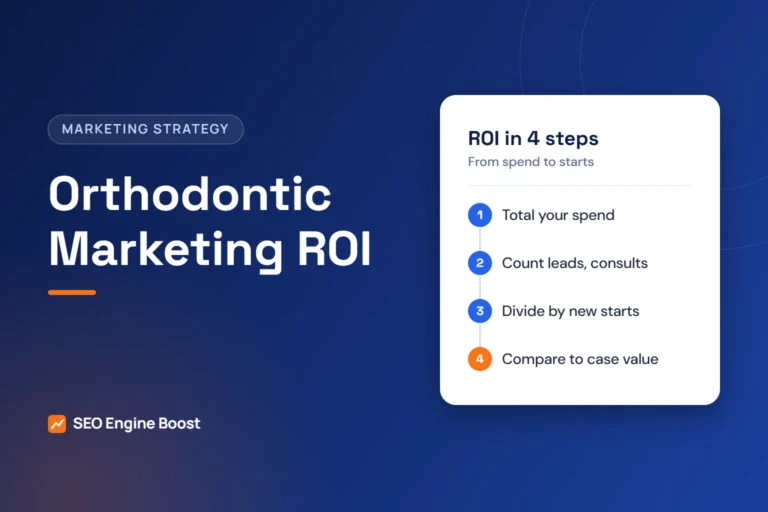
Clicks and impressions tell you little. Track the steps that lead to a start: landing page calls and forms, consults booked, consults attended, and treatment starts with an aligner as the chosen option. Illustrative example: if a month of ads produces 40 tracked leads, 20 booked consults and 6 starts, the bottleneck is lead-to-consult conversion, which points to phone handling and follow-up rather than ad spend. Use our guide to orthodontic marketing ROI to turn those numbers into cost per start.
Want this done for your practice? We can audit your Invisalign mentions, build a compliant aligner landing page and run tightly themed ad groups with call tracking. Start with a free growth audit or see our published prices.
Frequently asked questions
Can I use the word Invisalign in my practice name or domain?
Avoid it. Invisalign is a registered trademark of Align Technology, and Align’s public social media guidelines ask people not to use its brand names in any online identity. Use your own brand in names and domains and mention Invisalign on the relevant service page instead.
Can I bid on Invisalign as a Google Ads keyword?
Google’s trademark policy does not restrict trademarks used as keywords, but it can restrict trademarks in ad text. Your ad and landing page must also be accurate, so only use Invisalign messaging if you currently offer Invisalign treatment.
Does a Diamond or Platinum tier mean a doctor is more skilled?
Not by itself. Tiers reflect participation and case volume in Align’s program. Display a tier only if it is current, describe it accurately, and do not present it as a clinical credential or a specialty.
Can I mention other aligner brands on my Invisalign page?
Keep each system on its own clearly labelled page or section. Never let another aligner appear to be Invisalign. Align has sued a practice it alleged did this, so separation and accurate labels are the safe approach.
Who is the best audience for Invisalign marketing?
Adults are usually the core audience because they research and decide on their own. Segment them into professionals, relapse patients, parents and former mail-order users, and answer each group’s main worry on your landing page.