
How Orthodontists Compete With General Dentists on Clear Aligners
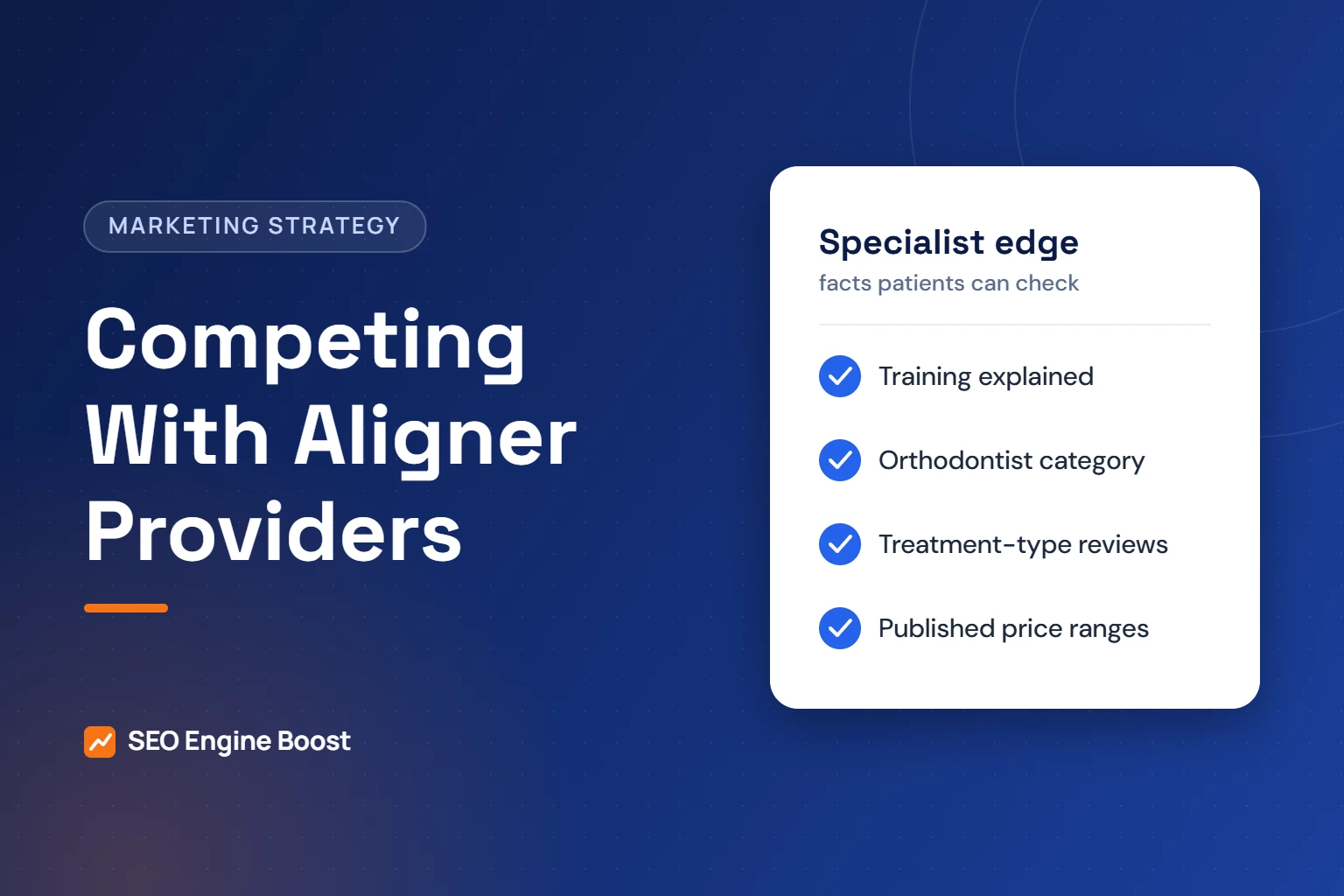
Independent orthodontists compete best by making the specialist difference easy to check, not by criticizing other dentists. Explain your 2 to 3 years of accredited residency in plain words. Publish accurate complex-case and pricing pages. Choose the right Google Business Profile category. Earn reviews that name the treatment. Patients can then compare on facts.
The market has changed. Align Technology says its recent growth came from both orthodontist and GP dentist channels, with double-digit growth from DSOs. SmileDirectClub wound down its operations in December 2023. So your main competitors are now local offices, not a mail-order brand. This guide shows how to win the comparison patients already make when they search “orthodontist vs general dentist Invisalign.”
Key takeaways
- Patients compare cost, convenience, trust and fit for their case. Answer each one on its own page.
- State specialist training as a verifiable fact: 24 to 36 months in a CODA-accredited program, per the AAO.
- Use “Orthodontist” as your primary Google Business Profile category, and ask for reviews that describe the treatment in the patient’s own words.
- Publish price ranges and financing terms, and check your state’s specialty-advertising rules before you publish any claim.
In this article
- What patients actually compare
- The 2026 aligner landscape in plain terms
- How to explain specialist training factually
- Complex-case pages reviewed for clinical accuracy
- Google Business Profile: Orthodontist versus Dentist
- Reviews that mention treatment types
- Comparison content patients search for
- Pricing and financing transparency
- Specialty-advertising caveats
- Frequently asked questions
What patients actually compare
Most aligner shoppers do not start by asking who is a specialist. They start with price, convenience and whether the treatment will work for them. Specialist training matters, but only once it connects to their own case.
Patients usually weigh five things:
- Cost and monthly payment. Total fee, down payment and what is included.
- Convenience. Distance, hours, and whether they can see the same office they already use.
- Trust. Reviews, photos of the team, and how clearly the office explains things.
- Fit for their case. Whether aligners can handle their bite, crowding or past relapse.
- Who plans the treatment. This question often comes last, after the first four.
Your marketing should answer all five. A page that only says “see a specialist” skips the questions patients ask first.
| Patient question | Page or asset that answers it |
|---|---|
| How much will aligners cost me? | Pricing and financing page with ranges |
| Can you fit my schedule? | Hours on your website and Google Business Profile |
| Will aligners work for my bite? | Complex-case pages reviewed by the treating orthodontist |
| Why see an orthodontist? | Training page with verifiable facts |
| What do other patients say? | Reviews that mention aligners or braces |
The 2026 aligner landscape in plain terms
Align Technology makes Invisalign. In its second quarter 2026 results, Align reported shipping cases to 89,175 Invisalign-trained doctors. That was up from 86,250 a year earlier. Align said growth reflected adoption across both orthodontist and GP dentist channels. It also cited continued double-digit growth from DSOs.
Two points matter for your marketing:
- General dentists and DSOs are a core, growing part of the aligner market. They are not going away.
- The largest direct-to-consumer brand is gone. SmileDirectClub announced it would wind down its global operations in December 2023, months after filing for Chapter 11.
Align does not publish the split of doctors by specialty in that release. So avoid quoting a share of aligner cases started by orthodontists unless you find a current, primary source.
How to explain specialist training factually
Your strongest message is also the simplest one. According to the AAO, orthodontists invest an additional 24 to 36 months after dental school. They must complete a program accredited by the Commission on Dental Accreditation (CODA). The AAO describes this as about 3,700 hours of training.
The AAO also notes that general dentists are licensed to practice dentistry. Some states let them provide braces or aligners. That is a fact to state calmly, not a weakness to attack.
| Say this | Avoid this |
|---|---|
| “Dr. Lee completed a 3-year orthodontic residency at [program name].” | “Only orthodontists can safely move teeth.” |
| “Orthodontists complete 2 to 3 years of accredited training after dental school.” | “Your dentist isn’t qualified for aligners.” |
| “We plan every aligner case in-house, start to finish.” | “Other offices just send your scan to a lab.” |
| “Some cases need attachments, elastics or braces. We will tell you at the consult.” | “Guaranteed results in 6 months.” |
Use the doctor’s real program name and graduation year. Link to the program or the AAO page so patients can check. Facts patients can verify do more than adjectives.
Complex-case pages reviewed for clinical accuracy
Complex cases are where specialist training is easiest to show. Build a page for each problem patients search for, such as open bite, crossbite, impacted canines or relapse after earlier treatment. Explain what the problem is, how it is assessed, and which options may apply.
Have the treating orthodontist review every page before it goes live. Add a “clinically reviewed by” line with the date. Update it when your protocols change. Our content marketing guide for orthodontists covers how to set up that review step.
- List the 5 to 10 case types you see most often among adult and teen consults.
- Write one page per case type in plain language, with a short answer at the top.
- State when aligners may work and when braces or other appliances may fit better.
- Avoid outcome promises. Say what a consult will decide.
- Have the orthodontist review, sign off and date the page.
Never use before-and-after photos without the patient’s written authorization. If you do use them, show typical cases, not only your best ones.
Want to see where you stand locally?
We will review your Google Business Profile, aligner pages and pricing page against the offices patients compare you with.
Google Business Profile: Orthodontist versus Dentist
Your primary category tells Google what kind of business you are. Google’s help page says to choose a primary category that best describes your business. It also says to pick specific categories over general ones, and not to add a category for every service.
For a specialty practice, the primary category is normally “Orthodontist.” That signals your specialty to Google and to patients reading the listing. Adding “Dentist” only to catch more searches works against Google’s guidance if you do not offer general dentistry.
- Set the primary category to “Orthodontist.”
- Add secondary categories only for real departments or services you offer.
- List aligners and braces as services, with short plain descriptions.
- Show accurate hours, including any evening or Saturday times.
- Add real photos of the team, office and technology.
Categories are one ranking input among many. See our guides to Google Business Profile for orthodontists and local SEO for orthodontists for the rest of the setup. This category advice is agency guidance, not a Google rule beyond what its help page states.
Reviews that mention treatment types
A review that says “my Invisalign treatment” helps a reader who is comparing aligner providers. It also gives Google and AI tools more context about what you treat.
You can ask for reviews in a way that invites detail without scripting them:
- Ask at a natural moment, such as debond or the final aligner tray.
- Invite patients to mention what treatment they had, if they are comfortable.
- Ask every patient, not only the happy ones.
- Never write reviews for patients or offer rewards for positive ones.
The FTC’s 2024 rule on consumer reviews bars offering incentives conditioned on a review’s sentiment. It also bans fake reviews and undisclosed insider reviews. When you reply to reviews, do not confirm that the reviewer is a patient or share treatment details.
Comparison content patients search for
Patients type comparison questions into search engines and AI tools. Typical examples include “orthodontist vs dentist for Invisalign” and “Invisalign vs braces for adults.” Another is “how much is Invisalign near me.” These are example phrasings, not keyword volume data.
Write one fair comparison page. Say what a general dentist offers, what an orthodontist offers, and which cases may suit each. A balanced page earns more trust than a sales pitch. It is also more likely to be quoted by AI answers.
| Section of the page | What to include |
|---|---|
| Short answer | Both can provide aligners. Training and case range differ. |
| Training | The 2 to 3 years of accredited residency, with a source link |
| Case types | Which problems often need specialist planning |
| Cost | Your own ranges and what they include |
| Next step | How a consult works and how long it takes |
Do not name local competitors or describe their care. Speak only about what you do.
Pricing and financing transparency
Price is often the first question, and offices that hide it lose the comparison by default. Publish a range for aligners and for braces. Explain what moves a fee up or down, such as case complexity and length.
- State what the fee includes: records, refinements, retainers and follow-up visits.
- Show your down payment and monthly plan terms, with any interest stated clearly.
- List insurance and HSA or FSA options you accept.
- Use clearly labeled examples, such as “for example, a $5,000 fee with $500 down over 18 months.”
Our guide to showing prices and financing on your website covers wording and layout. If you advertise financing terms, keep them accurate and current.
Specialty-advertising caveats
Rules on calling yourself a specialist, and on what general dentists may say about orthodontic care, vary by state. Some states have specific wording requirements. This section is general information, not legal advice.
Before you publish training or comparison claims, check your state dental board’s advertising rules. Our article on orthodontic specialty advertising rules explains the main points to check. When in doubt, ask a healthcare attorney in your state.
Frequently asked questions
Can a general dentist provide Invisalign?
Yes. The AAO notes that general dentists are licensed to practice dentistry, and some states let them provide braces or aligners. An orthodontist has completed an additional 24 to 36 months of CODA-accredited training focused on the bite. Patients can choose either. Your job is to explain the difference factually so they can decide.
Should my practice add “Dentist” as a Google Business Profile category?
Usually not, unless you provide general dentistry. Google advises choosing a primary category that best describes the business and not adding a category for every service. For a specialty practice, “Orthodontist” is normally the right primary category. Add secondary categories only for real departments or services you offer.
How do we talk about specialist training without sounding negative?
State facts patients can check. Name the residency program, its length and the accrediting body. Describe what you do, not what others fail to do. Avoid claims that only orthodontists can treat safely, and never name or describe a local competitor. Check your state board’s advertising rules before you publish.
Should we publish aligner prices on our website?
In our experience as an agency, a published range helps patients who are comparing offices. Show a typical range, what it includes, and your financing terms. Explain that the exact fee depends on the consult. Keep numbers current, and label any example payment plans clearly as examples.
Is SmileDirectClub still a competitor?
No. SmileDirectClub announced in December 2023 that it was winding down its global operations, months after filing for Chapter 11 bankruptcy. Your main aligner competitors are now local general dentists, DSOs and other orthodontists. Focus your marketing on the comparison patients make between local offices.
Related guide: Independent orthodontist vs DSO: how to compete locally.
Sources
- American Association of Orthodontists: Orthodontist vs. Dentist: What’s the Difference? (last modified April 15, 2026)
- Align Technology via Business Wire: Align Technology Announces Second Quarter 2026 Financial Results (July 29, 2026)
- Fortune: Bankrupt SmileDirectClub shutting down (December 11, 2023)
- Google Business Profile Help: Manage your business category
- Federal Trade Commission: FTC Announces Final Rule Banning Fake Reviews and Testimonials (August 14, 2024)
Keep reading
See where your practice stands
If you would like a second pair of eyes on your own practice, we offer a free growth audit: a manual review of your local visibility, website, reviews and content, with a prioritized list of what to fix first.