
Orthodontic Marketing Agency vs In-House: Which Fits Your Practice?
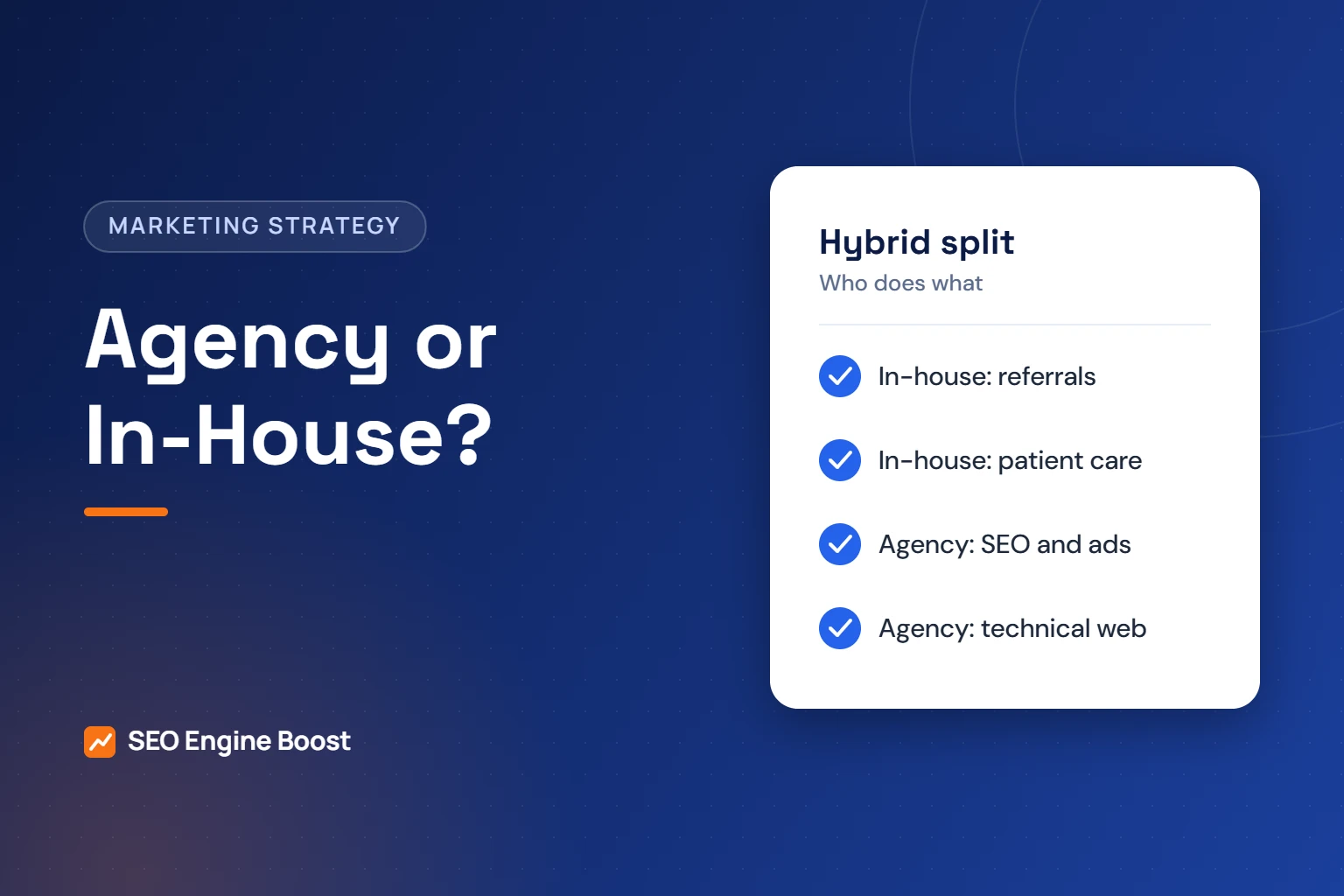
For most independent orthodontic practices, a hybrid works best. Keep relationship work in-house: patient experience, dentist referrals, social posting and community events. Use an agency for specialist work such as SEO, Google Ads and technical website care. Go fully in-house only when you can afford a skilled team and manage it.
The choice is not about which option is cheaper on paper. It is about who can do each task well, how much of your time it takes, and who controls your accounts. This guide compares costs, sorts tasks, and gives you a decision table and a list of questions to ask any agency, including ours.
Key takeaways
- Relationship tasks belong in-house. Technical, fast-changing tasks usually suit an agency.
- A coordinator’s real cost includes benefits, tools and your management time, not just salary.
- In a hybrid, write down who owns each task so nothing falls between the two.
- Whatever you choose, the practice should own every account: website, Google Business Profile, Analytics and Ads.
In this article
- The three options at a glance
- Tasks that belong in-house
- Tasks that suit an agency
- What each option costs
- The hidden cost: your management time
- Decision table: which model fits your practice?
- How to split work in a hybrid model
- Signs it is time to change your model
- What to ask an agency before you sign
- Frequently asked questions
The three options at a glance
Most practices choose one of three models. Each has a clear strength and a clear risk.
| Model | Who does the work | Main strength | Main risk |
|---|---|---|---|
| In-house | A marketing coordinator or team on your payroll | Knows your patients and your community | One person cannot master SEO, ads and web |
| Agency | An outside firm or consultant | Specialist skills and tools | Less local knowledge; quality varies widely |
| Hybrid | Coordinator plus an agency | Each task goes to the best-placed person | Gaps and overlaps if roles are unclear |
We are an agency, so we have a stake in this answer. We have tried to be fair. Some tasks we do not offer at all, and we say so below.
Tasks that belong in-house
Some marketing depends on being in the building. These tasks rely on relationships, daily presence and knowledge of your patients.
- Patient experience. The welcome, the consult, follow-up calls and small touches. No agency can do this for you.
- Dentist referral relationships. Office visits, lunches, thank-you notes and case updates to referring dentists.
- Social media posting. Photos of real moments, staff stories and debond celebrations, with patient consent.
- Community events. School sponsorships, sports teams, fairs and lunch-and-learns.
- Review requests. Asking happy patients at the right moment, in person or by text.
- Front desk and phone follow-up. Turning calls and form requests into consults.
A coordinator who does these well can lift results more than any ad campaign. Our guide to orthodontic referral marketing covers the referral side in detail.
Tasks that suit an agency
Other tasks need deep technical skill, paid tools and constant updating. One generalist coordinator rarely has time to keep up with all of them.
- SEO and local SEO. Site structure, content, schema, citations and Google Business Profile optimization.
- Google Ads. Keyword choice, bidding, conversion tracking and budget control.
- Technical website work. Speed, security, accessibility, hosting and form tracking.
- Analytics and call tracking setup. Clean data that shows cost per start by channel.
- AI search visibility. How your practice appears in AI answers and overviews.
An agency also sees patterns across many sites and campaigns. It pays for tools that a single practice rarely needs full time, such as rank tracking, site crawlers and call tracking. That shared cost is part of what you buy.
We offer these services. We do not offer social media management or Meta ads. When practices need those, we refer them out.
What each option costs
In-house coordinator
The Bureau of Labor Statistics groups marketing specialists with market research analysts. The median annual wage for that occupation was $78,760 in May 2025. The lowest 10 percent earned less than $43,390. A coordinator role in a small practice may sit toward the lower end.
Salary is only part of the cost. BLS reports that benefits made up 30.0% of total compensation for private industry workers in June 2026.
Here is a hypothetical example. A practice pays a coordinator $55,000 a year. If benefits are 30% of total compensation, total cost is about $78,600. Add software, design tools and training. The true cost could pass $80,000 a year, or about $6,700 a month.
Agency
Agency fees vary widely, and many firms do not publish prices. Ad spend is usually extra. Our own plans are published on our pricing page: from $990 and $1,490 a month, month-to-month, with no setup fees.
Hybrid
A hybrid often pairs a part-time or lower-cost coordinator with a focused agency retainer. Total cost depends on how many hours the coordinator spends on marketing versus front desk work. Our guide to orthodontic marketing budgets shows how to size the total.
| Cost item | In-house coordinator | Agency | Hybrid |
|---|---|---|---|
| Pay or fees | Salary or hourly wage | Monthly retainer or project fee | Part-time wage plus a smaller retainer |
| Benefits and payroll costs | Yes | No | Yes, for the coordinator |
| Software and tools | Paid by the practice | Often included; ask | Split; agree who pays for what |
| Ad spend | Paid by the practice | Paid by the practice, usually on top of fees | Paid by the practice |
| Training | Ongoing | Agency’s responsibility | Coordinator only |
| Cover for sick days and turnover | Your problem | Agency’s problem | Shared |
Compare options on total yearly cost, not on salary versus retainer. Then compare that cost with the new starts each option is likely to support. Our guide to orthodontic marketing ROI shows how to measure cost per start.
The hidden cost: your management time
Every option needs a manager. In most independent practices, that is the doctor or the practice manager. Their time is expensive.
| Model | What you manage | Typical time demands |
|---|---|---|
| In-house | Hiring, training, daily priorities, reviewing work, covering absences | Ongoing, weekly direction and approvals |
| Agency | Choosing the firm, monthly reviews, approving content and budgets | A monthly meeting plus quick approvals |
| Hybrid | The coordinator plus the agency relationship and handoffs | Both, but each is lighter if roles are clear |
An in-house hire also brings people risk. If your only coordinator leaves, the work and the know-how leave too. Agencies carry a different risk: if you part ways, you need your accounts and data back quickly.
Want help deciding?
We will look at your current marketing and tell you which tasks to keep in-house and which, if any, to hand off.
Decision table: which model fits your practice?
Find the row that best matches your situation. Many practices fit more than one row, which usually points to a hybrid.
| Your situation | Best fit | Why |
|---|---|---|
| One office, no marketing staff, limited time | Agency for SEO and ads; front desk handles reviews | Covers specialist work without a new hire |
| Strong community presence, weak online visibility | Hybrid | Keep events and referrals; outsource search |
| Two or three offices, steady growth | Hybrid with a full-time coordinator | Enough work for a coordinator, plus specialist support |
| Group or OSO with a marketing team | In-house team plus targeted agency help | Scale justifies specialists on staff |
| Opening a new practice | Agency for website, GBP and ads; owner leads community work | Fast setup without building a team first |
| Tight budget, high capacity | Owner-led in-house basics, then add an agency for search | Start with free relationship work |
How to split work in a hybrid model
Hybrids fail when nobody knows who owns a task. Write the split down and review it each quarter.
- List every recurring task. Include reviews, posts, referral visits, ads, website edits and reporting.
- Assign one owner per task. Shared ownership usually means no ownership.
- Set handoffs. For example, the coordinator sends event photos to the agency for website and Google Business Profile posts.
- Agree on one report. Leads, consults and starts by source, reviewed together each month.
- Name one decision maker. Usually the doctor or practice manager approves budgets and big changes.
The coordinator brings local knowledge. The agency brings technical depth. Make sure each feeds the other. A coordinator who hears common patient questions should pass them to whoever writes your website content.
Signs it is time to change your model
No model is permanent. Practices often move from agency to hybrid, or from in-house to hybrid, as they grow. Watch for these signs.
- Your coordinator is always busy but leads are flat. Time may be going to tasks that do not bring new patients.
- You cannot see cost per start by channel. Tracking may need specialist setup.
- Your agency reports traffic but not consults or starts. Ask for reporting tied to patients, not clicks.
- Referral visits and events have stopped. These need a person in the building, not an outside firm.
- You do not have admin access to your own accounts. Fix this first, whatever model you choose.
- You have added an office. More locations often justify a full-time coordinator plus agency support.
Change one thing at a time. If you switch agencies and hire a coordinator in the same month, you will not know which change made the difference.
What to ask an agency before you sign
These questions apply to any agency, including us. Our guide on how to choose an orthodontic marketing agency goes deeper.
- Who owns the accounts? Your practice should be the primary owner of your Google Business Profile. Only owners can remove other owners and managers.
- Do we have admin access? In Google Ads, only Admin users can grant or change access. In Google Analytics, you need the Administrator role to manage users.
- Who owns the website? Ask whether you can move the site if you leave. See our guide to owning your practice website.
- What are the contract terms? Ask about length, notice period and setup fees.
- Who does the work? Ask who handles your account day to day.
- How do you report? Ask for leads, consults and starts by source, not just traffic.
- Will you sign a business associate agreement? Ask if the agency will handle any patient information.
- What do you not do? A clear answer shows honesty and helps you plan the in-house side.
Frequently asked questions
Should an orthodontic practice hire a marketing coordinator or an agency?
It depends on the tasks. A coordinator is best for patient experience, referrals, social posting and events. An agency is usually better for SEO, Google Ads and technical website work. Many independent practices use both. Start by listing your tasks, then give each one to whoever can do it best.
How much does an in-house marketing coordinator cost?
BLS reports a median wage of $78,760 in May 2025 for the occupation it calls market research analysts and marketing specialists. The lowest 10 percent earned under $43,390. Benefits made up 30.0% of private industry compensation in June 2026. Add software and training, plus your management time.
Can one marketing coordinator handle SEO and Google Ads?
Some can, but it is a lot for one person. SEO and ads change often and need paid tools and steady practice. A coordinator who also runs referrals, events and social media will have little time left. Many practices keep the coordinator on relationship work and outsource the technical channels.
What should we keep in-house even if we use an agency?
Keep anything that depends on relationships or being in the office. That includes the patient experience, phone follow-up, dentist referral visits, review requests and community events. Social posting with real practice moments also works best in-house. An agency can support these tasks, but it cannot replace them.
How do we protect ourselves if we leave an agency?
Make sure your practice owns every account from day one. Be the primary owner of your Google Business Profile and an Admin in Google Ads and Analytics. Confirm you can move your website and keep its content. Ask about notice periods and setup fees before you sign, and keep copies of reports.
Sources
- U.S. Bureau of Labor Statistics: Occupational Outlook Handbook, Market Research Analysts, Pay (May 2025 data)
- U.S. Bureau of Labor Statistics: Employer Costs for Employee Compensation (June 2026)
- Google Business Profile Help: Manage your Business Profile owners and managers
- Google Ads Help: About access levels in your Google Ads account
- Google Analytics Help: Add, edit, and delete Analytics users and user groups
Keep reading
See where your practice stands
If you would like a second pair of eyes on your own practice, we offer a free growth audit: a manual review of your local visibility, website, reviews and content, with a prioritized list of what to fix first.
Try it with your own numbers: use our free orthodontic marketing calculator to see what budget your growth goals need.