
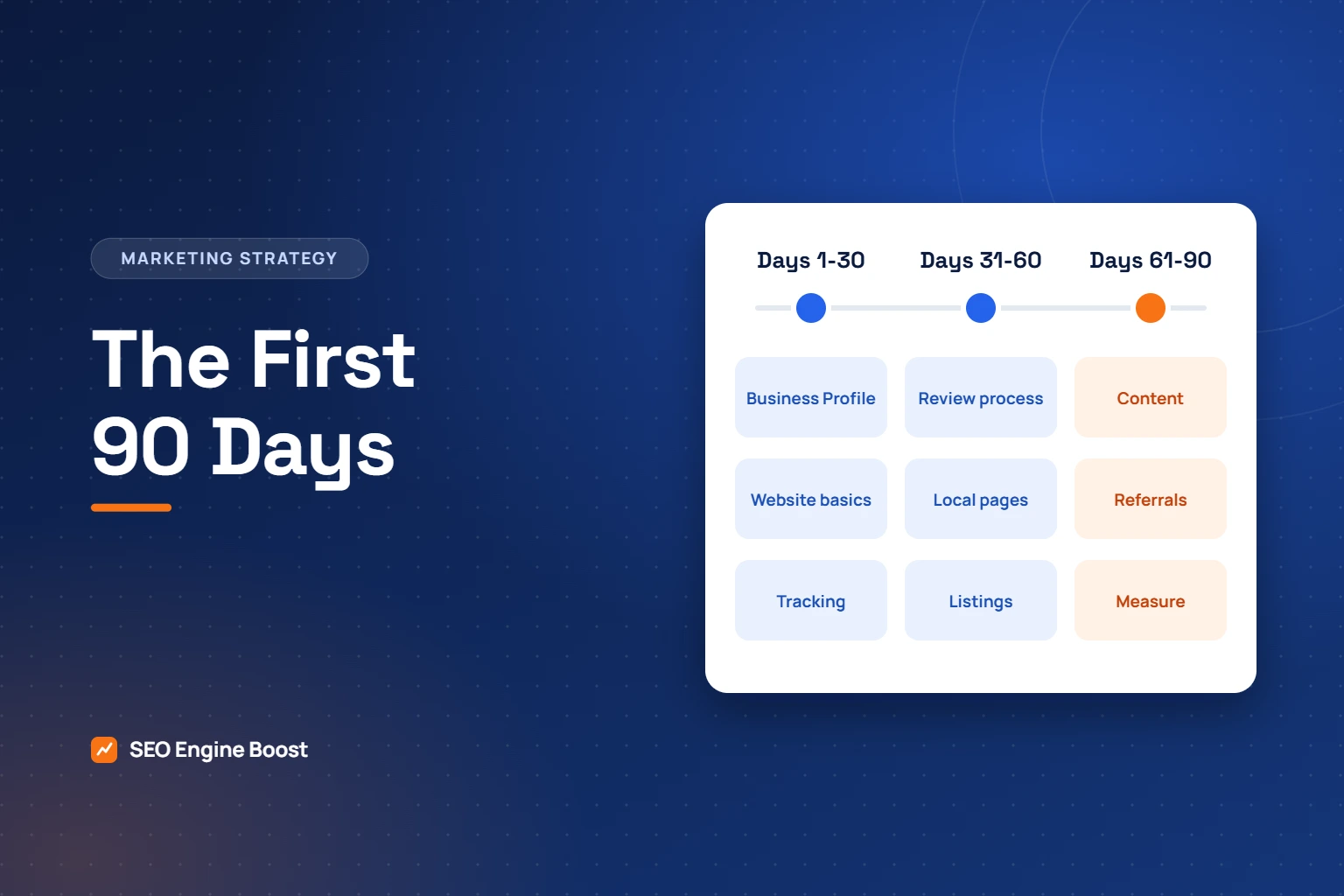
Marketing a New Orthodontic Practice: The First 90 Days
A new orthodontic practice has no reviews, no rankings and no referral history. What it does have is a clean start. The priority in the first ninety days is to become findable and credible in your immediate area, in that order, without spending heavily before the basics are in place.
Key takeaways
- Become findable first, then credible: a website, a verified Business Profile and consistent listings come before advertising.
- Introduce yourself to nearby general and pediatric dentists in the first weeks.
- Ask every patient for a review from day one, and never ask friends or family to post.
In this article
- Before opening
- Weeks 1 to 4: be findable
- Weeks 5 to 8: be credible
- Weeks 9 to 13: add reach
- What to spend
- Mistakes a new orthodontic practice makes
- What to expect
- A countdown to opening day
- The website a new practice needs
- Announcing the opening
- Building referral relationships from nothing
- Earning the first reviews fairly
- What to measure in the first ninety days
- Where to put the first marketing money
- If you are buying an existing practice
- Frequently asked questions
- The first month open, week by week
- After the first ninety days
Before opening
- Register the domain in your own name and set up a business email on it.
- Build a small, fast website: home, about the doctor, each main treatment, first visit, location and contact. Six to ten pages is enough.
- Prepare your Google Business Profile. Google’s guidelines require a real location, so create it once you have the address and signage.
- Set up analytics and call tracking so that you measure from day one.
- Take real photographs of the office and team as soon as the space is ready.
Weeks 1 to 4: be findable
- Verify the Business Profile. Set the primary category to Orthodontist, add hours, services and photos.
- List the practice on the main directories with exactly the same name, address and phone number.
- Introduce yourself to general and pediatric dentists nearby. In orthodontics, referrals matter from the first week.
- Tell the local community you are open: neighborhood groups, the chamber of commerce, schools.
Weeks 5 to 8: be credible
- Start asking every patient for a review. Early reviews matter most because you have none. Do not offer rewards and do not ask friends or family to post.
- Publish a first-visit page and a page answering when a child should first be seen. The American Association of Orthodontists recommends a check-up by age 7.
- Add the doctor’s background, training and approach. Parents want to know who will treat their child.
- Post on the Business Profile every week.
Weeks 9 to 13: add reach
- Consider a small Google Ads test on one treatment, with tracking in place. See what to set up before you spend.
- Support one local event or team.
- Review where every inquiry came from and how many became consultations.
- Plan the next quarter’s pages based on what patients asked about.
Opening soon, or just opened?
The free growth audit works as a pre-launch checklist for your website, profile and listings.
What to spend
New practices often spend a higher share of revenue on marketing than established ones, because revenue is still low and awareness is zero. Spend first on the things you will own for years, which are the website, photography and profile, before advertising. See planning an orthodontic marketing budget.
Mistakes a new orthodontic practice makes
- Opening with no website or an unfinished one
- Putting keywords in the business name on Google, which Google’s guidelines do not allow
- Asking friends and family for reviews
- Buying a long, expensive marketing contract before knowing what works locally
- Not recording where patients heard about the practice
What to expect
A new profile can start appearing in map results for searches close to the office within weeks. Wider visibility follows as reviews and content build. Organic rankings for treatment pages take longer, usually several months.
If you are opening or have recently opened, our free growth audit works just as well as a pre-launch checklist.
A countdown to opening day
Marketing a new orthodontic practice begins months before the first patient. The countdown below puts the tasks in the order they depend on each other.
| When | What to do | Why now |
|---|---|---|
| Three months before | Register the domain in your own name, choose the practice name and check that it is free on the main social platforms | Everything else is built on the name |
| Ten weeks before | Brief the website: pages, photographs needed and who will write the content | A good small site takes weeks, not days |
| Eight weeks before | Introduce yourself to nearby general and pediatric dentists | Referral relationships take the longest to build |
| Six weeks before | Set up analytics, call tracking and the consultation form | So that the first inquiry is counted |
| Four weeks before | Launch the website with a clear opening date and a way to request a consultation | Families plan ahead |
| Two weeks before | Create the Business Profile once the address and signage are final, and begin verification | A profile should represent a real location |
| Opening week | Photograph the finished office and team, and add the photos to the site and profile | Real photos build trust at once |
| First month | Ask every patient for a review and thank every referring dentist | Momentum starts with the first few |
If the opening date slips, move the whole countdown. Do not announce a date you may miss.
The website a new practice needs
A new practice does not need a large website. It needs a small one that answers the questions a parent asks about an unfamiliar office.
| Page | The question it answers |
|---|---|
| Home | Who are you, where are you and how do I request a consultation? |
| About the doctor | Who will treat my child, and what is their training? |
| Each main treatment | What do you offer, and which option suits us? |
| First visit | What happens, how long does it take and what does it cost? |
| Cost and payment | Can we afford this, and how do payment plans work? |
| Location | Where do I park, and what are your hours? |
| Contact | How do I reach you today? |
Six to ten pages, written clearly and loading quickly on a phone, are enough for the first year. Make sure you own the site. The checks are in do you own your practice website?
Announcing the opening
A new orthodontic practice has to tell people it exists. Use several channels at once, and keep the message the same in each.
- Dentists. A personal visit and a short letter explaining who you are, what you treat and how to refer.
- Schools and parent groups. An introduction, an offer to speak about dental health or a sponsorship of something they already run.
- Neighbors. The businesses around your office see the same families every day.
- Local news and community sites. A short, factual announcement of the opening.
- An open day. A chance for families to see the office and meet the team, without any pressure to book.
- Your own channels. The website, the Business Profile and one or two social profiles, each showing the opening date and how to request a consultation.
Keep claims modest. A new practice earns trust by being clear and welcoming, not by describing itself as the best in town.
Building referral relationships from nothing
In orthodontics, referrals from dentists can matter from the first week. A new practitioner has no history to rely on, so the approach has to be personal.
- List the general and pediatric dental offices within a sensible distance.
- Visit each one briefly, in person, and ask what they need from an orthodontist.
- Leave a one-page summary: your training, the treatments you provide, how to refer and how you report back.
- After every referred patient’s consultation, send a short, specific update.
- Make referring easy with a simple form and one named contact in your office.
- Stay in touch a few times a year, with something useful, such as a short update on a treatment you offer.
Dentists refer to colleagues they trust and hear from. Reliability does more than gifts.
Earning the first reviews fairly
The first reviews carry the most weight, because a profile with none gives a parent nothing to go on. The temptation to ask friends and family is strong, and it should be resisted. Google’s policies and the FTC’s rule both address reviews that do not reflect a real customer experience.
- Ask every patient from the first week, at the same point in the visit.
- Send a direct link the same day, to people who have agreed to receive messages.
- Use neutral wording and offer nothing in return.
- Reply to each review briefly, without confirming that the reviewer is a patient.
- Accept that the first reviews arrive slowly. A handful of real ones is worth more than twenty that look arranged.
The full process is in how to get more Google reviews.
What to measure in the first ninety days
A new practice has no history to compare with, so the first quarter is about establishing a baseline.
| Number | Where it comes from | Why it matters |
|---|---|---|
| Inquiries by source | Front desk, call tracking and form records | Shows which channel is working first |
| Consultations booked and attended | Practice software | Shows whether inquiries are being converted |
| Treatment starts | Practice software | The number that matters |
| Referring dentists who sent a patient | Referral records | Shows which relationships are forming |
| Reviews and latest review date | Business Profile | Shows the request process is running |
| Searches and views of the profile | Business Profile performance | Shows visibility is growing |
Add a source field to every new patient record from day one. It is far easier to start the habit than to add it later. See measuring orthodontic marketing.
Where to put the first marketing money
The percentages below are an illustration of priorities, not a recommendation for any particular practice.
| Priority | What it covers | Share in the first quarter |
|---|---|---|
| Foundation | Website, photography, tracking | The largest share, because it is paid once and owned for years |
| Launch awareness | Announcements, an open day, local sponsorship | A meaningful share |
| Referral relationships | Visits, printed summaries, a referral form | Small in money, large in time |
| Advertising test | One treatment, tracked, for sixty days | A modest, fixed amount |
| Reserve | Opportunities that appear after opening | A small amount kept back |
Spend first on what you will own. Advertising stops working the day you stop paying for it. A good website and a complete profile keep working. See planning an orthodontic marketing budget.
If you are buying an existing practice
A purchase changes the plan, because there is something to protect as well as something to build.
- Confirm that the domain, website, Business Profile and phone numbers transfer to you as part of the sale.
- Keep the practice name, address format and phone number stable through the transition if you can.
- Introduce the new doctor on the website and profile, with a photograph and a short biography.
- Write to existing patients and referring dentists before they hear the news elsewhere.
- Update the doctor’s name on every listing and directory.
- Do not delete the old website. Improve it, or redirect each old page to its new equivalent.
Reviews stay with the Business Profile, which is one reason ownership of the profile should be written into the purchase agreement.
Opening a practice soon?
A free growth audit reviews what you have in place so far and helps you decide what to build first.
Frequently asked questions
When should a new orthodontic practice start marketing?
About three months before opening, starting with the domain, the website brief and introductions to nearby dentists.
Can we create a Google Business Profile before we open?
Create it once the address and signage are final, because a profile should represent a real location. Set the opening date on the profile so that nobody arrives early.
How many pages does the first website need?
Six to ten good pages are enough: home, about the doctor, each main treatment, first visit, cost, location and contact.
Should a new practice advertise straight away?
A small, tracked test on one treatment can help while organic visibility builds. Put the foundation in place first. See what to set up before you spend on Google Ads.
How long until a new practice appears on Google Maps?
A verified profile can begin appearing for searches close to the office within weeks. Wider visibility follows as reviews, content and local mentions build.
Is it acceptable to ask friends and family for the first reviews?
No. Ask real patients, with no reward and no filtering.
What is the most common mistake?
Opening without a finished website or a way to record where patients came from. Both are much harder to fix later.
Where should we begin?
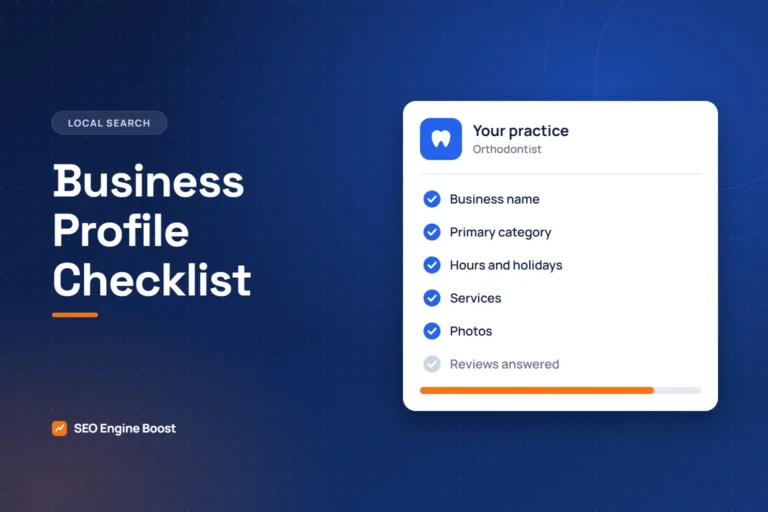
With a written plan and the countdown above. Our free growth audit works as a pre-launch checklist, and the Google Business Profile checklist covers the profile in detail.
The first month open, week by week
| Week | Focus | Tasks |
|---|---|---|
| 1 | Be findable | Confirm the profile is verified and complete, check the website form and phone number, send the opening announcement |
| 2 | Start the habits | Ask every patient for a review, record a source for every inquiry, send the first referral updates |
| 3 | Listen | Note the questions parents ask at the front desk and on the phone. They are your next pages. |
| 4 | Count | Total the inquiries, consultations and starts by source, and compare them with what you expected |
The fourth week matters most. A new orthodontic practice that counts from the first month can see by the end of the quarter which channel deserves more attention. One that waits a year has only impressions to go on.
After the first ninety days
By the end of the first quarter the basics should be in place: a small website you own, a complete profile, the first reviews, a handful of referring dentists and a record of where each inquiry came from. The next quarter builds on that.
- Write the pages that answer the questions you heard most often.
- Add a page about a child’s first visit if you have not already. The American Association of Orthodontists recommends a check-up by age 7, and parents search for exactly that.
- Decide whether the advertising test earned a second round.
- Visit the dentists who have not yet referred, and thank the ones who have.
- Choose one local commitment, such as a school team or event, that you can keep for years.
- Review what you spent and what it produced.
Growth in the second and third quarters usually comes from repeating these habits, not from adding new channels. The practices that struggle in their first year are rarely short of ideas. They are short of a routine. For the ideas that suit an established routine, see twelve orthodontic marketing ideas, and for the search side specifically, SEO for orthodontists.
Keep reading
See where your practice stands
If you would like a second pair of eyes on your own practice, we offer a free growth audit: a manual review of your local visibility, website, reviews and content, with a prioritized list of what to fix first.