How Can an Orthodontic SEO Consultant Help Your Practice Reach Its Goals?
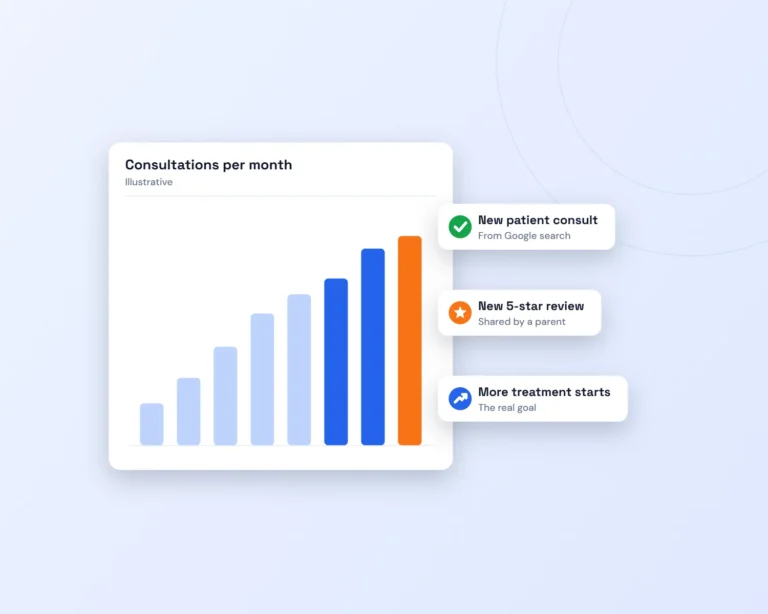
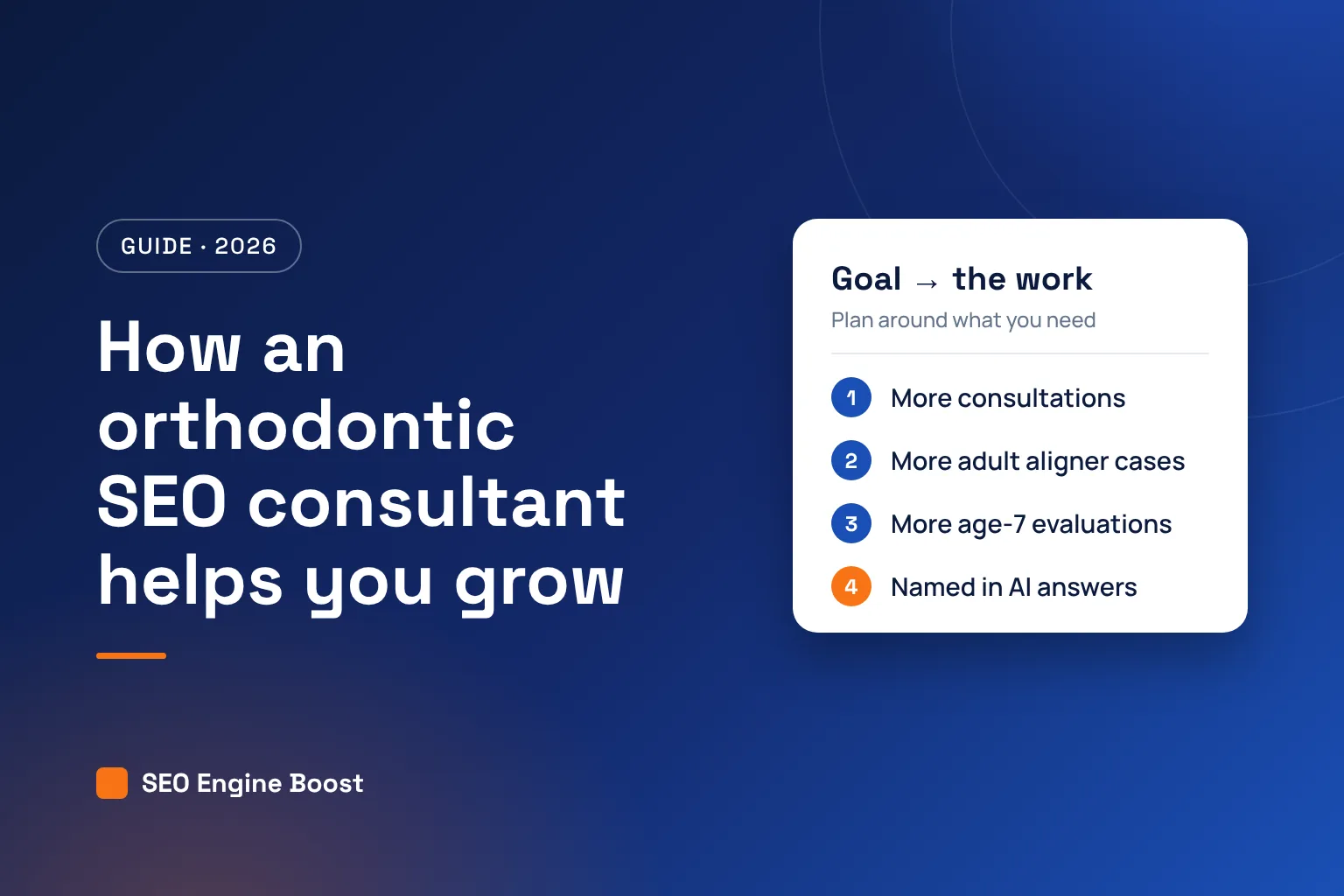
Short answer: an orthodontic SEO consultant turns your practice goals (more consultations, more adult aligner cases, a fuller early-treatment schedule) into specific work on Google Maps, your website and AI answers, then shows you each week what moved. The value is not “rankings”. It is a clear line from the work to your phone ringing.
By Dr. Mahmoud Elsheikh, a dentist completing an MSD in Orthodontics · Updated
Start with the goal, not the keyword
Most practices hire SEO help with a vague brief: “we want to rank higher.” A good consultant pushes back and asks what the practice actually needs in the next 12 months. The answer changes the work completely.
| Your goal | What the consultant focuses on | What you should see first |
|---|---|---|
| More new-patient consultations | Google Business Profile, local rankings by neighborhood, review routine, clear booking path | More calls and form requests from Maps |
| More adult clear aligner cases | A dedicated adult aligner page, cost and financing answers, adult-focused reviews and photos | Visits and inquiries on the aligner page |
| More early-treatment (phase 1) evaluations | Age-7 first check content written for parents, pediatric dentist referral pages | Parent inquiries and referral visits |
| Fill a new second location | A real location page, a separate Business Profile, local links and listings | The new office appearing in the local pack |
| Show up in ChatGPT and AI Overviews | Structured data, clear answers on your pages, consistent listings across the web | Your name in AI answers for local patient questions |
What an orthodontic SEO consultant actually does
1. Audits what patients see today
Before changing anything, the consultant reviews your practice the way a parent or adult patient would: the Maps listing, the reviews, the homepage on a phone, the treatment pages, and what AI tools say when someone asks for an orthodontist near them. In our study of 30 orthodontic homepages in the 10 largest US cities, 25 showed no treatment cost and 26 never mentioned the age-7 first check. Those are the kinds of gaps an audit should surface in writing.
2. Fixes the Google Business Profile
For “orthodontist near me” searches, the map pack is the front door. That means the right primary category, complete services, real photos, accurate hours, and answers to common questions. See our guide to Business Profile categories for orthodontists.
3. Builds one page for each treatment and each office
One “Services” page cannot rank for braces, Invisalign, adult treatment, early treatment and cost all at once. A consultant plans a page for each, written for the patient’s real questions and reviewed for clinical accuracy. Our treatment page template shows the structure.
4. Sets up a steady review routine
Recency matters to patients. In BrightLocal’s 2026 survey, 74% of consumers said they look for reviews written in the last three months. A simple, compliant request routine beats a burst of reviews once a year.
5. Tracks calls and forms, not just rankings
If no one knows which channel produced which consultation, no one can tell whether SEO is working. Call tracking and form tracking should be set up early, without creating listing inconsistencies. See call tracking for orthodontists.
6. Reports in plain language, every week
You should always know what was done, what changed and what is next. A weekly update keeps the work visible; a monthly report shows the trend.
Consultant, agency or in-house?
| In-house staff | Large agency | Specialist consultant | |
|---|---|---|---|
| Knows orthodontics | Yes, but limited SEO time | Varies; often generalist writers | Yes, if dental or ortho focused |
| Who does the work | A team member between other tasks | Often an account manager plus a team | Usually the consultant directly |
| Contract | None | Often 6 to 12 months | Often month-to-month |
| Best for | Small updates and photos | Large groups wanting one vendor for everything | Single and small multi-location practices |
We cover this choice in more depth in agency vs in-house orthodontic marketing.
What it costs, and how to think about the return
Many providers do not publish prices. Among those that do, monthly orthodontic or dental SEO commonly falls somewhere between about $750 and $2,000 or more. Our own plans are published on the pricing page: a $790 audit credited to month one, then $990 or $1,490 a month, month-to-month.
A useful way to judge the investment: divide the yearly cost by what one comprehensive case is worth to your practice. Pearl’s cost data, based on ADA fee survey figures, puts the US average for comprehensive orthodontic treatment at about $5,645 (updated May 2026). At that figure, a $990 monthly plan is covered by roughly two additional case starts a year. Your own fee, close rate and margin will differ, so do the math with your numbers.
Not sure where your practice stands? A free growth review shows your top three fixes for Google, Maps and AI answers, in writing.
How to judge a consultant before you sign
- Do they ask about your goals first? Or do they open with a ranking report?
- Do you own every account? Website, Business Profile, analytics and ads should stay in your name.
- Is pricing clear and the contract short? Month-to-month means they must earn the next month.
- Who checks clinical content? Treatment pages should be reviewed by someone with dental training.
- Do they promise guaranteed rankings? Walk away. Google itself warns that no one can guarantee a #1 ranking.
Want this done for your practice? We can put this into practice for you as part of our orthodontic SEO services. Start with a free growth audit or see our published prices.
Frequently asked questions
How long until an orthodontic SEO consultant shows results?
Profile and technical fixes often show early movement in Maps within the first weeks; treatment pages and reviews usually build over three to six months. Anyone promising a fixed timeline for rankings is guessing.
Can a consultant help if we already have a website vendor?
Yes. Many practices keep their current site and hire SEO help for the profile, pages, reviews and tracking. The consultant works alongside the vendor.
Does SEO replace Google Ads?
No. Ads bring calls quickly while you pay; SEO builds visibility that keeps working. Many practices run both and shift budget as organic visibility grows.
Is a consultant worth it for a single-location practice?
Usually yes, because local search is where single-location practices win or lose. The question is whether the yearly cost is smaller than the value of the extra cases it helps bring in.
Next step
If you want to see where your practice stands, start with a free growth review or the full $790 audit. You keep the written findings either way.