
Orthodontic Referral Marketing: Dentists, Patients and the Rules
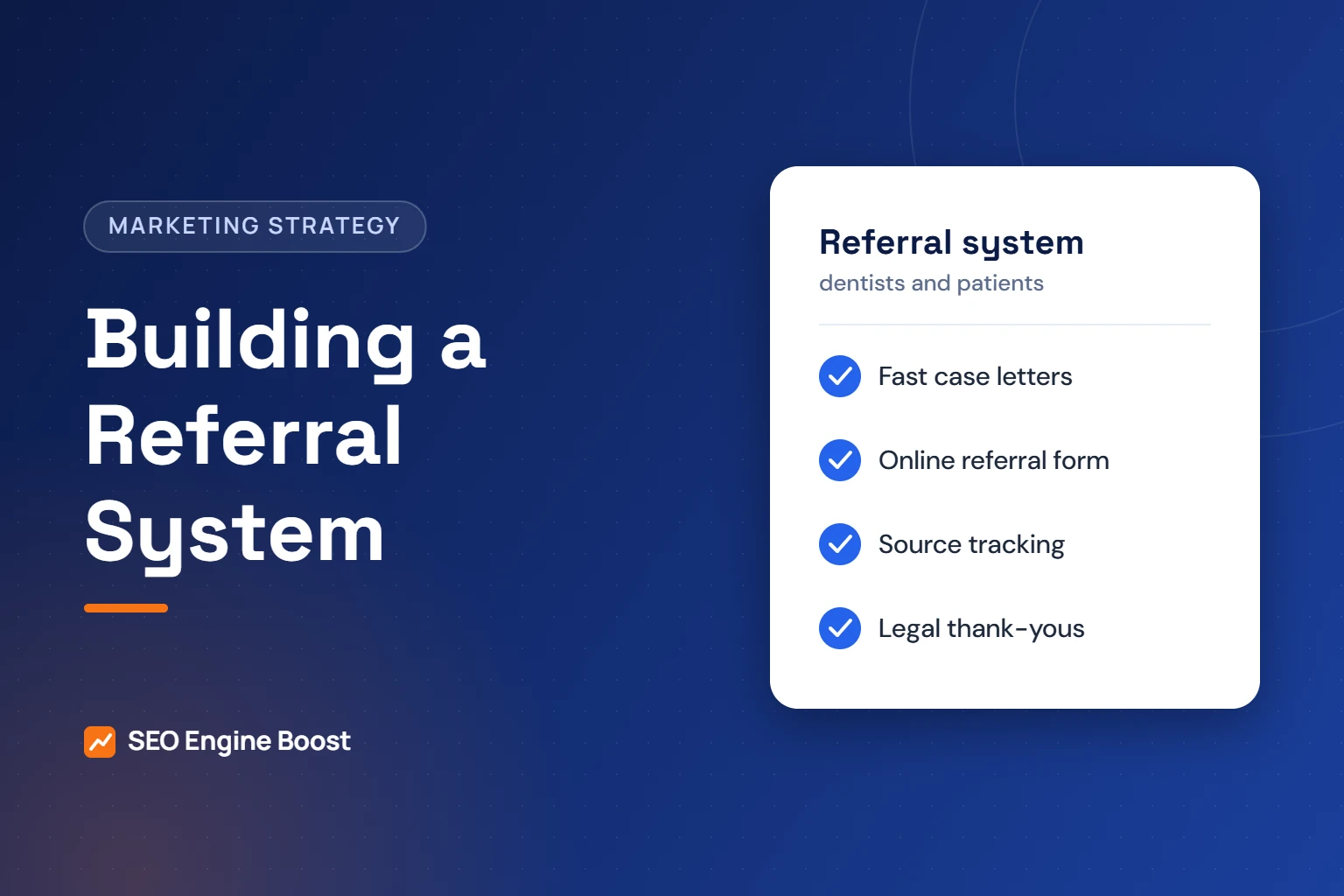
Orthodontic referral marketing is a repeatable system for earning new patients from general dentists, pediatric dentists and happy families. It rests on four parts: strong relationships with referring offices, fast case reports, an easy online referral form, and clean source tracking. Patient rewards are allowed only within ethical and legal limits.
This guide covers each part in order. It also explains the rules on patient referral rewards, using the ADA Code, federal anti-kickback law and an example state rule. That section is general information, not legal advice. Check your own state dental board and a healthcare attorney before you launch a program.
Key takeaways
- Referring dentists judge you on communication. Send a short case report after every consult and progress letters at key milestones.
- Make referring take one minute: a short online referral form, a direct phone line and a named contact person.
- Track every new patient’s referral source in your practice-management system, or you cannot tell which relationships work.
- Patient thank-yous have limits. Avoid cash or gift cards, never pay per referral, and get legal review if you treat Medicaid patients.
In this article
- Where orthodontic referrals come from
- Build relationships with general and pediatric dentists
- Send timely case reports and progress letters
- Make referring easy with an online referral form
- Track referral sources in your practice-management system
- Patient referral programs and their legal limits
- How reviews and your Google profile support referrals
- A 90-day plan to launch your referral system
- Frequently asked questions
Where orthodontic referrals come from
Most practices get referrals from two groups. Professional referrals come from general and pediatric dentists who spot a problem and send the family to you. Patient referrals come from families who liked their experience and tell friends.
Each group needs a different plan. Dentists want clinical communication and easy logistics. Families want a great experience and an easy way to share your name.
| Referral source | What they value | Your main tools |
|---|---|---|
| General dentists | Clear reports, respect for their patient relationship, fast scheduling | Case letters, referral form, periodic visits |
| Pediatric dentists | Timing advice for growing children, gentle care, clear next steps | Growth-timing notes, recall updates, shared protocols |
| Current patients and parents | A good experience and an easy way to recommend you | Review requests, shareable links, lawful thank-you notes |
| People who look you up | Proof that others trust you | Google Business Profile, reviews, a clear website |
Build relationships with general and pediatric dentists
A referring dentist is trusting you with their patient. Your job is to make that trust feel safe. That means clear communication, sending patients back for routine dental care, and never criticizing prior care in front of the family.
Practice consultant Roger Levin has suggested sorting referring offices into tiers and setting a contact schedule for each. He also recommends engaging the referring office’s front-desk team, not only the dentist. Treat this as consultant opinion, not research, but the structure is practical.
- List your referrers. Pull the last 12 months of referrals and rank offices by volume.
- Set a contact rhythm. Top offices might get a visit each quarter. Others might get a call or a note.
- Offer something useful. Share a timing guide for interceptive treatment or host a study club on a clinical topic.
- Name one contact person. Referring teams should know exactly whom to call in your office.
- Return patients for hygiene. Remind families to keep their regular dental visits during treatment.
Be careful with gifts to referring offices. Lunches and gifts given because an office sends patients can raise kickback concerns, especially when Medicaid patients are involved. Keep them modest, not tied to referral counts, and ask your attorney first.
Send timely case reports and progress letters
The fastest way to lose a referrer is silence. A dentist who never hears back assumes the patient was lost or mishandled. A short, prompt letter shows that you respect the referral.
The schedule below is agency guidance based on common practice. It is not a published standard. Adjust it to your workflow and your practice-management software.
| Milestone | What to send | Suggested timing |
|---|---|---|
| Consult completed | Thank-you, diagnosis summary, proposed plan or observation | Within 1 to 2 business days |
| Treatment started | Start date, appliance type, estimated duration | Within 1 week of start |
| Mid-treatment | Progress note and any hygiene concerns | At a natural milestone |
| Patient on observation | Recall plan and when you will re-evaluate | After each recall visit |
| Debond | Final summary, retainer plan, return to routine care | Within 1 week of debond |
Use templates in your practice-management system so letters go out with a few clicks. Send them through a secure channel your office already uses for patient information. Include photos only when your privacy policy and patient consent allow it.
Make referring easy with an online referral form
A referring office should be able to send a patient in about a minute. A short online referral form on your website removes phone tag and fax delays. It also gives you a clean, timestamped record of each referral.
What to include on the form
- Referring dentist name, office and phone number
- Patient and parent name with a preferred contact method
- Reason for referral, with a few checkboxes for common concerns
- Urgency, such as routine or soon
- An optional file upload for an X-ray or note
Because the form collects patient information, handle it with care. Use a secure form tool, keep advertising tracking pixels off the page, and limit who can see submissions. Our guide to tracking pixels and patient privacy explains why.
Call the family quickly after a referral arrives. A referral that waits days for a callback may go elsewhere. The same speed rules apply to web leads, as covered in our consultation follow-up guide.
Track referral sources in your practice-management system
You cannot improve what you do not measure. Every new patient record should store a referral source. Most orthodontic practice-management systems have a referral field or referrer list for this.
- Create a clean list of referring offices with one entry per office, not per spelling.
- Add patient sources such as “existing patient or family” and “Google search”.
- Make the referral field required before a new-patient record can be saved.
- Ask every new caller, “How did you hear about us?” and record the exact answer.
- Run a monthly report of consults and starts by source.
Watch starts, not only consults. An office that sends ten consults with two starts may need different communication than one with eight starts. Our guide to measuring orthodontic marketing shows how to connect sources to starts and revenue.
Want a clear view of where your patients come from?
Our free growth audit reviews your referral tracking, Google Business Profile and website, then gives you a short fix list.
Patient referral programs and their legal limits
This section is general information, not legal advice. Rules differ by state and change over time. Ask your state dental board and a healthcare attorney before you offer any reward.
The ADA Code on rebates and split fees
The ADA Code of Ethics says dentists “shall not accept or tender ‘rebates’ or ‘split fees.'” Its advisory opinion 4.E.1 applies the ban to third parties, not only other dentists. Paying a marketer a share of patient fees can count as fee splitting.
The Code’s opinion 5.F.4 also addresses referral services. A service that charges dentists per referral while presenting itself as a free public service violates the Code.
The federal Anti-Kickback Statute
The HHS Office of Inspector General (OIG) describes the Anti-Kickback Statute as a criminal law. It bans knowingly paying remuneration to induce or reward referrals of services payable by federal health care programs, such as Medicaid. OIG says remuneration “includes anything of value.”
Penalties include fines, jail terms and exclusion from federal programs. If any of your patients are covered by Medicaid, a reward for referrals deserves legal review.
Gifts to Medicaid patients
A separate law limits inducements to Medicare and Medicaid beneficiaries. In a 2016 policy statement, OIG said items of nominal value are allowed. It set that at $15 per item and $75 per patient per year, and said items may not be cash or cash equivalents.
State dental board rules
States add their own rules. Minnesota’s rule 3100.6900 bars paying or receiving compensation from a third party for a patient referral. The same rule says it does not stop a dentist from giving a patient a gift or a credit for dental services.
| Program idea | Risk level | Why |
|---|---|---|
| Handwritten thank-you note | Low | Nothing of value is exchanged |
| Small branded item of low value | Usually low | Check state rules and OIG nominal-value limits for Medicaid patients |
| Gift card or cash per referral | High | Cash equivalents and per-referral payments raise ethics and kickback concerns |
| Paying a marketer per patient or a share of fees | High | ADA opinion 4.E.1 treats this as fee splitting |
| Charity donation in the patient’s name | Check first | Rules vary by state; ask your board or attorney |
When in doubt, thank people without giving anything of value. A personal note from the doctor often means more to a family than a small gift.
How reviews and your Google profile support referrals
Referred families still search for you before they call. They check your Google Business Profile, read reviews and scan your website. A weak profile can undo a strong referral.
- Keep your profile complete. Hours, phone, photos and services should be accurate. See our Google Business Profile service.
- Ask every happy family for a review. Use a simple, consistent process from our guide to getting more Google reviews.
- Make your website match the referral. A page for referring dentists with the form and a contact name builds confidence.
Keep reviews and referral rewards separate. Google’s Maps content policy bars businesses from offering incentives in exchange for reviews. It also bars selectively asking only happy customers for reviews. Never tie a referral thank-you to a review.
A 90-day plan to launch your referral system
This plan is agency guidance. It suits a practice with one to three offices and an existing referral base.
- Days 1 to 15: Clean up your referrer list and make the referral source field required.
- Days 16 to 30: Build letter templates for consults, starts and debonds. Launch the online referral form.
- Days 31 to 60: Visit or call your top referring offices. Share the form and your contact person.
- Days 61 to 75: Get legal review of any patient thank-you idea, then launch it in writing for staff.
- Days 76 to 90: Run your first monthly report by source. Adjust contact plans for each tier.
Frequently asked questions
Can an orthodontist give patients gift cards for referrals?
Gift cards are risky. OIG treats cash equivalents as outside its nominal-value allowance for Medicare and Medicaid patients, and some state rules restrict referral rewards. Per-referral payments can also raise kickback concerns. A thank-you note or a small low-value item is safer. Check your state board and a healthcare attorney first.
Does the Anti-Kickback Statute apply if we do not take Medicaid?
The federal statute targets referrals for services payable by federal health care programs, such as Medicaid. If you treat no such patients, it may not apply. State laws and dental board rules can still restrict referral payments for all patients. This is general information, so confirm your situation with a healthcare attorney.
How fast should we send a consult letter to a referring dentist?
As agency guidance, we suggest sending a short report within one to two business days of the consult. Include the diagnosis, the proposed plan or observation schedule, and a thank-you. Speed matters because silence makes referring dentists assume the patient was lost or mishandled.
What should an orthodontic online referral form include?
Keep it short. Ask for the referring dentist and office, patient and parent names, contact details, the reason for referral and urgency. Add an optional upload for an X-ray. Use a secure form tool, keep advertising pixels off the page, and limit who can see submissions.
How do we know which dentists refer the most starts?
Make the referral source a required field in your practice-management system and keep one clean entry per office. Then run a monthly report of consults and starts by source. Comparing starts, not only consults, shows which relationships produce treatment and which need more communication.
Sources
- ADA: Principles of Ethics and Code of Professional Conduct (advisory opinions revised to October 2024)
- HHS OIG: Fraud and Abuse Laws (Anti-Kickback Statute)
- HHS OIG: Policy Statement Regarding Gifts of Nominal Value to Medicare and Medicaid Beneficiaries (December 7, 2016)
- Minnesota Rules 3100.6900: Compensation for Patient Referral
- Google: Maps User Generated Content Policy, Prohibited and restricted content
- Orthodontic Products: Five Essential Tips for Referral Marketing Success, Roger P. Levin, DDS (October 18, 2019)
Keep reading

Reviews and Compliance
How to Get More Google Reviews for Your Orthodontic Practice (Within the Rules)

See where your practice stands
If you would like a second pair of eyes on your own practice, we offer a free growth audit: a manual review of your local visibility, website, reviews and content, with a prioritized list of what to fix first.