
Orthodontic Missed Calls: What They Cost and How to Fix Them
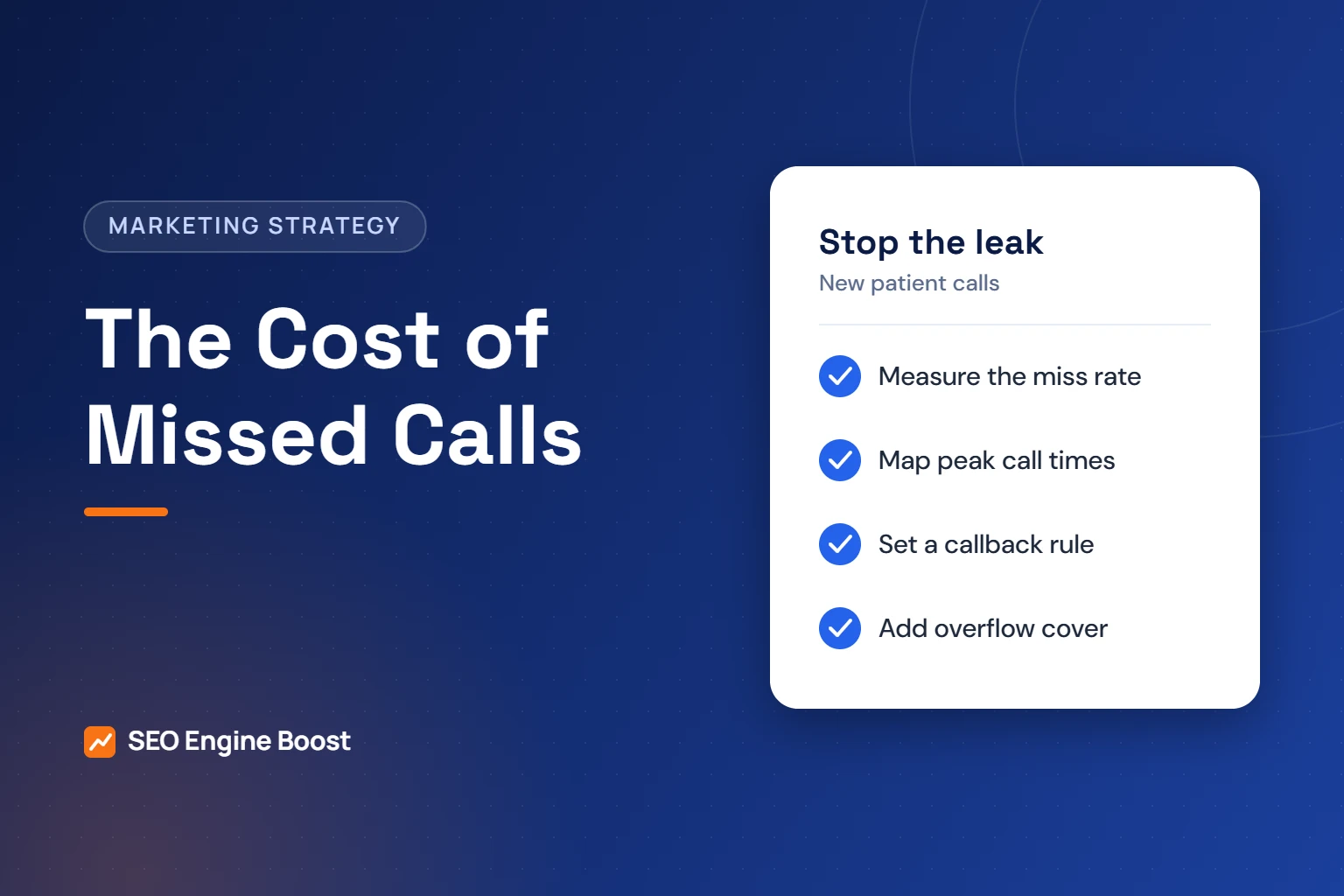
Orthodontic missed calls cost a practice the consults and starts those callers would have become. Vendor data suggests the gap can be large. One dental group left 38% of inbound calls unanswered in a month. The fix is to measure your miss rate, cover peak times, return calls fast and add overflow help.
Marketing spend is wasted if the phone is not answered. A parent who reaches voicemail may simply call the next practice on the map. This guide shows how to measure the problem, what it costs, and the staffing, callback and script changes that close the gap.
Key takeaways
- Measure your own miss rate with call tracking before you change anything.
- Published miss-rate figures come from vendors who sell phone tools. Treat them as vendor data.
- Set a written callback rule, such as returning every missed new patient call within one business hour.
- Keep voicemail, texts and recordings privacy-safe. Check HIPAA, consent and state recording laws.
In this article
- What a missed new patient call really costs
- What published data says about missed calls
- How to measure your miss rate with call tracking
- Find your peak call times
- Voicemail and callback rules
- Overflow, answering services, text-back and staffing
- A simple script for new patient calls
- Privacy notes for calls, voicemail and texts
- Frequently asked questions
What a missed new patient call really costs
A missed call is not lost forever. Some callers leave a message or call back. Many do not. The cost is the starts you would have won from the ones who moved on.
Here is a hypothetical example. The numbers show the method, not a benchmark.
- A practice gets 200 new patient calls a month.
- It misses 20%, or 40 calls.
- Half of those callers never reach the practice again. That is 20 lost callers.
- Normally, half of callers book a consult, and half of consults start. So 20 lost callers equal about 5 lost starts.
- At the practice’s own average case fee of $5,500, that is about $27,500 in treatment value each month.
Your numbers will differ. Plug in your own call volume, booking rate and case fee with our missed call revenue calculator. Then compare the result with your cost per start in our guide to orthodontic marketing ROI.
What published data says about missed calls
There is no independent, peer-reviewed study of missed call rates in orthodontic offices that we could find. The best public figures come from phone and AI vendors analyzing their customers’ calls. They are useful, but they are vendor data. Each vendor also sells a fix.
| Source (vendor data) | What was measured | Finding |
|---|---|---|
| Peerlogic, 2026 | 4,280 patient calls across a 26-practice dental group in February 2026 | 38% of inbound patient calls went unanswered |
| Peerlogic, 2026 | Same dataset, call-to-appointment conversion | New patients converted to an appointment 25.24% of the time, versus 55.77% for existing patients |
| Convirza, 2025 | Thousands of tracked calls to dental practices | 75.2% of missed calls came in after hours, 16.2% at lunch, and 6.0% when lines were busy |
The pattern matters more than the exact number. Calls are missed most when the office is closed or short-staffed. New patients are also harder to convert than existing ones, so the first call needs your best people.
How to measure your miss rate with call tracking
You cannot fix what you cannot see. Your phone system or call tracking tool should show every inbound call, whether it was answered, and how long callers waited.
- Pull 30 days of call logs. Include every line that new patients might call.
- Separate new patient calls. Use tracking numbers on marketing channels, or tag calls by caller ID against your patient list.
- Count four outcomes. Answered, sent to voicemail, abandoned on hold, and rang out.
- Calculate your miss rate. Unanswered new patient calls divided by all new patient calls.
- Track the callback. For each missed call, record whether and when someone called back, and whether a consult was booked.
| Metric | How to calculate it | Why it matters |
|---|---|---|
| Miss rate | Unanswered calls ÷ all calls | The size of the leak |
| Hold abandonment | Callers who hung up on hold ÷ calls placed on hold | Shows when one person covers too many lines |
| Time to callback | Average minutes from missed call to return call | Speed decides who wins the patient |
| Callback reach rate | Missed callers reached ÷ missed callers | Shows if callbacks actually connect |
| Call-to-consult rate | Consults booked ÷ answered new patient calls | Tests your scripts and scheduling |
Our guide to measuring orthodontic marketing explains how to tie these calls back to each channel.
Find your peak call times
Missed calls cluster. Break your call log into hourly blocks for each weekday and look for the spikes.
Orthodontic offices face a pattern most general offices do not. Many patients are in school during the day. Parents often call on their own breaks. After school, the clinic fills with appointments just as the phones get busy.
- Before school and morning drop-off. Parents may call as soon as you open.
- Lunch hour. Convirza’s data put 16.2% of missed dental calls at lunch. Stagger front desk lunches.
- After school. Check-in, payments and scheduling compete with the phone. This is often the worst gap in an orthodontic office.
- Evenings and weekends. Convirza found most missed dental calls happened after hours. Decide how these calls get covered.
Do not assume your pattern matches anyone else’s. Your own call log is the only reliable guide.
Voicemail and callback rules
Voicemail is not a strategy. Many callers will not leave a message. Treat every missed new patient call as a lead to call back, whether or not a message was left.
Practice consultant Amy Stafford, writing in Orthodontic Products, suggests three targets. Answer all calls within three rings. Hold callers no more than 60 seconds. Return missed calls within one business hour. These are practical targets, not research findings. They make a good starting rule.
- Write a callback rule. For example, every missed new patient call is returned within one business hour.
- Assign an owner. One named person checks the missed call list each hour.
- Set an attempt limit. Decide how many calls and texts you make before closing the lead.
- Update the greeting. Say when you will call back and point callers to your online consult request form.
- Log the outcome. Record each callback in your practice software or CRM.
Form leads need the same discipline. See our guide to consultation request follow-up for timing and message ideas.
Not sure where your calls go?
We can review your call tracking, Google Business Profile and website to show where new patient calls leak.
Overflow, answering services, text-back and staffing
Once you know when calls are missed, match the fix to the gap. Most practices combine more than one option.
| Option | Best for | Watch out for |
|---|---|---|
| Overflow routing to another team member | Busy after-school hours | Staff who cannot book consults or answer basic questions |
| Dedicated new patient line | Practices with steady call volume | Needs a trained person to answer it |
| Live answering service | Lunch, evenings and weekends | Scripts must match yours; ask for a business associate agreement |
| AI or virtual receptionist | After-hours booking requests | Check accuracy, consent and how data is stored |
| Automatic text-back after a missed call | Callers who prefer text | Consent rules for automated texts; keep messages free of health details |
| Remote or shared front desk staff | Multi-location practices | Needs a shared schedule and clear handoffs |
Staffing
Sometimes the honest answer is more people at the right hours. Look at your peak blocks. If one person handles check-in, payments and phones after school, calls will be missed. Shifting one shift or adding a part-time phone role may cost less than the starts you lose.
- Separate the phone from the front desk during your busiest block, even for two hours a day.
- Cross-train one more person to book consults, so overflow calls are not just message-taking.
- Stagger breaks so the phone is never left to one person at lunch.
- Review recorded or sampled calls together each month, if you record with proper notice.
- Share the numbers. Show the team the monthly miss rate and callback time. What gets measured tends to improve.
Unreturned calls deserve extra attention. A missed call returned within the hour still has a fair chance of booking. A missed call that nobody returns depends on the caller trying again. In many offices the callback, not the first ring, is the real weak point.
A simple script for new patient calls
A good script is a guide, not a recording. It helps new team members sound confident and makes sure every caller is offered a consult.
- Greet warmly. “Thank you for calling [practice name], this is [name]. How can I help?”
- Get a name early. “May I have your name? And who is the appointment for?”
- Ask what prompted the call. “What made you decide to look into braces or aligners now?”
- Answer the main question briefly. Explain that the orthodontist will review options and fees at the consult.
- Offer two times. “I have Tuesday at 4:00 or Thursday at 3:30. Which works better?”
- Ask how they heard about you. This supports your marketing reports.
- Confirm and set expectations. Confirm date, time, address and what to bring.
Avoid quoting firm fees on the phone unless your practice has a clear policy. Do record common questions, such as cost, insurance and aligners. They are good topics for your website too.
Privacy notes for calls, voicemail and texts
This section is general information, not legal advice. Check your state dental board and a health care attorney for your situation.
- Voicemail. HHS says HIPAA allows providers to leave messages on answering machines, but they should limit the information. Leave your name, number and a request to call back.
- Confidential requests. HHS says providers must accommodate reasonable patient requests for confidential communication, such as calls at a different number.
- Call recording. Most states require only one party’s consent to record. A smaller group requires everyone on the call to consent. Use a recorded notice if you record.
- Automated texts. Automated or prerecorded calls and texts to mobile phones generally require prior express consent under the TCPA. Marketing messages can require written consent.
- Vendors. Answering services, call tracking and AI tools that handle patient information may need a business associate agreement.
Our article on tracking pixels and patient privacy covers related website risks.
Frequently asked questions
How many calls do orthodontic practices miss?
No independent study of orthodontic offices exists that we could find. Vendor data gives a sense of scale. Peerlogic found a 26-practice dental group left 38% of inbound calls unanswered in February 2026. Your rate may be higher or lower, so measure it with 30 days of call logs before making changes.
How fast should we return a missed new patient call?
Set a written rule and stick to it. Many practices aim to return missed calls within one business hour, a target recommended by consultant Amy Stafford. Speed matters because a parent who cannot reach you may call another office. Assign one person to check the missed call list every hour.
Is it OK to leave a voicemail for a new patient?
Yes, with care. HHS says HIPAA allows providers to leave answering machine messages if they limit the information shared. Leave your name, practice name, number and a request to call back. Avoid treatment details. Honor any patient request to be contacted at a different number or in a different way.
Should we use an answering service or an AI receptionist?
Either can cover lunch, evening and weekend gaps. Test the script, check how leads reach your team the next morning, and ask whether the vendor will sign a business associate agreement. Review a sample of calls each month. Make sure the service can book consults or capture the details you need.
Can we text people back automatically after a missed call?
Many practices do, but consent rules apply. Under the TCPA, automated calls and texts to mobile phones generally need prior express consent, and marketing texts can need written consent. Keep messages short and free of health details. This is general information, so confirm your setup with a health care attorney.
Sources
- Peerlogic (vendor data): Peerlogic DSO case study, 4,280 calls across 26 practices (February 2026)
- Convirza (vendor data): Why 75% of Missed Dental Calls Happen After Hours (November 11, 2025)
- Orthodontic Products, Amy Stafford: Why Operational Gaps, Not Ad Spend, Are Holding Back Your Practice Growth (July 15, 2025)
- HHS: May health care providers leave messages at patients’ homes? (reviewed December 28, 2022)
- Justia: Recording Phone Calls and Conversations, 50-State Survey (September 2024)
- Manatt: The TCPA and Healthcare: Consent, Exemptions and Risk Mitigation (February 26, 2020)
Keep reading
See where your practice stands
If you would like a second pair of eyes on your own practice, we offer a free growth audit: a manual review of your local visibility, website, reviews and content, with a prioritized list of what to fix first.
Try it with your own numbers: use our free missed call revenue calculator to estimate what unanswered calls cost each month.