
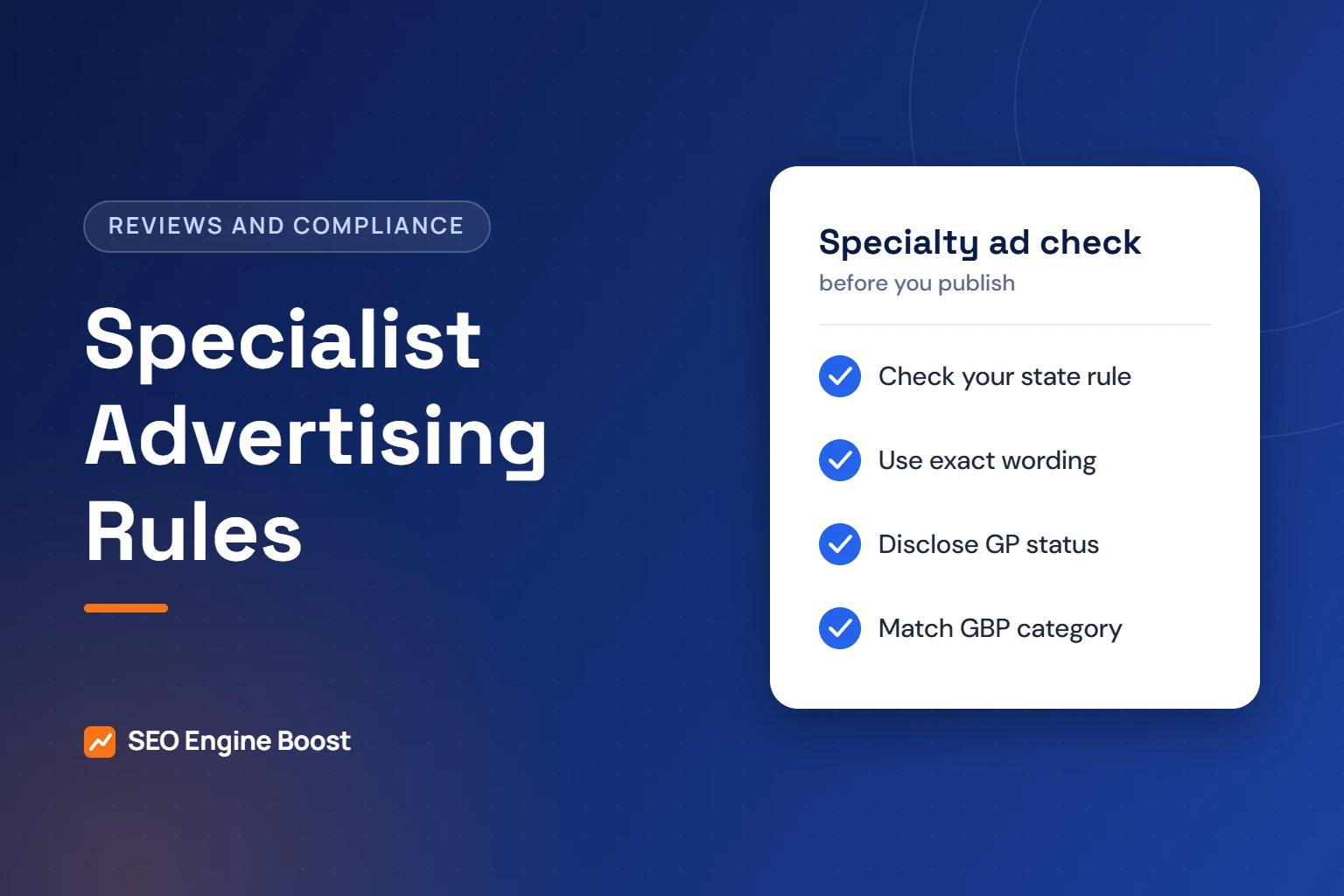
Orthodontic Specialist Advertising Rules: Who Can Say What
Orthodontic specialist advertising rules come from your state dental board, with the ADA Code as a common reference. In most states, only dentists who finished an accredited orthodontic residency may advertise as orthodontic specialists. General dentists may usually offer orthodontic services but must say they are general dentists and avoid implying specialization.
The details vary by state and keep changing. This guide covers the ADA Code, the national commission that recognizes specialties, board certification, and five state examples. It then explains what the rules mean for websites, Google Business Profiles and ads. It is general information, not legal advice. Always check your own state board’s current rules.
Key takeaways
- Specialist status usually comes from completing an accredited specialty residency. ABO board certification is a separate, voluntary credential.
- General dentists can often advertise orthodontic services, but many states require a clear “general dentist” disclosure.
- State rules differ on wording, font size and which boards count. Some states are reviewing their rules now.
- Your website, Google Business Profile and ads should all use the same compliant wording.
In this article
- What the ADA Code says about specialty announcements
- Who recognizes dental specialties
- Specialist status versus ABO board certification
- State examples with their actual rule text
- Why these rules keep changing
- What this means for your practice website
- Google Business Profile names and categories
- Ads, social posts and paid search copy
- Frequently asked questions
What the ADA Code says about specialty announcements
The ADA Principles of Ethics and Code of Professional Conduct sets the ethical baseline many boards reference. Section 5.H covers announcing a specialty. It lists “orthodontics and dentofacial orthopedics” among the recognized specialties.
Under the Code, a dentist who announces a specialty must meet ADA-adopted or state-accepted education standards. The Code’s footnote describes completing an accredited advanced program of at least two years, or holding diplomate status from a recognized board.
- Wording. Specialists should use “specialist in” and keep enough of their practice in the specialty to stay expert.
- “Limited to.” Only practices that work exclusively in a specialty may say practice “is limited to” it.
- Shared offices. It is unethical to suggest that general dentists in a specialist’s office are specialists.
Section 5.I covers general dentists. They may announce services such as orthodontics. They must avoid “any communications that express or imply specialization.” They must also state that they are general dentists.
Who recognizes dental specialties
The National Commission on Recognition of Dental Specialties and Certifying Boards (NCRDSCB) recognizes dental specialties and their certifying boards. It recognizes no more than one certifying board per specialty. For orthodontics, that board is the American Board of Orthodontics (ABO).
The Commission lists 11 recognized certifying boards on its website. Recognition by the Commission is a voluntary process for those organizations. Your state board, not the Commission, decides what you may advertise in your state.
Several states tie their own rules to this structure. For example, Texas defines an “educationally qualified” specialist by reference to programs “as specified by” the NCRDSCB.
Specialist status versus ABO board certification
Patients often confuse these two ideas. They are different steps.
| Credential | How it is earned | What you may claim |
|---|---|---|
| Dental degree (DDS or DMD) | Dental school | General dentist |
| Orthodontic specialist | Accredited orthodontic residency after dental school | “Specialist in orthodontics” or “orthodontist,” subject to state rules |
| ABO board certified | Voluntary written and clinical exams after residency | “ABO-Board Certified” for the individual diplomate, per ABO guidelines |
The ABO describes board certification as “a voluntary credential.” It requires written and clinical examinations beyond residency. Not every orthodontist is board certified, and that does not make them less of a specialist under most state rules.
The ABO’s July 2025 marks guidelines add limits. The certification marks refer to the individual diplomate. They must not suggest that a practice or entity is certified. They also cannot be part of a practice name or logo.
For marketing, this means two separate, accurate claims. A residency-trained orthodontist can say so. A diplomate can add ABO certification to their own bio. Neither claim should be stretched to cover associates or the whole practice.
State examples with their actual rule text
The table shows how five states handle specialist claims. It summarizes rule text we read in October 2026. Rules change, so open the source link and confirm the current version before you rely on it.
| State | Who may claim specialist status | What general dentists must do | Source |
|---|---|---|---|
| Texas | Specialty must be recognized by a certifying board and accredited by CODA. The dentist must be “educationally qualified” or board certified. | Put “General Dentist” or “General Dentistry” directly after the name, in a font no smaller than the largest service text. | 22 TAC 108.54 and 108.55 |
| North Carolina | Specialist claims are misleading unless the dentist completed a program accredited by an agency recognized by the U.S. Department of Education, or holds qualifying board certification. | May advertise limited practice areas but may not use “specialist” and must state a general dentist provides the services. | 21 NCAC 16P .0105 |
| Oregon | Only in an area “recognized by the Board” and in which the dentist is licensed or certified. | Must clearly disclose general dentist status. Example: “Jane Doe, DDS, General Dentist, practice limited to pediatric dentistry.” | OAR 818-015-0007 |
| Pennsylvania | The area must be a Board-recognized specialty, and the dentist must complete an approved specialty training program. | When naming a recognized specialty area, the ad “shall conspicuously disclose that services are provided by a general dentist.” | 49 Pa. Code 33.203 |
| Ohio | Current system relies on CODA accreditation. The board is considering a change that would let dentists claim specialist status if they name the recognizing board or organization. | Proposal still under review as of July 2026, per the AAO. | AAO update, July 2026 |
Texas amended rule 108.54 effective April 1, 2021, and rule 108.55 effective September 30, 2021. North Carolina readopted its specialist rule effective February 1, 2019. The AAO reported that North Carolina’s amendments aligned with comments it had submitted.
Why these rules keep changing
Specialty advertising rules sit between consumer protection and free speech. Courts have struck down rules that went too far.
In January 2016, a federal judge in Texas ruled for the American Academy of Implant Dentistry and other plaintiffs. Dr. Bicuspid reported that the court found the Texas specialty rule an “unconstitutional restriction” on commercial speech. Texas later rewrote its rules around certifying boards and accreditation.
Ohio shows the debate is still live. In July 2026, the AAO said Ohio’s board was weighing a change to its CODA-based system. The AAO and specialty groups have filed comments opposing it.
The practical lesson is simple. Do not copy wording from another state or an old template. Check your board’s current rule each year, and after any news of a rule change.
Multi-state groups face the hardest version of this problem. A phrase that is fine in one state may need a disclosure in the next. Keep a wording sheet for each state where you have offices. Have a local attorney or your state association review it. Our page on SEO for orthodontic groups explains how we handle location pages with different rules.
What this means for your practice website
Your website is advertising under most state rules. Every page that names a doctor or service should follow your state’s wording rules. The ADA Code’s opinion 5.F.6 also says websites and search optimization must be truthful and not misleading.
- Doctor bios. State the residency program and any ABO certification accurately. Use the ABO’s approved post-nominal only for diplomates.
- Mixed practices. If general dentists provide aligners or braces, label them as general dentists on every page they appear.
- Page titles and headings. “Orthodontist in [City]” on a general dentist’s page can imply specialization. Use “orthodontic treatment” or “clear aligners” instead.
- Schema markup. Keep structured data consistent with the visible text. Do not label a general dentist as a specialist in code.
- Old pages. Audit blog posts and landing pages for outdated claims such as “best orthodontist.”
For specialists, clear credentials are also a ranking and trust advantage. Our guide on competing with general dentists on clear aligners explains how to present them honestly. Our list of common orthodontic website mistakes covers other issues to fix during the same audit.
Not sure your site wording is compliant?
Our free growth audit flags risky specialist claims on your website and Google profile alongside SEO issues.
Google Business Profile names and categories
Your Google Business Profile is a public claim about your practice. Its name and category should match what your state allows you to say.
Google’s own guidelines help here. Google asks for “the fewest number of categories” that describe your overall core business. It also says not to use categories “solely as keywords.”
- Specialist practices. “Orthodontist” is the natural primary category when your doctors are qualified orthodontists.
- General practices. Use a general dentistry category. Adding “Orthodontist” as a category can imply specialist status in states that restrict it.
- Business name. Google says the name should match your real-world name, without extra service or location keywords.
- Practitioner profiles. Google allows a title or degree on individual practitioner profiles. Keep those consistent with your state rule.
Our Google Business Profile service sets up categories and names with these rules in mind.
Ads, social posts and paid search copy
Paid ads have little room, which makes compliance harder. A headline like “Top Orthodontist” can break both state rules and ADA guidance on unsupported claims.
- Write a short, approved wording list for each doctor, such as “ABO-Board Certified” (diplomates only) or “General dentist offering clear aligners.”
- Use that list in every Google Ads headline, social bio and printed flyer.
- Avoid superlatives such as “best” or “top” unless you can support them.
- Keep the general dentist disclosure visible in the ad itself where your state requires it, not only on the landing page.
- Save dated copies of every ad for your records.
Our Google Ads service builds approved wording into each campaign. We do not manage social media or Meta ads, but we can refer you to a partner and share your wording list.
Frequently asked questions
Can a general dentist call themselves an orthodontist?
In most states, no. The ADA Code says general dentists must avoid communications that express or imply specialization and must state they are general dentists. Texas, North Carolina, Oregon and Pennsylvania all require a general dentist disclosure. Check your own state board rule before using the word “orthodontist” in any ad.
Is ABO board certification required to advertise as an orthodontist?
Usually not. Specialist status typically comes from completing an accredited orthodontic residency. The ABO calls board certification a voluntary credential earned through extra written and clinical exams. Some states, such as Texas, accept either educational qualification or board certification. Confirm the rule in your state.
Can a practice say it is board certified?
Under the ABO’s July 2025 marks guidelines, certification marks refer to the individual diplomate. They must not suggest that a practice or entity has achieved board certification. Name the certified doctor instead, for example in a bio. Your state may add its own rules on the phrase.
What Google Business Profile category should a general dentist use?
Use a general dentistry category as the primary one. Google asks for the fewest categories that describe your core business and warns against using categories as keywords. Adding “Orthodontist” may imply specialist status in states that restrict it. Check your state rule before adding it.
How often do specialty advertising rules change?
There is no fixed schedule. Texas amended its rules in 2021 after a 2016 court ruling. Ohio’s board was reviewing a proposed change as of July 2026. Review your state board’s current rules at least once a year and whenever your association reports a proposed change.
Sources
- ADA: Principles of Ethics and Code of Professional Conduct (advisory opinions revised to October 2024)
- NCRDSCB: Recognized Certifying Boards
- American Board of Orthodontics: Certification Marks Usage Guidelines (July 2025)
- Texas Administrative Code: 22 TAC 108.54, Advertising of Specialties (amended eff. April 1, 2021)
- Oregon Administrative Rules: OAR 818-015-0007, Specialty Advertising
- Google: Guidelines for representing your business on Google
Keep reading

See where your practice stands
If you would like a second pair of eyes on your own practice, we offer a free growth audit: a manual review of your local visibility, website, reviews and content, with a prioritized list of what to fix first.